

conformation, unit cell structure, lamellar thickness, and lamellar surface structure.
With this goal in mind, we designed a family of polypeptides (1) made up of
repeating alanylglycine (AlaGly) dyads separating regularly spaced glutamic acid
(Glu) residues [11]. The basis of the design was simple: AlaGly-rich polypeptides
(including silkworm silk) were known to adopt β-sheet structures [12], which we
imagined would serve well as the crystal “stems” in the lamellar aggregate. The Glu
residues seemed likely to be excluded from the interior of such aggregates because
of their large size relative to Ala and Gly, and because their polar side chains would
be strongly solvated during crystal growth from polar solvents. We also noted that
Glu is the weakest β-sheet former among the 20 canonical amino acids, according to
the Chou–Fasman rules for secondary structure prediction [13].
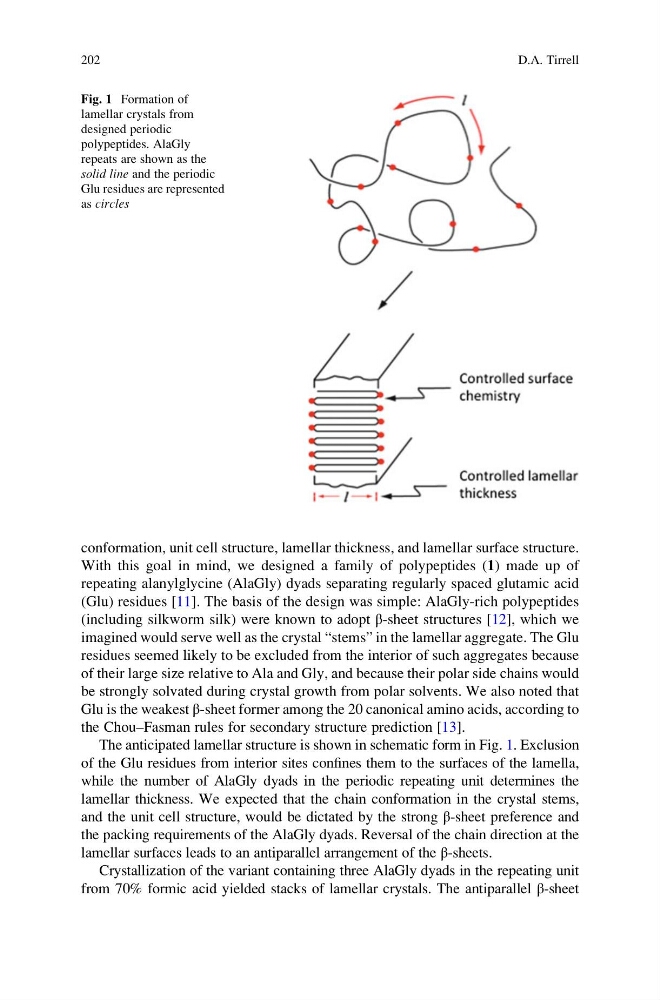
The anticipated lamellar structure is shown in schematic form in Fig. 1. Exclusion
of the Glu residues from interior sites confines them to the surfaces of the lamella,
while the number of AlaGly dyads in the periodic repeating unit determines the
lamellar thickness. We expected that the chain conformation in the crystal stems,
and the unit cell structure, would be dictated by the strong β-sheet preference and
the packing requirements of the AlaGly dyads. Reversal of the chain direction at the
lamellar surfaces leads to an antiparallel arrangement of the β-sheets.
Crystallization of the variant containing three AlaGly dyads in the repeating unit
from 70% formic acid yielded stacks of lamellar crystals. The antiparallel β-sheet
Fig. 1 Formation of
lamellar crystals from
designed periodic
polypeptides. AlaGly
repeats are shown as the
solid line and the periodic
Glu residues are represented
as circles
202
D.A. Tirrell
With this goal in mind, we designed a family of polypeptides (1) made up of
repeating alanylglycine (AlaGly) dyads separating regularly spaced glutamic acid
(Glu) residues [11]. The basis of the design was simple: AlaGly-rich polypeptides
(including silkworm silk) were known to adopt β-sheet structures [12], which we
imagined would serve well as the crystal “stems” in the lamellar aggregate. The Glu
residues seemed likely to be excluded from the interior of such aggregates because
of their large size relative to Ala and Gly, and because their polar side chains would
be strongly solvated during crystal growth from polar solvents. We also noted that
Glu is the weakest β-sheet former among the 20 canonical amino acids, according to
the Chou–Fasman rules for secondary structure prediction [13].
The anticipated lamellar structure is shown in schematic form in Fig. 1. Exclusion
of the Glu residues from interior sites confines them to the surfaces of the lamella,
while the number of AlaGly dyads in the periodic repeating unit determines the
lamellar thickness. We expected that the chain conformation in the crystal stems,
and the unit cell structure, would be dictated by the strong β-sheet preference and
the packing requirements of the AlaGly dyads. Reversal of the chain direction at the
lamellar surfaces leads to an antiparallel arrangement of the β-sheets.
Crystallization of the variant containing three AlaGly dyads in the repeating unit
from 70% formic acid yielded stacks of lamellar crystals. The antiparallel β-sheet
Fig. 1 Formation of
lamellar crystals from
designed periodic
polypeptides. AlaGly
repeats are shown as the
solid line and the periodic
Glu residues are represented
as circles
202
D.A. Tirrell