

imines for the reversible crosslinking of polymers, see [61]). Of particular interest
because they present a wide field of implementation that covers organic chemistry,
biochemistry, and materials science are the different types of amine-carbonyl
condensations that produce carbon–nitrogen double bonds C¼N. The
acylhydrazone group presents special features because it combines, in a small
molecular subunit, the hydrogen bonding features of the amide function (present
in polyamides and in peptides) with the reversibility conferred by the imine group
(see also scheme 3 in [30]). It has been exploited in a range of covalent dynamers
formed through polyacylhydrazone connections.
Like dynamic polymers in general, those of covalent type present specific
properties that non-reversible polymers do not possess. They have been illustrated
for instance in degradable “green” polymers based on imine connections [72], in
polymer blending [73], in the modification of mechanical [74] and optical [75]
properties. Metallosupramolecular polymers are also able to undergo dynamic
modification of their mechanical and optical properties, as shown in Fig. 5 [53–55].
Three Levels Hierarchical Self-Assembly
Helical Fibrils/Fibres
by lateral association
of triple helical strands
(electron microscopy)
Complementary
Molecular
Components
HN
N
H
O
O
O
* *
O
O
OR
OR
O
NH
H
N
O
O
N
HN
HN O
O
O
*
O
*
RO
OR
N
NH
NH
O
O
O
O
O
O
+
Z=CH 3
R=C 12 H 25
Triple Helical
Strand
(from X-Ray scattering data)
C 12 H 25
from three (LP 2 -LU 2 ) n
supramolecular polymer chains
forming a « hairy » cylinder
O
NH
H
N O
O
N
HN
HN O
Z
O
Z
O
O
*
O
*
OR
OR
N
NH
NH
O
Z
O
Z
O
O
O
HN
N
H
O
O
*
O
O
O
N
NH
O
Z
O
O
*
O
*
OR
OR
N
NH
NH
O
Z
O
Z
O
O
O
HN
N
H
O
O
O
* *
O
OR
OR
O
O
Supramolecular
Polymer Chain
D
A
D
A D
A
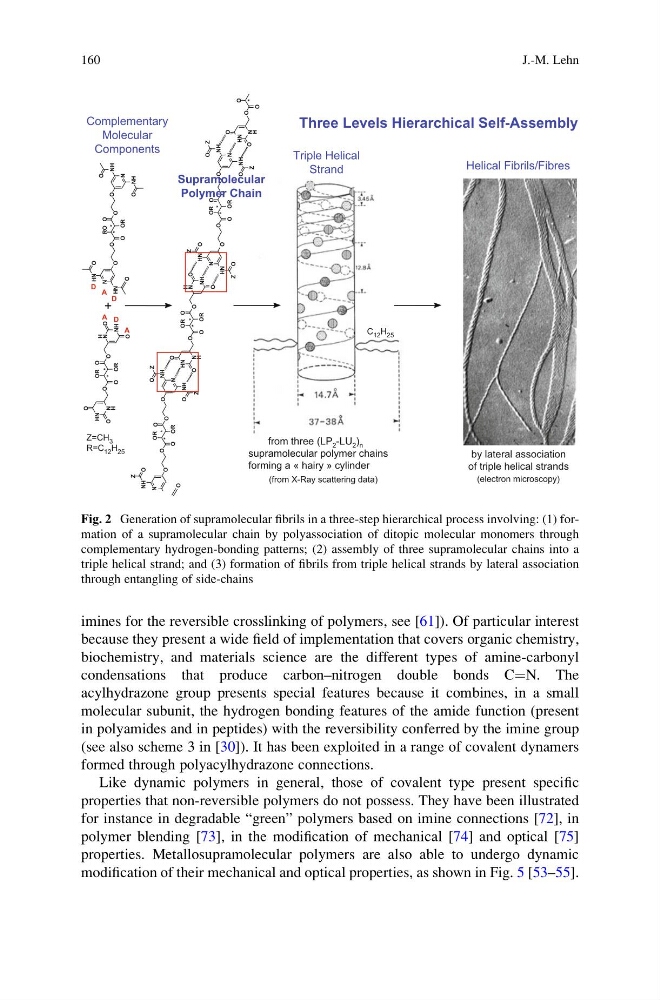
Fig. 2 Generation of supramolecular fibrils in a three-step hierarchical process involving: (1) formation of a supramolecular chain by polyassociation of ditopic molecular monomers through
complementary hydrogen-bonding patterns; (2) assembly of three supramolecular chains into a
triple helical strand; and (3) formation of fibrils from triple helical strands by lateral association
through entangling of side-chains
160
J.-M. Lehn
because they present a wide field of implementation that covers organic chemistry,
biochemistry, and materials science are the different types of amine-carbonyl
condensations that produce carbon–nitrogen double bonds C¼N. The
acylhydrazone group presents special features because it combines, in a small
molecular subunit, the hydrogen bonding features of the amide function (present
in polyamides and in peptides) with the reversibility conferred by the imine group
(see also scheme 3 in [30]). It has been exploited in a range of covalent dynamers
formed through polyacylhydrazone connections.
Like dynamic polymers in general, those of covalent type present specific
properties that non-reversible polymers do not possess. They have been illustrated
for instance in degradable “green” polymers based on imine connections [72], in
polymer blending [73], in the modification of mechanical [74] and optical [75]
properties. Metallosupramolecular polymers are also able to undergo dynamic
modification of their mechanical and optical properties, as shown in Fig. 5 [53–55].
Three Levels Hierarchical Self-Assembly
Helical Fibrils/Fibres
by lateral association
of triple helical strands
(electron microscopy)
Complementary
Molecular
Components
HN
N
H
O
O
O
* *
O
O
OR
OR
O
NH
H
N
O
O
N
HN
HN O
O
O
*
O
*
RO
OR
N
NH
NH
O
O
O
O
O
O
+
Z=CH 3
R=C 12 H 25
Triple Helical
Strand
(from X-Ray scattering data)
C 12 H 25
from three (LP 2 -LU 2 ) n
supramolecular polymer chains
forming a « hairy » cylinder
O
NH
H
N O
O
N
HN
HN O
Z
O
Z
O
O
*
O
*
OR
OR
N
NH
NH
O
Z
O
Z
O
O
O
HN
N
H
O
O
*
O
O
O
N
NH
O
Z
O
O
*
O
*
OR
OR
N
NH
NH
O
Z
O
Z
O
O
O
HN
N
H
O
O
O
* *
O
OR
OR
O
O
Supramolecular
Polymer Chain
D
A
D
A D
A
Fig. 2 Generation of supramolecular fibrils in a three-step hierarchical process involving: (1) formation of a supramolecular chain by polyassociation of ditopic molecular monomers through
complementary hydrogen-bonding patterns; (2) assembly of three supramolecular chains into a
triple helical strand; and (3) formation of fibrils from triple helical strands by lateral association
through entangling of side-chains
160
J.-M. Lehn