

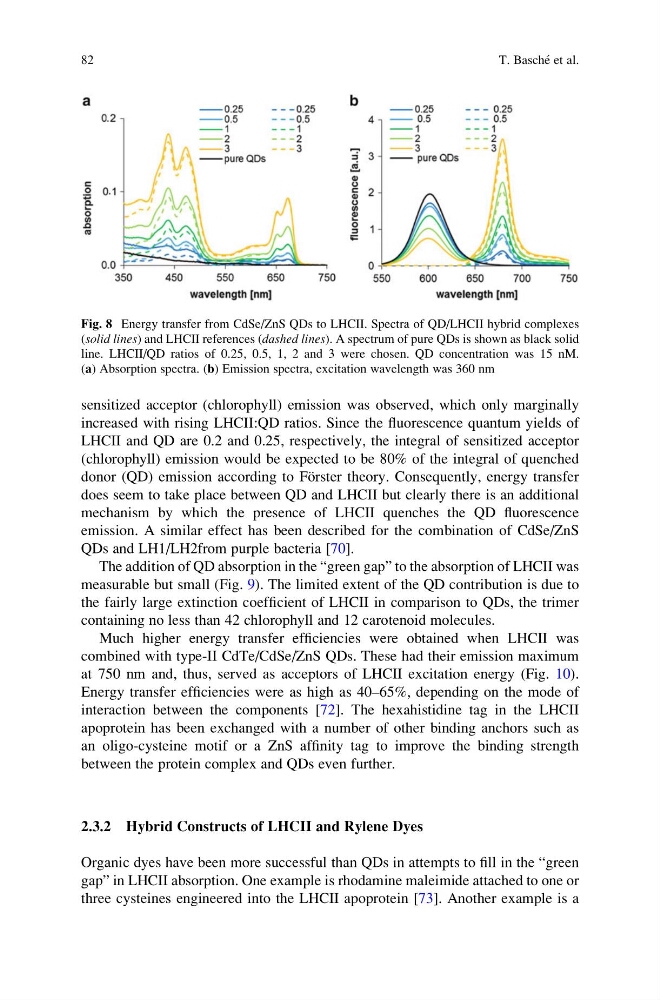
sensitized acceptor (chlorophyll) emission was observed, which only marginally
increased with rising LHCII:QD ratios. Since the fluorescence quantum yields of
LHCII and QD are 0.2 and 0.25, respectively, the integral of sensitized acceptor
(chlorophyll) emission would be expected to be 80% of the integral of quenched
donor (QD) emission according to Fo ¨rster theory. Consequently, energy transfer
does seem to take place between QD and LHCII but clearly there is an additional
mechanism by which the presence of LHCII quenches the QD fluorescence
emission. A similar effect has been described for the combination of CdSe/ZnS
QDs and LH1/LH2from purple bacteria [70].
The addition of QD absorption in the “green gap” to the absorption of LHCII was
measurable but small (Fig. 9). The limited extent of the QD contribution is due to
the fairly large extinction coefficient of LHCII in comparison to QDs, the trimer
containing no less than 42 chlorophyll and 12 carotenoid molecules.
Much higher energy transfer efficiencies were obtained when LHCII was
combined with type-II CdTe/CdSe/ZnS QDs. These had their emission maximum
at 750 nm and, thus, served as acceptors of LHCII excitation energy (Fig. 10).
Energy transfer efficiencies were as high as 40–65%, depending on the mode of
interaction between the components [72]. The hexahistidine tag in the LHCII
apoprotein has been exchanged with a number of other binding anchors such as
an oligo-cysteine motif or a ZnS affinity tag to improve the binding strength
between the protein complex and QDs even further.
2.3.2 Hybrid Constructs of LHCII and Rylene Dyes
Organic dyes have been more successful than QDs in attempts to fill in the “green
gap” in LHCII absorption. One example is rhodamine maleimide attached to one or
three cysteines engineered into the LHCII apoprotein [73]. Another example is a
Fig. 8 Energy transfer from CdSe/ZnS QDs to LHCII. Spectra of QD/LHCII hybrid complexes
(solid lines) and LHCII references (dashed lines). A spectrum of pure QDs is shown as black solid
line. LHCII/QD ratios of 0.25, 0.5, 1, 2 and 3 were chosen. QD concentration was 15 nM.
(a) Absorption spectra. (b) Emission spectra, excitation wavelength was 360 nm
82
T. Basche ´ et al.
increased with rising LHCII:QD ratios. Since the fluorescence quantum yields of
LHCII and QD are 0.2 and 0.25, respectively, the integral of sensitized acceptor
(chlorophyll) emission would be expected to be 80% of the integral of quenched
donor (QD) emission according to Fo ¨rster theory. Consequently, energy transfer
does seem to take place between QD and LHCII but clearly there is an additional
mechanism by which the presence of LHCII quenches the QD fluorescence
emission. A similar effect has been described for the combination of CdSe/ZnS
QDs and LH1/LH2from purple bacteria [70].
The addition of QD absorption in the “green gap” to the absorption of LHCII was
measurable but small (Fig. 9). The limited extent of the QD contribution is due to
the fairly large extinction coefficient of LHCII in comparison to QDs, the trimer
containing no less than 42 chlorophyll and 12 carotenoid molecules.
Much higher energy transfer efficiencies were obtained when LHCII was
combined with type-II CdTe/CdSe/ZnS QDs. These had their emission maximum
at 750 nm and, thus, served as acceptors of LHCII excitation energy (Fig. 10).
Energy transfer efficiencies were as high as 40–65%, depending on the mode of
interaction between the components [72]. The hexahistidine tag in the LHCII
apoprotein has been exchanged with a number of other binding anchors such as
an oligo-cysteine motif or a ZnS affinity tag to improve the binding strength
between the protein complex and QDs even further.
2.3.2 Hybrid Constructs of LHCII and Rylene Dyes
Organic dyes have been more successful than QDs in attempts to fill in the “green
gap” in LHCII absorption. One example is rhodamine maleimide attached to one or
three cysteines engineered into the LHCII apoprotein [73]. Another example is a
Fig. 8 Energy transfer from CdSe/ZnS QDs to LHCII. Spectra of QD/LHCII hybrid complexes
(solid lines) and LHCII references (dashed lines). A spectrum of pure QDs is shown as black solid
line. LHCII/QD ratios of 0.25, 0.5, 1, 2 and 3 were chosen. QD concentration was 15 nM.
(a) Absorption spectra. (b) Emission spectra, excitation wavelength was 360 nm
82
T. Basche ´ et al.