

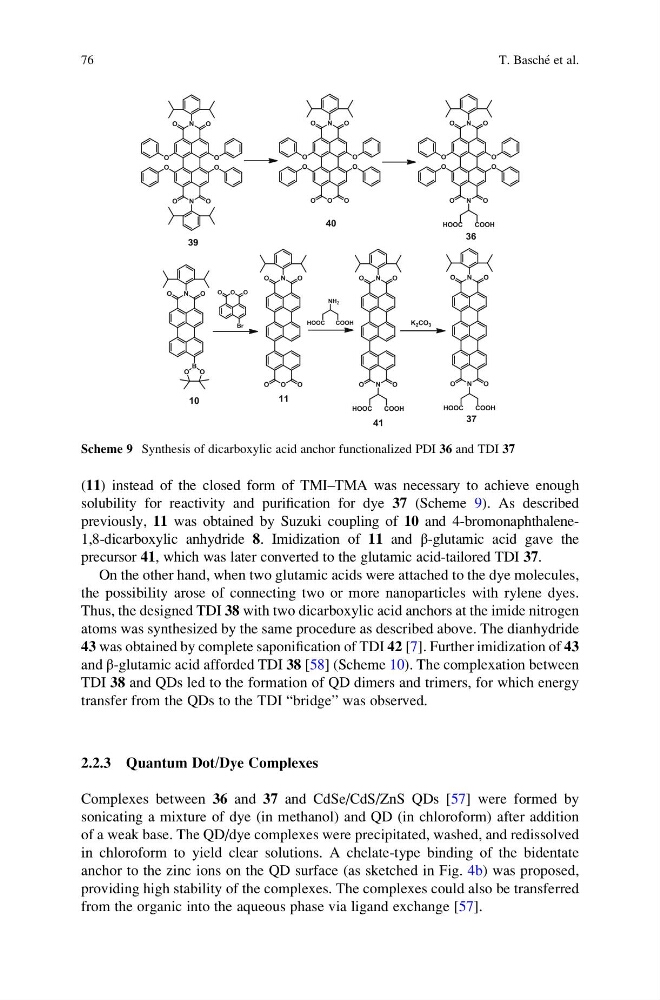
(11) instead of the closed form of TMI–TMA was necessary to achieve enough
solubility for reactivity and purification for dye 37 (Scheme 9). As described
previously, 11 was obtained by Suzuki coupling of 10 and 4-bromonaphthalene1,8-dicarboxylic anhydride 8. Imidization of 11 and β-glutamic acid gave the
precursor 41, which was later converted to the glutamic acid-tailored TDI 37.
On the other hand, when two glutamic acids were attached to the dye molecules,
the possibility arose of connecting two or more nanoparticles with rylene dyes.
Thus, the designed TDI 38 with two dicarboxylic acid anchors at the imide nitrogen
atoms was synthesized by the same procedure as described above. The dianhydride
43 was obtained by complete saponification of TDI 42 [7]. Further imidization of 43
and β-glutamic acid afforded TDI 38 [58] (Scheme 10). The complexation between
TDI 38 and QDs led to the formation of QD dimers and trimers, for which energy
transfer from the QDs to the TDI “bridge” was observed.
2.2.3 Quantum Dot/Dye Complexes
Complexes between 36 and 37 and CdSe/CdS/ZnS QDs [57] were formed by
sonicating a mixture of dye (in methanol) and QD (in chloroform) after addition
of a weak base. The QD/dye complexes were precipitated, washed, and redissolved
in chloroform to yield clear solutions. A chelate-type binding of the bidentate
anchor to the zinc ions on the QD surface (as sketched in Fig. 4b) was proposed,
providing high stability of the complexes. The complexes could also be transferred
from the organic into the aqueous phase via ligand exchange [57].
Scheme 9 Synthesis of dicarboxylic acid anchor functionalized PDI 36 and TDI 37
76
T. Basche ´ et al.
solubility for reactivity and purification for dye 37 (Scheme 9). As described
previously, 11 was obtained by Suzuki coupling of 10 and 4-bromonaphthalene1,8-dicarboxylic anhydride 8. Imidization of 11 and β-glutamic acid gave the
precursor 41, which was later converted to the glutamic acid-tailored TDI 37.
On the other hand, when two glutamic acids were attached to the dye molecules,
the possibility arose of connecting two or more nanoparticles with rylene dyes.
Thus, the designed TDI 38 with two dicarboxylic acid anchors at the imide nitrogen
atoms was synthesized by the same procedure as described above. The dianhydride
43 was obtained by complete saponification of TDI 42 [7]. Further imidization of 43
and β-glutamic acid afforded TDI 38 [58] (Scheme 10). The complexation between
TDI 38 and QDs led to the formation of QD dimers and trimers, for which energy
transfer from the QDs to the TDI “bridge” was observed.
2.2.3 Quantum Dot/Dye Complexes
Complexes between 36 and 37 and CdSe/CdS/ZnS QDs [57] were formed by
sonicating a mixture of dye (in methanol) and QD (in chloroform) after addition
of a weak base. The QD/dye complexes were precipitated, washed, and redissolved
in chloroform to yield clear solutions. A chelate-type binding of the bidentate
anchor to the zinc ions on the QD surface (as sketched in Fig. 4b) was proposed,
providing high stability of the complexes. The complexes could also be transferred
from the organic into the aqueous phase via ligand exchange [57].
Scheme 9 Synthesis of dicarboxylic acid anchor functionalized PDI 36 and TDI 37
76
T. Basche ´ et al.