

synthesis of liner dyad 1, the kinked dyad 2 was obtained via Suzuki coupling of 15
and 18, followed by a mild cyclization with the weak base K 2 CO 3 in ethanolamine.
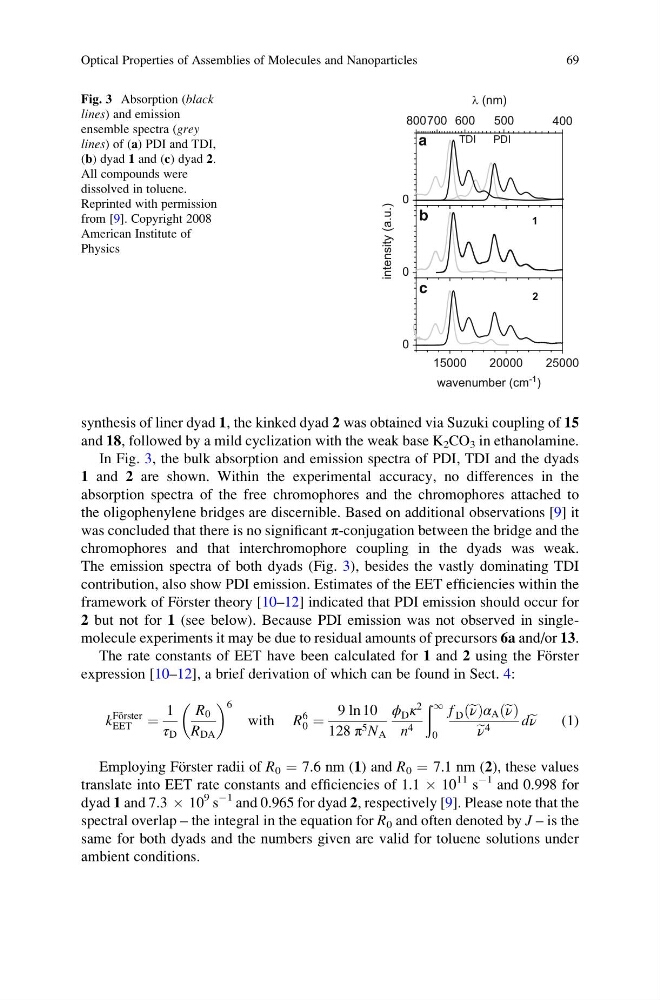
In Fig. 3, the bulk absorption and emission spectra of PDI, TDI and the dyads
1 and 2 are shown. Within the experimental accuracy, no differences in the
absorption spectra of the free chromophores and the chromophores attached to
the oligophenylene bridges are discernible. Based on additional observations [9] it
was concluded that there is no significant π-conjugation between the bridge and the
chromophores and that interchromophore coupling in the dyads was weak.
The emission spectra of both dyads (Fig. 3), besides the vastly dominating TDI
contribution, also show PDI emission. Estimates of the EET efficiencies within the
framework of Fo ¨rster theory [10–12] indicated that PDI emission should occur for
2 but not for 1 (see below). Because PDI emission was not observed in singlemolecule experiments it may be due to residual amounts of precursors 6a and/or 13.
The rate constants of EET have been calculated for 1 and 2 using the Fo ¨rster
expression [10–12], a brief derivation of which can be found in Sect. 4:
k
Förster
EET ¼
1
τ D
R 0
R DA
6
with R
6
0 ¼
9 ln10
128 π 5 N A
ϕ D κ
2
n 4
ð 1
0
f D e ν
ð Þα A e ν
ð Þ
e ν 4
de ν
(1)
Employing Fo ¨rster radii of R 0 ¼ 7.6 nm (1) and R 0 ¼ 7.1 nm (2), these values
translate into EET rate constants and efficiencies of 1.1 Â 10
11 s
À1 and 0.998 for
dyad 1 and 7.3 Â 10
9 s
À1 and 0.965 for dyad 2, respectively [9]. Please note that the
spectral overlap – the integral in the equation for R 0 and often denoted by J – is the
same for both dyads and the numbers given are valid for toluene solutions under
ambient conditions.
0
15000
20000
25000
0
0
TDI
a
PDI
c
wavenumber (cm
-1 )
2
b
1
intensity (a.u.)
800700 600
500
400
l (nm)
Fig. 3 Absorption (black
lines) and emission
ensemble spectra (grey
lines) of (a) PDI and TDI,
(b) dyad 1 and (c) dyad 2.
All compounds were
dissolved in toluene.
Reprinted with permission
from [9]. Copyright 2008
American Institute of
Physics
Optical Properties of Assemblies of Molecules and Nanoparticles
69
and 18, followed by a mild cyclization with the weak base K 2 CO 3 in ethanolamine.
In Fig. 3, the bulk absorption and emission spectra of PDI, TDI and the dyads
1 and 2 are shown. Within the experimental accuracy, no differences in the
absorption spectra of the free chromophores and the chromophores attached to
the oligophenylene bridges are discernible. Based on additional observations [9] it
was concluded that there is no significant π-conjugation between the bridge and the
chromophores and that interchromophore coupling in the dyads was weak.
The emission spectra of both dyads (Fig. 3), besides the vastly dominating TDI
contribution, also show PDI emission. Estimates of the EET efficiencies within the
framework of Fo ¨rster theory [10–12] indicated that PDI emission should occur for
2 but not for 1 (see below). Because PDI emission was not observed in singlemolecule experiments it may be due to residual amounts of precursors 6a and/or 13.
The rate constants of EET have been calculated for 1 and 2 using the Fo ¨rster
expression [10–12], a brief derivation of which can be found in Sect. 4:
k
Förster
EET ¼
1
τ D
R 0
R DA
6
with R
6
0 ¼
9 ln10
128 π 5 N A
ϕ D κ
2
n 4
ð 1
0
f D e ν
ð Þα A e ν
ð Þ
e ν 4
de ν
(1)
Employing Fo ¨rster radii of R 0 ¼ 7.6 nm (1) and R 0 ¼ 7.1 nm (2), these values
translate into EET rate constants and efficiencies of 1.1 Â 10
11 s
À1 and 0.998 for
dyad 1 and 7.3 Â 10
9 s
À1 and 0.965 for dyad 2, respectively [9]. Please note that the
spectral overlap – the integral in the equation for R 0 and often denoted by J – is the
same for both dyads and the numbers given are valid for toluene solutions under
ambient conditions.
0
15000
20000
25000
0
0
TDI
a
PDI
c
wavenumber (cm
-1 )
2
b
1
intensity (a.u.)
800700 600
500
400
l (nm)
Fig. 3 Absorption (black
lines) and emission
ensemble spectra (grey
lines) of (a) PDI and TDI,
(b) dyad 1 and (c) dyad 2.
All compounds were
dissolved in toluene.
Reprinted with permission
from [9]. Copyright 2008
American Institute of
Physics
Optical Properties of Assemblies of Molecules and Nanoparticles
69