

main byproducts in the synthetic step h (Scheme 2) are compounds PMI–PMA
and 11, which both have quite polar anhydride groups and thus readily stick on the
silica gel column during purification. Target compound 1 was purified by column
chromatography on silica gel using a mixture of toluene, dichloromethane and
methanol as eluent to yield dyad 1 in 20% isolated yield for the cyclization reaction.
The relatively low yield is due to the formation of hydrolyzed byproducts
PMI–PMA and 11.
Synthesis of the Kinked Dyad 2
Based on a facile synthetic route to linear dyad 1, the synthesis of the kinked dyad
2 with a longer spacer becomes possible [8, 9]. Adopting the same strategy but
using a longer linker 14 for connection with the open form of TDI unit 13 and a
kinked linker (i.e., meta-substituted biphenyl; Scheme 3) to combine with the PDI
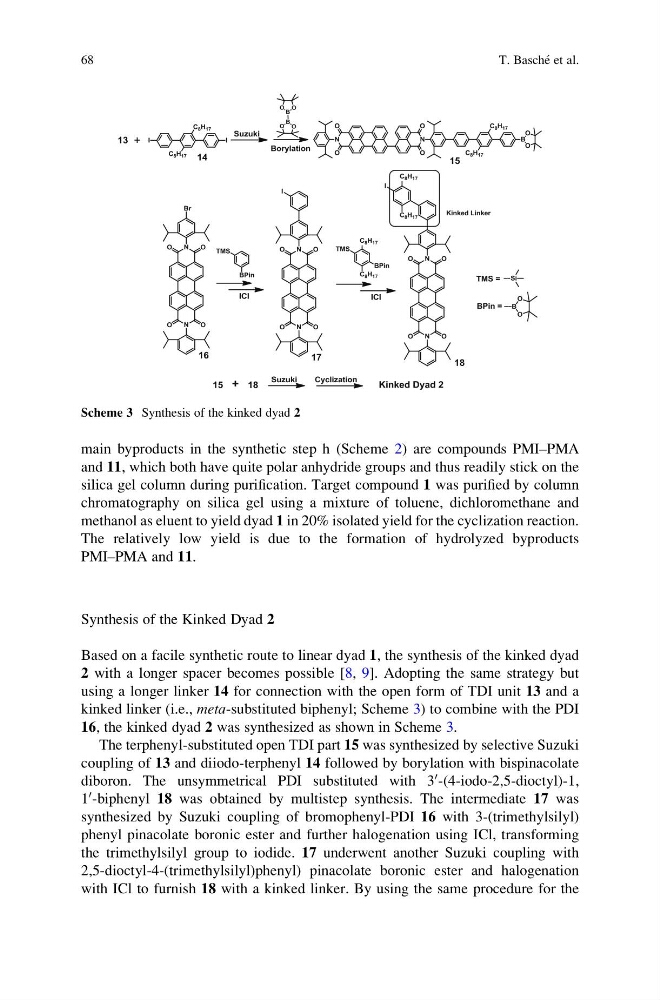
16, the kinked dyad 2 was synthesized as shown in Scheme 3.
The terphenyl-substituted open TDI part 15 was synthesized by selective Suzuki
coupling of 13 and diiodo-terphenyl 14 followed by borylation with bispinacolate
diboron. The unsymmetrical PDI substituted with 3
0 -(4-iodo-2,5-dioctyl)-1,
1
0 -biphenyl 18 was obtained by multistep synthesis. The intermediate 17 was
synthesized by Suzuki coupling of bromophenyl-PDI 16 with 3-(trimethylsilyl)
phenyl pinacolate boronic ester and further halogenation using ICl, transforming
the trimethylsilyl group to iodide. 17 underwent another Suzuki coupling with
2,5-dioctyl-4-(trimethylsilyl)phenyl) pinacolate boronic ester and halogenation
with ICl to furnish 18 with a kinked linker. By using the same procedure for the
Scheme 3 Synthesis of the kinked dyad 2
68
T. Basche ´ et al.
and 11, which both have quite polar anhydride groups and thus readily stick on the
silica gel column during purification. Target compound 1 was purified by column
chromatography on silica gel using a mixture of toluene, dichloromethane and
methanol as eluent to yield dyad 1 in 20% isolated yield for the cyclization reaction.
The relatively low yield is due to the formation of hydrolyzed byproducts
PMI–PMA and 11.
Synthesis of the Kinked Dyad 2
Based on a facile synthetic route to linear dyad 1, the synthesis of the kinked dyad
2 with a longer spacer becomes possible [8, 9]. Adopting the same strategy but
using a longer linker 14 for connection with the open form of TDI unit 13 and a
kinked linker (i.e., meta-substituted biphenyl; Scheme 3) to combine with the PDI
16, the kinked dyad 2 was synthesized as shown in Scheme 3.
The terphenyl-substituted open TDI part 15 was synthesized by selective Suzuki
coupling of 13 and diiodo-terphenyl 14 followed by borylation with bispinacolate
diboron. The unsymmetrical PDI substituted with 3
0 -(4-iodo-2,5-dioctyl)-1,
1
0 -biphenyl 18 was obtained by multistep synthesis. The intermediate 17 was
synthesized by Suzuki coupling of bromophenyl-PDI 16 with 3-(trimethylsilyl)
phenyl pinacolate boronic ester and further halogenation using ICl, transforming
the trimethylsilyl group to iodide. 17 underwent another Suzuki coupling with
2,5-dioctyl-4-(trimethylsilyl)phenyl) pinacolate boronic ester and halogenation
with ICl to furnish 18 with a kinked linker. By using the same procedure for the
Scheme 3 Synthesis of the kinked dyad 2
68
T. Basche ´ et al.