

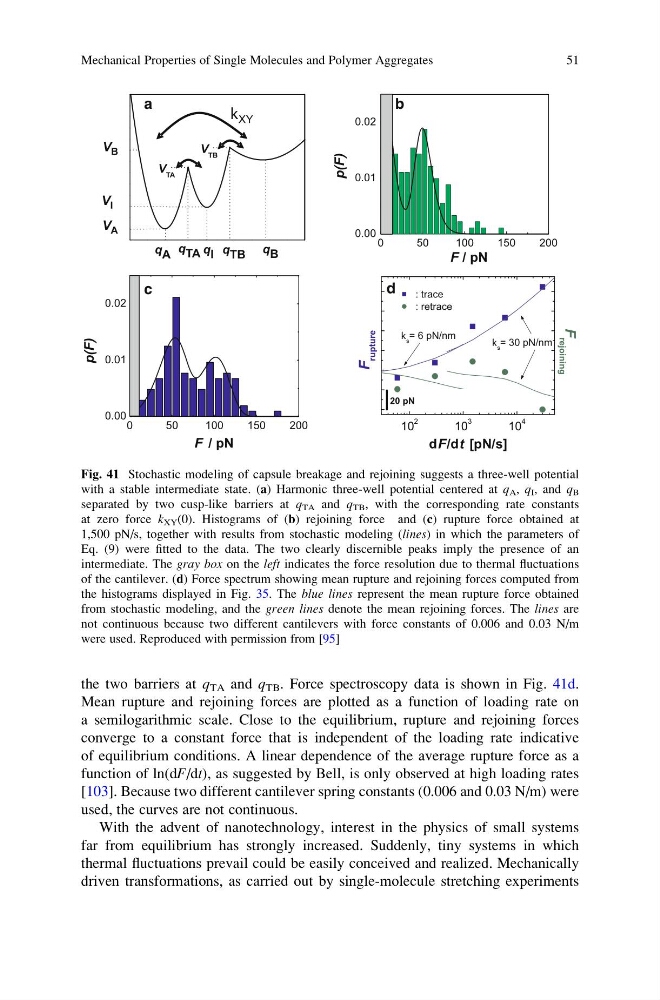
the two barriers at q TA and q TB . Force spectroscopy data is shown in Fig. 41d.
Mean rupture and rejoining forces are plotted as a function of loading rate on
a semilogarithmic scale. Close to the equilibrium, rupture and rejoining forces
converge to a constant force that is independent of the loading rate indicative
of equilibrium conditions. A linear dependence of the average rupture force as a
function of ln(dF/dt), as suggested by Bell, is only observed at high loading rates
[103]. Because two different cantilever spring constants (0.006 and 0.03 N/m) were
used, the curves are not continuous.
With the advent of nanotechnology, interest in the physics of small systems
far from equilibrium has strongly increased. Suddenly, tiny systems in which
thermal fluctuations prevail could be easily conceived and realized. Mechanically
driven transformations, as carried out by single-molecule stretching experiments
10
2
10
3
10
4
F
rejoining
k s = 30 pN/nm
k s = 6 pN/nm
: trace
: retrace
dF/dt [pN/s]
F e
r u
t
p
u
r
20 pN
0
50
100
150
200
0.00
0.01
0.02
p(F)
F / pN
0
50
100
150
200
0.00
0.01
0.02
p(F)
F / pN
q B
q TB
q I
q TA
V TA
V TB
V B
V I
V A
q A
a
b
d
c
k XY
Fig. 41 Stochastic modeling of capsule breakage and rejoining suggests a three-well potential
with a stable intermediate state. (a) Harmonic three-well potential centered at q A , q I , and q B
separated by two cusp-like barriers at q TA and q TB , with the corresponding rate constants
at zero force k XY (0). Histograms of (b) rejoining force and (c) rupture force obtained at
1,500 pN/s, together with results from stochastic modeling (lines) in which the parameters of
Eq. (9) were fitted to the data. The two clearly discernible peaks imply the presence of an
intermediate. The gray box on the left indicates the force resolution due to thermal fluctuations
of the cantilever. (d) Force spectrum showing mean rupture and rejoining forces computed from
the histograms displayed in Fig. 35. The blue lines represent the mean rupture force obtained
from stochastic modeling, and the green lines denote the mean rejoining forces. The lines are
not continuous because two different cantilevers with force constants of 0.006 and 0.03 N/m
were used. Reproduced with permission from [95]
Mechanical Properties of Single Molecules and Polymer Aggregates
51
Mean rupture and rejoining forces are plotted as a function of loading rate on
a semilogarithmic scale. Close to the equilibrium, rupture and rejoining forces
converge to a constant force that is independent of the loading rate indicative
of equilibrium conditions. A linear dependence of the average rupture force as a
function of ln(dF/dt), as suggested by Bell, is only observed at high loading rates
[103]. Because two different cantilever spring constants (0.006 and 0.03 N/m) were
used, the curves are not continuous.
With the advent of nanotechnology, interest in the physics of small systems
far from equilibrium has strongly increased. Suddenly, tiny systems in which
thermal fluctuations prevail could be easily conceived and realized. Mechanically
driven transformations, as carried out by single-molecule stretching experiments
10
2
10
3
10
4
F
rejoining
k s = 30 pN/nm
k s = 6 pN/nm
: trace
: retrace
dF/dt [pN/s]
F e
r u
t
p
u
r
20 pN
0
50
100
150
200
0.00
0.01
0.02
p(F)
F / pN
0
50
100
150
200
0.00
0.01
0.02
p(F)
F / pN
q B
q TB
q I
q TA
V TA
V TB
V B
V I
V A
q A
a
b
d
c
k XY
Fig. 41 Stochastic modeling of capsule breakage and rejoining suggests a three-well potential
with a stable intermediate state. (a) Harmonic three-well potential centered at q A , q I , and q B
separated by two cusp-like barriers at q TA and q TB , with the corresponding rate constants
at zero force k XY (0). Histograms of (b) rejoining force and (c) rupture force obtained at
1,500 pN/s, together with results from stochastic modeling (lines) in which the parameters of
Eq. (9) were fitted to the data. The two clearly discernible peaks imply the presence of an
intermediate. The gray box on the left indicates the force resolution due to thermal fluctuations
of the cantilever. (d) Force spectrum showing mean rupture and rejoining forces computed from
the histograms displayed in Fig. 35. The blue lines represent the mean rupture force obtained
from stochastic modeling, and the green lines denote the mean rejoining forces. The lines are
not continuous because two different cantilevers with force constants of 0.006 and 0.03 N/m
were used. Reproduced with permission from [95]
Mechanical Properties of Single Molecules and Polymer Aggregates
51