

Effect of the Linker and Contour Length on Capsule Breakage
The elastic response of a molecular system is directly coupled to the mechanical
properties of the transducer. Evans and Ritchie studied the effect of a soft molecular
linkage on the strength of a weak connecting bond [132]. Based on theoretical
considerations, Friedsam et al. illustrated the effect of a soft spacer on rupture force
histograms [146]. Due to the presence of polymer spacers with a certain length
distribution, the rupture force histograms were broadened significantly. Thormann
et al. investigated the impact of either a bovine serum albumin (BSA) linker or
poly(ethylene)glycol (PEG) spacer on the well-known biotin–streptavidin bond
[147]. In the case of the BSA linker, they observed a soft response of the BSA
that leads to a broadening in the distribution of the rupture forces. The PEG linker
causes a reduction in average unbinding forces in comparison to calculations
without a soft spacer. Due to the soft linker, the force ramp inclines towards
lower forces compared to a linear force ramp. Hence, the molecular system spends
more time at low forces, which increases rupture probability at low forces.
If the molecules are rather stiff κ linker > > κ c , with κ c denoting the stiffness
of the transducer and κ linker the stiffness of the linker, the rupture force is approximately independent of the molecule length and elastic properties, and the spring
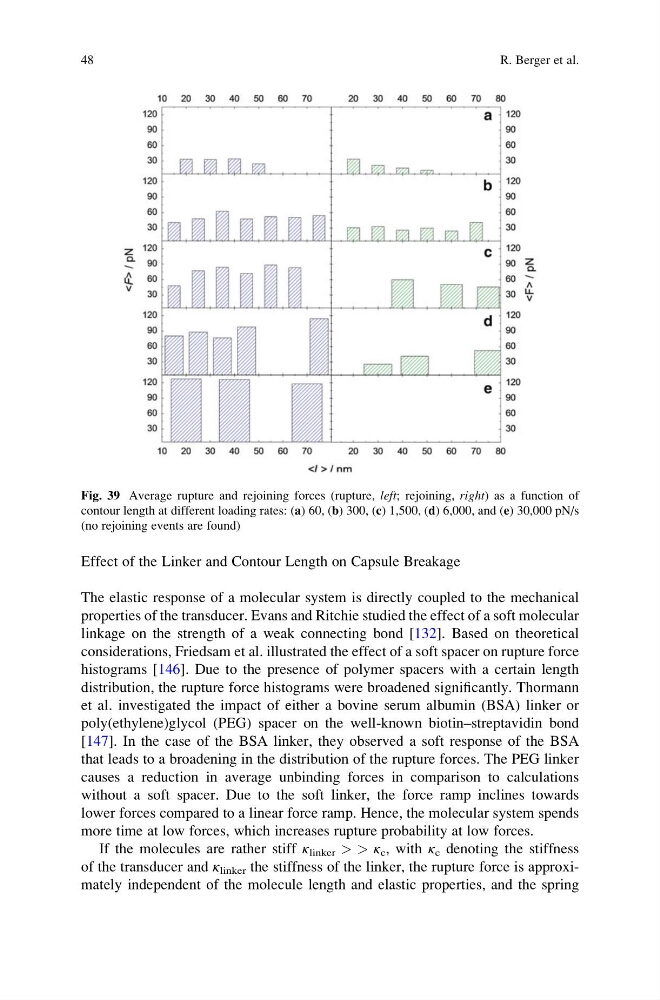
Fig. 39 Average rupture and rejoining forces (rupture, left; rejoining, right) as a function of
contour length at different loading rates: (a) 60, (b) 300, (c) 1,500, (d) 6,000, and (e) 30,000 pN/s
(no rejoining events are found)
48
R. Berger et al.
The elastic response of a molecular system is directly coupled to the mechanical
properties of the transducer. Evans and Ritchie studied the effect of a soft molecular
linkage on the strength of a weak connecting bond [132]. Based on theoretical
considerations, Friedsam et al. illustrated the effect of a soft spacer on rupture force
histograms [146]. Due to the presence of polymer spacers with a certain length
distribution, the rupture force histograms were broadened significantly. Thormann
et al. investigated the impact of either a bovine serum albumin (BSA) linker or
poly(ethylene)glycol (PEG) spacer on the well-known biotin–streptavidin bond
[147]. In the case of the BSA linker, they observed a soft response of the BSA
that leads to a broadening in the distribution of the rupture forces. The PEG linker
causes a reduction in average unbinding forces in comparison to calculations
without a soft spacer. Due to the soft linker, the force ramp inclines towards
lower forces compared to a linear force ramp. Hence, the molecular system spends
more time at low forces, which increases rupture probability at low forces.
If the molecules are rather stiff κ linker > > κ c , with κ c denoting the stiffness
of the transducer and κ linker the stiffness of the linker, the rupture force is approximately independent of the molecule length and elastic properties, and the spring
Fig. 39 Average rupture and rejoining forces (rupture, left; rejoining, right) as a function of
contour length at different loading rates: (a) 60, (b) 300, (c) 1,500, (d) 6,000, and (e) 30,000 pN/s
(no rejoining events are found)
48
R. Berger et al.