

vanishing pulling velocity. Also, the impact of a soft worm-like chain (WLC)
polymeric linker has been treated in an approximate manner using an effective
compliance of the composite system. It was found that not only the rupture force
distribution but also the rejoining force distribution is affected in a specific way,
depending on the parameters of the WLC model. Given the fact that the WLC
model might fail (cf. the discussion on this point in Sect. 1.2), this can be of
importance when analyzing DFS experiments. Additionally, it was found that in
equilibrium the impact of the linker on the equilibrium rupture forces vanishes. This
finding, however, depends on the specific model used to treat the system composed
of the double-well potential and the linker.
If the reversible dynamics of bond rupture is considered in the force clamp mode,
one can exploit an analogy to the treatment of single molecule fluorescence to treat the
statistical properties of the transition events [108, 109]. If one considers two states,
A (closed) and B (open) with rates k A ¼ k(A ! B) and k B ¼ k(B ! A),
the equilibrium constant is given by K ¼ k B /k A . Due to the strong exponential dependence of the kinetic rates on the external force, in the Bell model given
by k A F
ð Þ ¼ k A e
βFÁx A and k B F
ð Þ ¼ k B e
ÀβFÁx B one can vary K over a broad range. This
fact opens the possibility of very detailed analysis of two-state kinetics. In particular,
an analysis of the Mandel parameter [109] and the waiting time distributions [108]
should allow the investigation of deviations from simple Markovian kinetics. Different event counting schemes can be utilized, depending on the value of the equilibrium
constant, in order to study the possible effect of dynamic or static disorder on the
kinetics. As shown in Fig. 24, in the so-called cycle counting scheme only B!A
transitions are counted, and in the event-counting scheme every transition is considered. In particular, in situations where K differs strongly from unity, the cyclecounting scheme may be advantageous due to resolution problems. In favorable
cases, an analysis of the moments of the corresponding waiting times will allow
deciding whether the system can be described as a two-state system or whether a
more complex scheme is required for successful modeling of the kinetics.
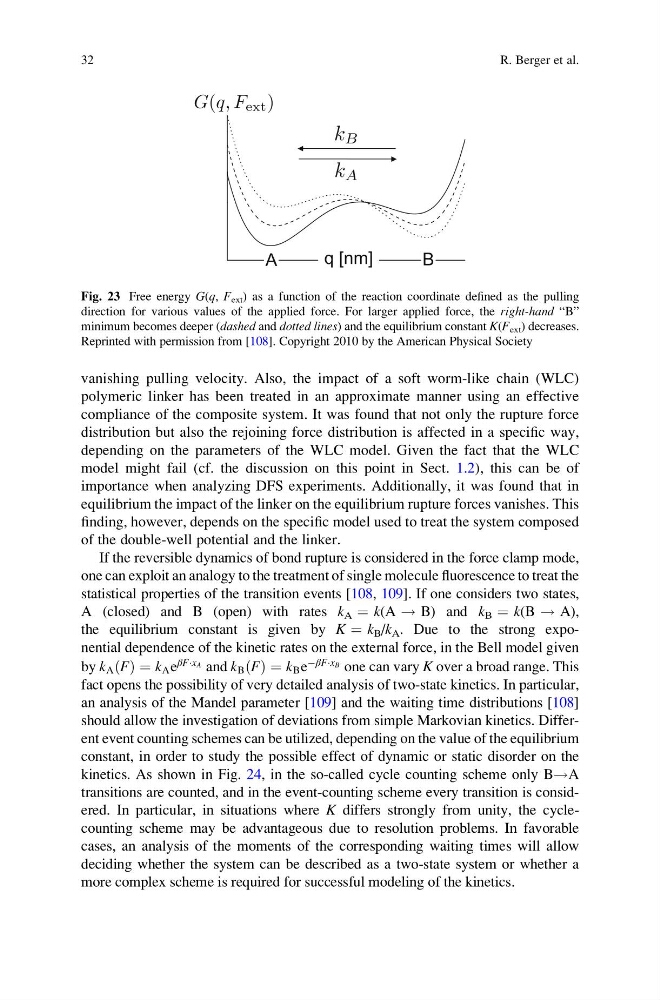
Fig. 23 Free energy G(q, F ext ) as a function of the reaction coordinate defined as the pulling
direction for various values of the applied force. For larger applied force, the right-hand “B”
minimum becomes deeper (dashed and dotted lines) and the equilibrium constant K(F ext ) decreases.
Reprinted with permission from [108]. Copyright 2010 by the American Physical Society
32
R. Berger et al.
polymeric linker has been treated in an approximate manner using an effective
compliance of the composite system. It was found that not only the rupture force
distribution but also the rejoining force distribution is affected in a specific way,
depending on the parameters of the WLC model. Given the fact that the WLC
model might fail (cf. the discussion on this point in Sect. 1.2), this can be of
importance when analyzing DFS experiments. Additionally, it was found that in
equilibrium the impact of the linker on the equilibrium rupture forces vanishes. This
finding, however, depends on the specific model used to treat the system composed
of the double-well potential and the linker.
If the reversible dynamics of bond rupture is considered in the force clamp mode,
one can exploit an analogy to the treatment of single molecule fluorescence to treat the
statistical properties of the transition events [108, 109]. If one considers two states,
A (closed) and B (open) with rates k A ¼ k(A ! B) and k B ¼ k(B ! A),
the equilibrium constant is given by K ¼ k B /k A . Due to the strong exponential dependence of the kinetic rates on the external force, in the Bell model given
by k A F
ð Þ ¼ k A e
βFÁx A and k B F
ð Þ ¼ k B e
ÀβFÁx B one can vary K over a broad range. This
fact opens the possibility of very detailed analysis of two-state kinetics. In particular,
an analysis of the Mandel parameter [109] and the waiting time distributions [108]
should allow the investigation of deviations from simple Markovian kinetics. Different event counting schemes can be utilized, depending on the value of the equilibrium
constant, in order to study the possible effect of dynamic or static disorder on the
kinetics. As shown in Fig. 24, in the so-called cycle counting scheme only B!A
transitions are counted, and in the event-counting scheme every transition is considered. In particular, in situations where K differs strongly from unity, the cyclecounting scheme may be advantageous due to resolution problems. In favorable
cases, an analysis of the moments of the corresponding waiting times will allow
deciding whether the system can be described as a two-state system or whether a
more complex scheme is required for successful modeling of the kinetics.
Fig. 23 Free energy G(q, F ext ) as a function of the reaction coordinate defined as the pulling
direction for various values of the applied force. For larger applied force, the right-hand “B”
minimum becomes deeper (dashed and dotted lines) and the equilibrium constant K(F ext ) decreases.
Reprinted with permission from [108]. Copyright 2010 by the American Physical Society
32
R. Berger et al.