

the trans side of a cell membrane scales like τ / N
2νþ2Àγ 1 with the chain length.
Thus, the anomalous dynamics of the translocation process has been related to a
universal exponent that contains the basic universal exponents of polymer physics,
the Flory exponent v, and the surface entropic exponent γ 1 . If a driving force is
present, our results suggested a scaling τ / f
À1 N
2νþ1Àγ 1 , in good agreement with
Monte Carlo (MC) and molecular dynamics (MD) simulation data.
While validating the sub- or superdiffusive behavior of hΔs
2
(t)i, several new
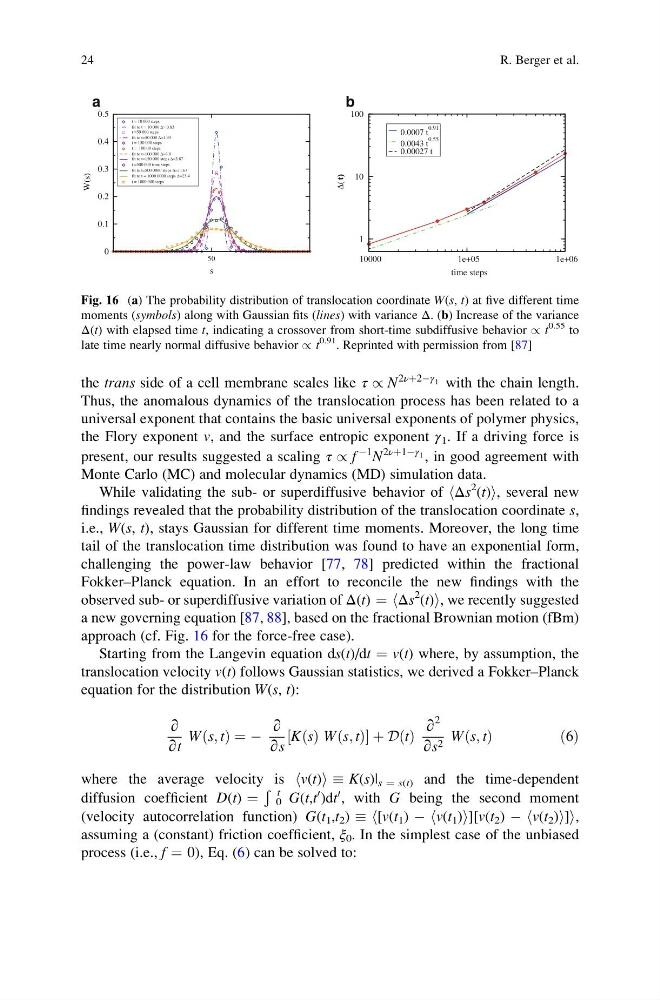
findings revealed that the probability distribution of the translocation coordinate s,
i.e., W(s, t), stays Gaussian for different time moments. Moreover, the long time
tail of the translocation time distribution was found to have an exponential form,
challenging the power-law behavior [77, 78] predicted within the fractional
Fokker–Planck equation. In an effort to reconcile the new findings with the
observed sub- or superdiffusive variation of Δ(t) ¼ hΔs
2 (t)i, we recently suggested
a new governing equation [87, 88], based on the fractional Brownian motion (fBm)
approach (cf. Fig. 16 for the force-free case).
Starting from the Langevin equation ds(t)/dt ¼ v(t) where, by assumption, the
translocation velocity v(t) follows Gaussian statistics, we derived a Fokker–Planck
equation for the distribution W(s, t):
∂
∂t
W s; t
ð Þ ¼ À
∂
∂s
K s
ð Þ W s; t
ð Þ
½
þDt ð Þ
∂
2
∂s 2 W s; t
ð Þ
ð6Þ
where the average velocity is hv(t)i K(s)| s ¼ s(t) and the time-dependent
diffusion coefficient D(t) ¼
Ð
0
t G(t,t
0 )dt
0 , with G being the second moment
(velocity autocorrelation function) G(t 1 ,t 2 ) h[v(t 1 ) À hv(t 1 )i][v(t 2 ) À hv(t 2 )i]i,
assuming a (constant) friction coefficient, ξ 0 . In the simplest case of the unbiased
process (i.e., f ¼ 0), Eq. (6) can be solved to:
50
s
0
0.1
0.2
0.3
0.4
0.5
W(s)
t = 10 000 steps
fit to t = 10 000 Δ= 0.83
t =50 000 steps
fit to t=50 000 Δ=1.93
t = 150 000 steps
t = 100 00 steps
fit to t=100 000 Δ=3.0
fit to t=150 000 steps Δ=3.87
t =500 000 time steps
fit to t=500 0000 steps Δ=11.63
fit to t = 1000 0000 steps Δ=23.4
t = 1000 000 steps
10000
1e+05
1e+06
time steps
1
10
100
Δ(
t)
0.0007 t
0.91
0.0043 t
0.55
0.00027 t
a
b
Fig. 16 (a) The probability distribution of translocation coordinate W(s, t) at five different time
moments (symbols) along with Gaussian fits (lines) with variance Δ. (b) Increase of the variance
Δ(t) with elapsed time t, indicating a crossover from short-time subdiffusive behavior / t
0.55 to
late time nearly normal diffusive behavior / t
0.91
. Reprinted with permission from [87]
24
R. Berger et al.
2νþ2Àγ 1 with the chain length.
Thus, the anomalous dynamics of the translocation process has been related to a
universal exponent that contains the basic universal exponents of polymer physics,
the Flory exponent v, and the surface entropic exponent γ 1 . If a driving force is
present, our results suggested a scaling τ / f
À1 N
2νþ1Àγ 1 , in good agreement with
Monte Carlo (MC) and molecular dynamics (MD) simulation data.
While validating the sub- or superdiffusive behavior of hΔs
2
(t)i, several new
findings revealed that the probability distribution of the translocation coordinate s,
i.e., W(s, t), stays Gaussian for different time moments. Moreover, the long time
tail of the translocation time distribution was found to have an exponential form,
challenging the power-law behavior [77, 78] predicted within the fractional
Fokker–Planck equation. In an effort to reconcile the new findings with the
observed sub- or superdiffusive variation of Δ(t) ¼ hΔs
2 (t)i, we recently suggested
a new governing equation [87, 88], based on the fractional Brownian motion (fBm)
approach (cf. Fig. 16 for the force-free case).
Starting from the Langevin equation ds(t)/dt ¼ v(t) where, by assumption, the
translocation velocity v(t) follows Gaussian statistics, we derived a Fokker–Planck
equation for the distribution W(s, t):
∂
∂t
W s; t
ð Þ ¼ À
∂
∂s
K s
ð Þ W s; t
ð Þ
½
þDt ð Þ
∂
2
∂s 2 W s; t
ð Þ
ð6Þ
where the average velocity is hv(t)i K(s)| s ¼ s(t) and the time-dependent
diffusion coefficient D(t) ¼
Ð
0
t G(t,t
0 )dt
0 , with G being the second moment
(velocity autocorrelation function) G(t 1 ,t 2 ) h[v(t 1 ) À hv(t 1 )i][v(t 2 ) À hv(t 2 )i]i,
assuming a (constant) friction coefficient, ξ 0 . In the simplest case of the unbiased
process (i.e., f ¼ 0), Eq. (6) can be solved to:
50
s
0
0.1
0.2
0.3
0.4
0.5
W(s)
t = 10 000 steps
fit to t = 10 000 Δ= 0.83
t =50 000 steps
fit to t=50 000 Δ=1.93
t = 150 000 steps
t = 100 00 steps
fit to t=100 000 Δ=3.0
fit to t=150 000 steps Δ=3.87
t =500 000 time steps
fit to t=500 0000 steps Δ=11.63
fit to t = 1000 0000 steps Δ=23.4
t = 1000 000 steps
10000
1e+05
1e+06
time steps
1
10
100
Δ(
t)
0.0007 t
0.91
0.0043 t
0.55
0.00027 t
a
b
Fig. 16 (a) The probability distribution of translocation coordinate W(s, t) at five different time
moments (symbols) along with Gaussian fits (lines) with variance Δ. (b) Increase of the variance
Δ(t) with elapsed time t, indicating a crossover from short-time subdiffusive behavior / t
0.55 to
late time nearly normal diffusive behavior / t
0.91
. Reprinted with permission from [87]
24
R. Berger et al.