

¼
1
2
κ
ð
0;L
½
2
d
2 r
h ii
ð Þ
2 À
1
2
h ii
ð Þ
2 h j h j À 2h ii h j h jk h k þ O h
6
À Á
&
'
,
ð3Þ
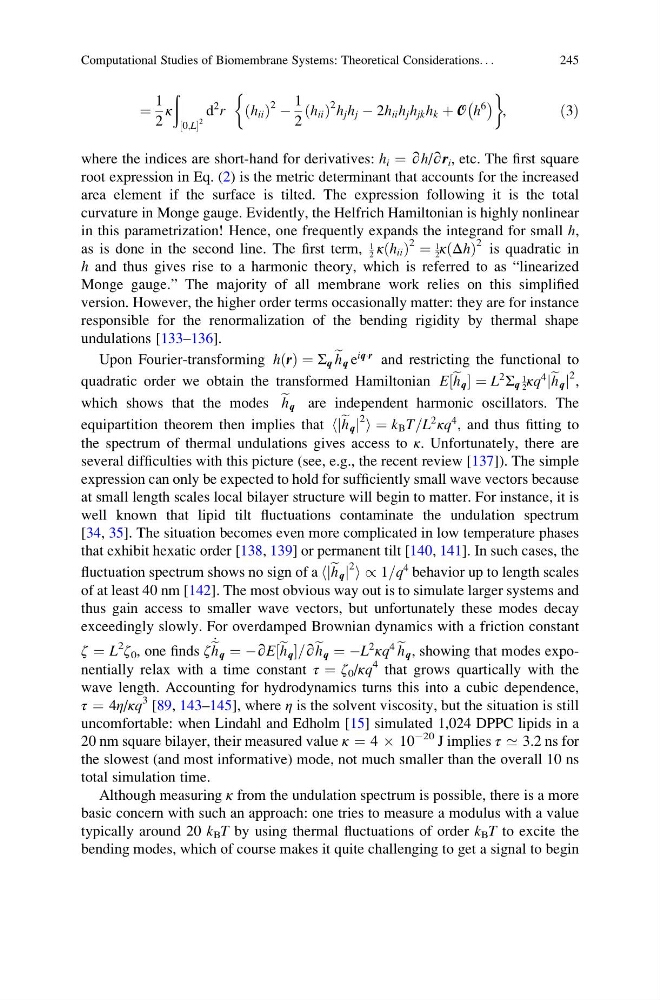
where the indices are short-hand for derivatives: h i ¼ ∂h/∂r i , etc. The first square
root expression in Eq. (2) is the metric determinant that accounts for the increased
area element if the surface is tilted. The expression following it is the total
curvature in Monge gauge. Evidently, the Helfrich Hamiltonian is highly nonlinear
in this parametrization! Hence, one frequently expands the integrand for small h,
as is done in the second line. The first term,
1
2 κ h ii
ð Þ
2 ¼
1
2 κ Δh
ð Þ
2 is quadratic in
h and thus gives rise to a harmonic theory, which is referred to as “linearized
Monge gauge.” The majority of all membrane work relies on this simplified
version. However, the higher order terms occasionally matter: they are for instance
responsible for the renormalization of the bending rigidity by thermal shape
undulations [133–136].
Upon Fourier-transforming h r
ð Þ ¼ Σ q e h q e
iqÁr and restricting the functional to
quadratic order we obtain the transformed Hamiltonian E½ e h q ¼ L
2
Σ q
1
2 κq
4
j e h q j
2 ,
which shows that the modes e h q are independent harmonic oscillators. The
equipartition theorem then implies that hj e h q j
2 i ¼ k B T=L
2
κq
4 , and thus fitting to
the spectrum of thermal undulations gives access to κ. Unfortunately, there are
several difficulties with this picture (see, e.g., the recent review [137]). The simple
expression can only be expected to hold for sufficiently small wave vectors because
at small length scales local bilayer structure will begin to matter. For instance, it is
well known that lipid tilt fluctuations contaminate the undulation spectrum
[34, 35]. The situation becomes even more complicated in low temperature phases
that exhibit hexatic order [138, 139] or permanent tilt [140, 141]. In such cases, the
fluctuation spectrum shows no sign of a hj e h q j
2 i / 1=q
4 behavior up to length scales
of at least 40 nm [142]. The most obvious way out is to simulate larger systems and
thus gain access to smaller wave vectors, but unfortunately these modes decay
exceedingly slowly. For overdamped Brownian dynamics with a friction constant
ζ ¼ L
2
ζ 0 , one finds ζ
_
e h q ¼ À∂E½ e h q =∂ e h q ¼ ÀL
2
κq
4 e h q , showing that modes exponentially relax with a time constant τ ¼ ζ 0 /κq
4 that grows quartically with the
wave length. Accounting for hydrodynamics turns this into a cubic dependence,
τ ¼ 4η/κq
3 [89, 143–145], where η is the solvent viscosity, but the situation is still
uncomfortable: when Lindahl and Edholm [15] simulated 1,024 DPPC lipids in a
20 nm square bilayer, their measured value κ ¼ 4 Â 10
À20 J implies τ ’ 3.2 ns for
the slowest (and most informative) mode, not much smaller than the overall 10 ns
total simulation time.
Although measuring κ from the undulation spectrum is possible, there is a more
basic concern with such an approach: one tries to measure a modulus with a value
typically around 20 k B T by using thermal fluctuations of order k B T to excite the
bending modes, which of course makes it quite challenging to get a signal to begin
Computational Studies of Biomembrane Systems: Theoretical Considerations. . .
245
1
2
κ
ð
0;L
½
2
d
2 r
h ii
ð Þ
2 À
1
2
h ii
ð Þ
2 h j h j À 2h ii h j h jk h k þ O h
6
À Á
&
'
,
ð3Þ
where the indices are short-hand for derivatives: h i ¼ ∂h/∂r i , etc. The first square
root expression in Eq. (2) is the metric determinant that accounts for the increased
area element if the surface is tilted. The expression following it is the total
curvature in Monge gauge. Evidently, the Helfrich Hamiltonian is highly nonlinear
in this parametrization! Hence, one frequently expands the integrand for small h,
as is done in the second line. The first term,
1
2 κ h ii
ð Þ
2 ¼
1
2 κ Δh
ð Þ
2 is quadratic in
h and thus gives rise to a harmonic theory, which is referred to as “linearized
Monge gauge.” The majority of all membrane work relies on this simplified
version. However, the higher order terms occasionally matter: they are for instance
responsible for the renormalization of the bending rigidity by thermal shape
undulations [133–136].
Upon Fourier-transforming h r
ð Þ ¼ Σ q e h q e
iqÁr and restricting the functional to
quadratic order we obtain the transformed Hamiltonian E½ e h q ¼ L
2
Σ q
1
2 κq
4
j e h q j
2 ,
which shows that the modes e h q are independent harmonic oscillators. The
equipartition theorem then implies that hj e h q j
2 i ¼ k B T=L
2
κq
4 , and thus fitting to
the spectrum of thermal undulations gives access to κ. Unfortunately, there are
several difficulties with this picture (see, e.g., the recent review [137]). The simple
expression can only be expected to hold for sufficiently small wave vectors because
at small length scales local bilayer structure will begin to matter. For instance, it is
well known that lipid tilt fluctuations contaminate the undulation spectrum
[34, 35]. The situation becomes even more complicated in low temperature phases
that exhibit hexatic order [138, 139] or permanent tilt [140, 141]. In such cases, the
fluctuation spectrum shows no sign of a hj e h q j
2 i / 1=q
4 behavior up to length scales
of at least 40 nm [142]. The most obvious way out is to simulate larger systems and
thus gain access to smaller wave vectors, but unfortunately these modes decay
exceedingly slowly. For overdamped Brownian dynamics with a friction constant
ζ ¼ L
2
ζ 0 , one finds ζ
_
e h q ¼ À∂E½ e h q =∂ e h q ¼ ÀL
2
κq
4 e h q , showing that modes exponentially relax with a time constant τ ¼ ζ 0 /κq
4 that grows quartically with the
wave length. Accounting for hydrodynamics turns this into a cubic dependence,
τ ¼ 4η/κq
3 [89, 143–145], where η is the solvent viscosity, but the situation is still
uncomfortable: when Lindahl and Edholm [15] simulated 1,024 DPPC lipids in a
20 nm square bilayer, their measured value κ ¼ 4 Â 10
À20 J implies τ ’ 3.2 ns for
the slowest (and most informative) mode, not much smaller than the overall 10 ns
total simulation time.
Although measuring κ from the undulation spectrum is possible, there is a more
basic concern with such an approach: one tries to measure a modulus with a value
typically around 20 k B T by using thermal fluctuations of order k B T to excite the
bending modes, which of course makes it quite challenging to get a signal to begin
Computational Studies of Biomembrane Systems: Theoretical Considerations. . .
245