

membrane tethers [104–106]. In simulations, monitoring undulations [12, 15, 28,
73, 74, 83, 107–111] or orientation fluctuations [112], measuring tensile forces in
tethers [111, 113, 114], and buckling [115, 116] have been used successfully.
The Gaussian curvature modulus κ is much harder to obtain because, by virtue of
the Gauss-Bonnet theorem [8, 9], the surface integral over the Gaussian curvature
K G depends only on the topology and the boundary of the membrane patch P.
Hence, one needs to change at least one of them to access the Gaussian curvature
modulus. It therefore tends to be measured by looking at the transitions between
topologically different membrane phases (e.g., the lamellar phase L α and the
inverted cubic phase Q II ) [117–120] or the shape of phase-separated membranes
in the vicinity of the contact line [121, 122] (even though the latter strictly speaking
only gives access to the difference in Gaussian moduli between the two phases). In
Sect. 2.3.2 we will briefly present a computational method that obtains κ from the
closure probability of finite membrane patches [76, 123].
To measure the edge tension requires an open edge, and in experiments this
essentially means looking at pores [124–127]. This also works in simulations [73,
74, 83, 108, 109], but it tends to be easier to create straight bilayer edges by
spanning a “half-membrane” across the periodic boundary conditions of the simulation box [128–131].
The spontaneous curvature K 0 usually vanishes due to bilayer up–down symmetry, but could be measured by creating regions of opposing spontaneous curvature and monitoring the curvature this imprints on the membrane [132], or by
measuring the shape of a spontaneously curved membrane strip [111].
Because curvature elasticity is such an important characteristic of lipid membranes, obtaining the associated moduli has always attracted a lot of attention. Let
us therefore provide a few more details on some classical and some more recent
computational strategies to measure them. Shiba and Noguchi [111] also provide a
detailed recent review.
2.3.1 Bending Modulus
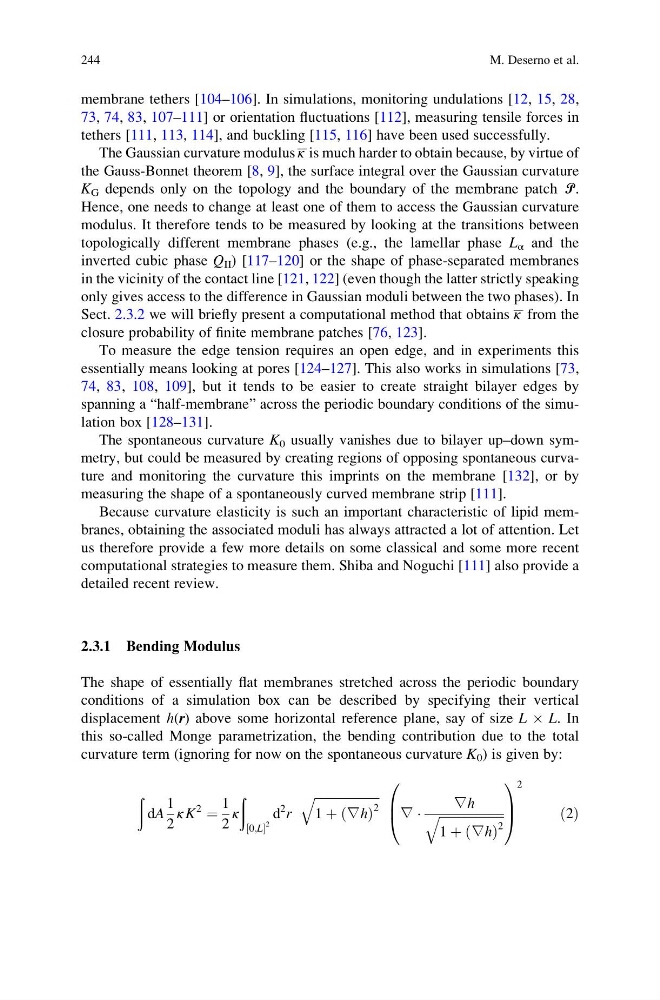
The shape of essentially flat membranes stretched across the periodic boundary
conditions of a simulation box can be described by specifying their vertical
displacement h(r) above some horizontal reference plane, say of size L Â L. In
this so-called Monge parametrization, the bending contribution due to the total
curvature term (ignoring for now on the spontaneous curvature K 0 ) is given by:
ð
dA
1
2
κ K
2
¼
1
2
κ
ð
0;L
½
2
d
2 r
ffiffiffiffiffiffiffiffiffiffiffiffiffiffiffiffiffiffiffiffiffi
1 þ ∇h
ð Þ
2
q
∇ Á
∇h
ffiffiffiffiffiffiffiffiffiffiffiffiffiffiffiffiffiffiffiffiffi
1 þ ∇h
ð Þ
2
q
0
B
@
1
C
A
2
ð2Þ
244
M. Deserno et al.
73, 74, 83, 107–111] or orientation fluctuations [112], measuring tensile forces in
tethers [111, 113, 114], and buckling [115, 116] have been used successfully.
The Gaussian curvature modulus κ is much harder to obtain because, by virtue of
the Gauss-Bonnet theorem [8, 9], the surface integral over the Gaussian curvature
K G depends only on the topology and the boundary of the membrane patch P.
Hence, one needs to change at least one of them to access the Gaussian curvature
modulus. It therefore tends to be measured by looking at the transitions between
topologically different membrane phases (e.g., the lamellar phase L α and the
inverted cubic phase Q II ) [117–120] or the shape of phase-separated membranes
in the vicinity of the contact line [121, 122] (even though the latter strictly speaking
only gives access to the difference in Gaussian moduli between the two phases). In
Sect. 2.3.2 we will briefly present a computational method that obtains κ from the
closure probability of finite membrane patches [76, 123].
To measure the edge tension requires an open edge, and in experiments this
essentially means looking at pores [124–127]. This also works in simulations [73,
74, 83, 108, 109], but it tends to be easier to create straight bilayer edges by
spanning a “half-membrane” across the periodic boundary conditions of the simulation box [128–131].
The spontaneous curvature K 0 usually vanishes due to bilayer up–down symmetry, but could be measured by creating regions of opposing spontaneous curvature and monitoring the curvature this imprints on the membrane [132], or by
measuring the shape of a spontaneously curved membrane strip [111].
Because curvature elasticity is such an important characteristic of lipid membranes, obtaining the associated moduli has always attracted a lot of attention. Let
us therefore provide a few more details on some classical and some more recent
computational strategies to measure them. Shiba and Noguchi [111] also provide a
detailed recent review.
2.3.1 Bending Modulus
The shape of essentially flat membranes stretched across the periodic boundary
conditions of a simulation box can be described by specifying their vertical
displacement h(r) above some horizontal reference plane, say of size L Â L. In
this so-called Monge parametrization, the bending contribution due to the total
curvature term (ignoring for now on the spontaneous curvature K 0 ) is given by:
ð
dA
1
2
κ K
2
¼
1
2
κ
ð
0;L
½
2
d
2 r
ffiffiffiffiffiffiffiffiffiffiffiffiffiffiffiffiffiffiffiffiffi
1 þ ∇h
ð Þ
2
q
∇ Á
∇h
ffiffiffiffiffiffiffiffiffiffiffiffiffiffiffiffiffiffiffiffiffi
1 þ ∇h
ð Þ
2
q
0
B
@
1
C
A
2
ð2Þ
244
M. Deserno et al.