

to relate the elementary steps of adsorption and desorption. From the numeric solution
of the equivalent discrete set of coupled first-order differential equations, we find that
the growth of the adsorbed fraction of monomers with time is governed by a power
law, n(t) / t
[1/(1 + ν)]
, while the typical time of adsorption τ scales with the length of
the polymer N as τ / N
α
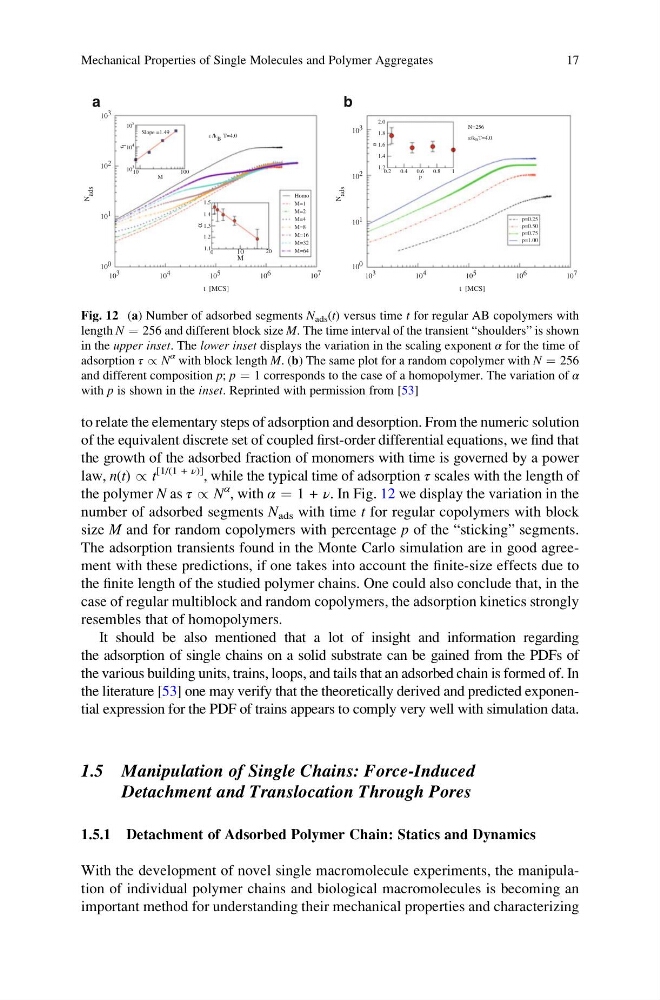
, with α ¼ 1 + ν. In Fig. 12 we display the variation in the
number of adsorbed segments N ads with time t for regular copolymers with block
size M and for random copolymers with percentage p of the “sticking” segments.
The adsorption transients found in the Monte Carlo simulation are in good agreement with these predictions, if one takes into account the finite-size effects due to
the finite length of the studied polymer chains. One could also conclude that, in the
case of regular multiblock and random copolymers, the adsorption kinetics strongly
resembles that of homopolymers.
It should be also mentioned that a lot of insight and information regarding
the adsorption of single chains on a solid substrate can be gained from the PDFs of
the various building units, trains, loops, and tails that an adsorbed chain is formed of. In
the literature [53] one may verify that the theoretically derived and predicted exponential expression for the PDF of trains appears to comply very well with simulation data.
1.5 Manipulation of Single Chains: Force-Induced
Detachment and Translocation Through Pores
1.5.1 Detachment of Adsorbed Polymer Chain: Statics and Dynamics
With the development of novel single macromolecule experiments, the manipulation of individual polymer chains and biological macromolecules is becoming an
important method for understanding their mechanical properties and characterizing
10 3
10 4
10 5
10 6
10 7
t [MCS]
10 0
10 1
10 2
10 3
N
ads
Homo
M=1
M=2
M=4
M=8
M=16
M=32
M=64
0
10
20
M
1.1
1.2
1.3
1.4
1.5
α
10
100
M
10
3
10
4
10
5
τ
1
Slope =1.49
ε /k B T=4.0
p=0.25
p=0.50
p=0.75
p=1.00
0.2
0.4
0.6
0.8
1
p
1.2
1.4
1.6
1.8
2.0
α
N=256
ε/kBT=4.0
10 3
10 4
10 5
10 6
10 7
t [MCS]
10 0
10 1
10 2
10 3
N
ads
a
b
Fig. 12 (a) Number of adsorbed segments N ads (t) versus time t for regular AB copolymers with
length N ¼ 256 and different block size M. The time interval of the transient “shoulders” is shown
in the upper inset. The lower inset displays the variation in the scaling exponent α for the time of
adsorption τ / N
α with block length M. (b) The same plot for a random copolymer with N ¼ 256
and different composition p; p ¼ 1 corresponds to the case of a homopolymer. The variation of α
with p is shown in the inset. Reprinted with permission from [53]
Mechanical Properties of Single Molecules and Polymer Aggregates
17
of the equivalent discrete set of coupled first-order differential equations, we find that
the growth of the adsorbed fraction of monomers with time is governed by a power
law, n(t) / t
[1/(1 + ν)]
, while the typical time of adsorption τ scales with the length of
the polymer N as τ / N
α
, with α ¼ 1 + ν. In Fig. 12 we display the variation in the
number of adsorbed segments N ads with time t for regular copolymers with block
size M and for random copolymers with percentage p of the “sticking” segments.
The adsorption transients found in the Monte Carlo simulation are in good agreement with these predictions, if one takes into account the finite-size effects due to
the finite length of the studied polymer chains. One could also conclude that, in the
case of regular multiblock and random copolymers, the adsorption kinetics strongly
resembles that of homopolymers.
It should be also mentioned that a lot of insight and information regarding
the adsorption of single chains on a solid substrate can be gained from the PDFs of
the various building units, trains, loops, and tails that an adsorbed chain is formed of. In
the literature [53] one may verify that the theoretically derived and predicted exponential expression for the PDF of trains appears to comply very well with simulation data.
1.5 Manipulation of Single Chains: Force-Induced
Detachment and Translocation Through Pores
1.5.1 Detachment of Adsorbed Polymer Chain: Statics and Dynamics
With the development of novel single macromolecule experiments, the manipulation of individual polymer chains and biological macromolecules is becoming an
important method for understanding their mechanical properties and characterizing
10 3
10 4
10 5
10 6
10 7
t [MCS]
10 0
10 1
10 2
10 3
N
ads
Homo
M=1
M=2
M=4
M=8
M=16
M=32
M=64
0
10
20
M
1.1
1.2
1.3
1.4
1.5
α
10
100
M
10
3
10
4
10
5
τ
1
Slope =1.49
ε /k B T=4.0
p=0.25
p=0.50
p=0.75
p=1.00
0.2
0.4
0.6
0.8
1
p
1.2
1.4
1.6
1.8
2.0
α
N=256
ε/kBT=4.0
10 3
10 4
10 5
10 6
10 7
t [MCS]
10 0
10 1
10 2
10 3
N
ads
a
b
Fig. 12 (a) Number of adsorbed segments N ads (t) versus time t for regular AB copolymers with
length N ¼ 256 and different block size M. The time interval of the transient “shoulders” is shown
in the upper inset. The lower inset displays the variation in the scaling exponent α for the time of
adsorption τ / N
α with block length M. (b) The same plot for a random copolymer with N ¼ 256
and different composition p; p ¼ 1 corresponds to the case of a homopolymer. The variation of α
with p is shown in the inset. Reprinted with permission from [53]
Mechanical Properties of Single Molecules and Polymer Aggregates
17