

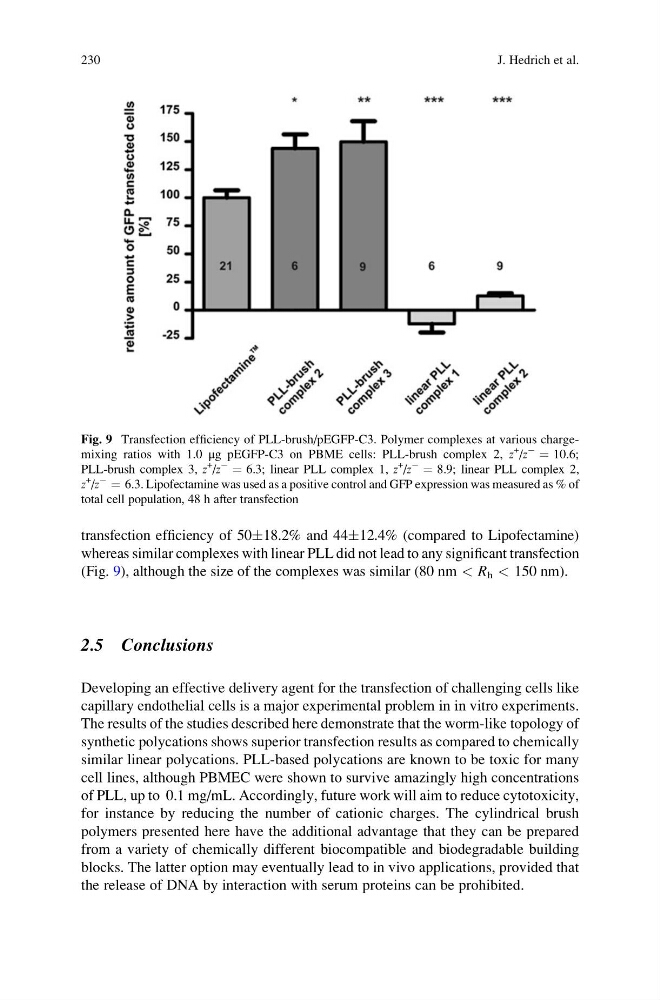
transfection efficiency of 50Æ18.2% and 44Æ12.4% (compared to Lipofectamine)
whereas similar complexes with linear PLL did not lead to any significant transfection
(Fig. 9), although the size of the complexes was similar (80 nm < R h < 150 nm).
2.5 Conclusions
Developing an effective delivery agent for the transfection of challenging cells like
capillary endothelial cells is a major experimental problem in in vitro experiments.
The results of the studies described here demonstrate that the worm-like topology of
synthetic polycations shows superior transfection results as compared to chemically
similar linear polycations. PLL-based polycations are known to be toxic for many
cell lines, although PBMEC were shown to survive amazingly high concentrations
of PLL, up to 0.1 mg/mL. Accordingly, future work will aim to reduce cytotoxicity,
for instance by reducing the number of cationic charges. The cylindrical brush
polymers presented here have the additional advantage that they can be prepared
from a variety of chemically different biocompatible and biodegradable building
blocks. The latter option may eventually lead to in vivo applications, provided that
the release of DNA by interaction with serum proteins can be prohibited.
Fig. 9 Transfection efficiency of PLL-brush/pEGFP-C3. Polymer complexes at various chargemixing ratios with 1.0 μg pEGFP-C3 on PBME cells: PLL-brush complex 2, z
+ /z
À ¼ 10.6;
PLL-brush complex 3, z
+
/z
À ¼ 6.3; linear PLL complex 1, z
+
/z
À ¼ 8.9; linear PLL complex 2,
z
+
/z
À ¼ 6.3. Lipofectamine was used as a positive control and GFP expression was measured as % of
total cell population, 48 h after transfection
230
J. Hedrich et al.
whereas similar complexes with linear PLL did not lead to any significant transfection
(Fig. 9), although the size of the complexes was similar (80 nm < R h < 150 nm).
2.5 Conclusions
Developing an effective delivery agent for the transfection of challenging cells like
capillary endothelial cells is a major experimental problem in in vitro experiments.
The results of the studies described here demonstrate that the worm-like topology of
synthetic polycations shows superior transfection results as compared to chemically
similar linear polycations. PLL-based polycations are known to be toxic for many
cell lines, although PBMEC were shown to survive amazingly high concentrations
of PLL, up to 0.1 mg/mL. Accordingly, future work will aim to reduce cytotoxicity,
for instance by reducing the number of cationic charges. The cylindrical brush
polymers presented here have the additional advantage that they can be prepared
from a variety of chemically different biocompatible and biodegradable building
blocks. The latter option may eventually lead to in vivo applications, provided that
the release of DNA by interaction with serum proteins can be prohibited.
Fig. 9 Transfection efficiency of PLL-brush/pEGFP-C3. Polymer complexes at various chargemixing ratios with 1.0 μg pEGFP-C3 on PBME cells: PLL-brush complex 2, z
+ /z
À ¼ 10.6;
PLL-brush complex 3, z
+
/z
À ¼ 6.3; linear PLL complex 1, z
+
/z
À ¼ 8.9; linear PLL complex 2,
z
+
/z
À ¼ 6.3. Lipofectamine was used as a positive control and GFP expression was measured as % of
total cell population, 48 h after transfection
230
J. Hedrich et al.