

these micelles [43, 44]. Via this strategy, several polycationic albumin polypeptides
have been reported that displayed efficient cell uptake, low cytotoxicity, fast enzymatic degradation, and multifunctionality [41, 44, 45]. Due to their excellent biocompatibility and high drug loading capacity, they have been developed into various
drug delivery systems [44, 45].
The hydrophobic effect that leads to micelle formation in the presence of lipophilic
guest molecules can be further enhanced by reacting the protein side chains with
additional hydrophobic groups such as ethynyl groups [43, 44]. Via this approach, the
anticancer drug DOX [44, 45] and hydrophobic fluorophores such as coumarin [43]
and perylenediimide [46] have been encapsulated into the interior of these
polycationic micelles and efficiently delivered into cells. The DOX-encapsulating
albumin micelles showed great potential as macromolecular anticancer drugs due to
their fast cellular uptake, significant cytotoxicity, but low toxicity of the albumin
carrier [41, 44].
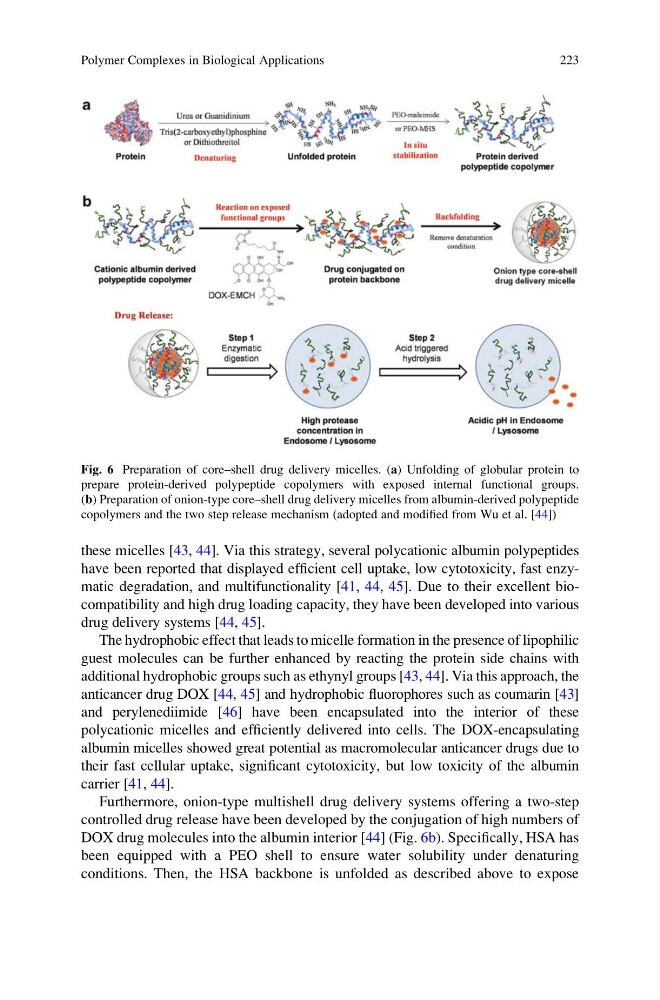
Furthermore, onion-type multishell drug delivery systems offering a two-step
controlled drug release have been developed by the conjugation of high numbers of
DOX drug molecules into the albumin interior [44] (Fig. 6b). Specifically, HSA has
been equipped with a PEO shell to ensure water solubility under denaturing
conditions. Then, the HSA backbone is unfolded as described above to expose
Fig. 6 Preparation of core–shell drug delivery micelles. (a) Unfolding of globular protein to
prepare protein-derived polypeptide copolymers with exposed internal functional groups.
(b) Preparation of onion-type core–shell drug delivery micelles from albumin-derived polypeptide
copolymers and the two step release mechanism (adopted and modified from Wu et al. [44])
Polymer Complexes in Biological Applications
223
have been reported that displayed efficient cell uptake, low cytotoxicity, fast enzymatic degradation, and multifunctionality [41, 44, 45]. Due to their excellent biocompatibility and high drug loading capacity, they have been developed into various
drug delivery systems [44, 45].
The hydrophobic effect that leads to micelle formation in the presence of lipophilic
guest molecules can be further enhanced by reacting the protein side chains with
additional hydrophobic groups such as ethynyl groups [43, 44]. Via this approach, the
anticancer drug DOX [44, 45] and hydrophobic fluorophores such as coumarin [43]
and perylenediimide [46] have been encapsulated into the interior of these
polycationic micelles and efficiently delivered into cells. The DOX-encapsulating
albumin micelles showed great potential as macromolecular anticancer drugs due to
their fast cellular uptake, significant cytotoxicity, but low toxicity of the albumin
carrier [41, 44].
Furthermore, onion-type multishell drug delivery systems offering a two-step
controlled drug release have been developed by the conjugation of high numbers of
DOX drug molecules into the albumin interior [44] (Fig. 6b). Specifically, HSA has
been equipped with a PEO shell to ensure water solubility under denaturing
conditions. Then, the HSA backbone is unfolded as described above to expose
Fig. 6 Preparation of core–shell drug delivery micelles. (a) Unfolding of globular protein to
prepare protein-derived polypeptide copolymers with exposed internal functional groups.
(b) Preparation of onion-type core–shell drug delivery micelles from albumin-derived polypeptide
copolymers and the two step release mechanism (adopted and modified from Wu et al. [44])
Polymer Complexes in Biological Applications
223