

for efficient membrane uptake, since none of the polyanions was taken up by cells.
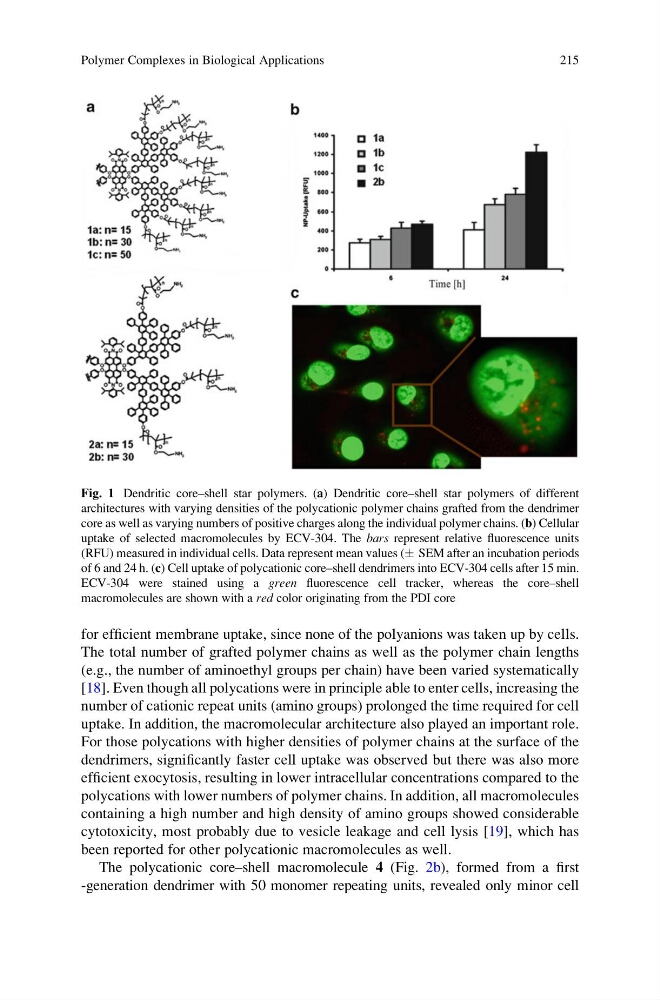
The total number of grafted polymer chains as well as the polymer chain lengths
(e.g., the number of aminoethyl groups per chain) have been varied systematically
[18]. Even though all polycations were in principle able to enter cells, increasing the
number of cationic repeat units (amino groups) prolonged the time required for cell
uptake. In addition, the macromolecular architecture also played an important role.
For those polycations with higher densities of polymer chains at the surface of the
dendrimers, significantly faster cell uptake was observed but there was also more
efficient exocytosis, resulting in lower intracellular concentrations compared to the
polycations with lower numbers of polymer chains. In addition, all macromolecules
containing a high number and high density of amino groups showed considerable
cytotoxicity, most probably due to vesicle leakage and cell lysis [19], which has
been reported for other polycationic macromolecules as well.
The polycationic core–shell macromolecule 4 (Fig. 2b), formed from a first
-generation dendrimer with 50 monomer repeating units, revealed only minor cell
Fig. 1 Dendritic core–shell star polymers. (a) Dendritic core–shell star polymers of different
architectures with varying densities of the polycationic polymer chains grafted from the dendrimer
core as well as varying numbers of positive charges along the individual polymer chains. (b) Cellular
uptake of selected macromolecules by ECV-304. The bars represent relative fluorescence units
(RFU) measured in individual cells. Data represent mean values (Æ SEM after an incubation periods
of 6 and 24 h. (c) Cell uptake of polycationic core–shell dendrimers into ECV-304 cells after 15 min.
ECV-304 were stained using a green fluorescence cell tracker, whereas the core–shell
macromolecules are shown with a red color originating from the PDI core
Polymer Complexes in Biological Applications
215
The total number of grafted polymer chains as well as the polymer chain lengths
(e.g., the number of aminoethyl groups per chain) have been varied systematically
[18]. Even though all polycations were in principle able to enter cells, increasing the
number of cationic repeat units (amino groups) prolonged the time required for cell
uptake. In addition, the macromolecular architecture also played an important role.
For those polycations with higher densities of polymer chains at the surface of the
dendrimers, significantly faster cell uptake was observed but there was also more
efficient exocytosis, resulting in lower intracellular concentrations compared to the
polycations with lower numbers of polymer chains. In addition, all macromolecules
containing a high number and high density of amino groups showed considerable
cytotoxicity, most probably due to vesicle leakage and cell lysis [19], which has
been reported for other polycationic macromolecules as well.
The polycationic core–shell macromolecule 4 (Fig. 2b), formed from a first
-generation dendrimer with 50 monomer repeating units, revealed only minor cell
Fig. 1 Dendritic core–shell star polymers. (a) Dendritic core–shell star polymers of different
architectures with varying densities of the polycationic polymer chains grafted from the dendrimer
core as well as varying numbers of positive charges along the individual polymer chains. (b) Cellular
uptake of selected macromolecules by ECV-304. The bars represent relative fluorescence units
(RFU) measured in individual cells. Data represent mean values (Æ SEM after an incubation periods
of 6 and 24 h. (c) Cell uptake of polycationic core–shell dendrimers into ECV-304 cells after 15 min.
ECV-304 were stained using a green fluorescence cell tracker, whereas the core–shell
macromolecules are shown with a red color originating from the PDI core
Polymer Complexes in Biological Applications
215