

PEO@Si wafer (Fig. 61a, top) showed a fringe, whereas on PS-(AGE)-PEO@Si wafer
(Fig. 61a, bottom) no fringe was detected. This confirms that layers with the TEOS
anchor group could not be rinsed away by solvents as a consequence of their
covalent attachment. Without TEOS, the polymer only physisorbs and can be
washed away. In addition, AFM images have been recorded (Fig. 62). Fully
covered, smooth surfaces on the nanometer scale were observed. The evenly
distributed hydrophilic and hydrophobic polymer chains result in a homogenous
thin polymer film without any visible microphase segregation, unlike conventional
mixed brushes.
Figure 61b presents images showing the contact angle and the proposed chain
alignments upon thermal treatment of the surface-confined diblock copolymers.
The PS chain flexibility is increased during the tempering process, and the PEO
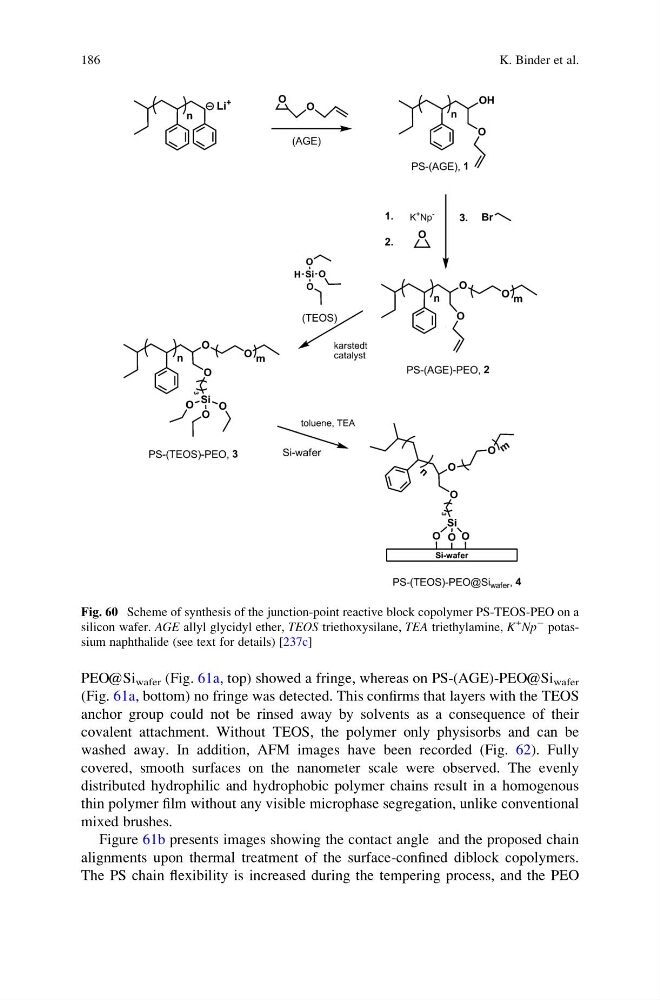
Fig. 60 Scheme of synthesis of the junction-point reactive block copolymer PS-TEOS-PEO on a
silicon wafer. AGE allyl glycidyl ether, TEOS triethoxysilane, TEA triethylamine, K
+ Np
À potassium naphthalide (see text for details) [237c]
186
K. Binder et al.
(Fig. 61a, bottom) no fringe was detected. This confirms that layers with the TEOS
anchor group could not be rinsed away by solvents as a consequence of their
covalent attachment. Without TEOS, the polymer only physisorbs and can be
washed away. In addition, AFM images have been recorded (Fig. 62). Fully
covered, smooth surfaces on the nanometer scale were observed. The evenly
distributed hydrophilic and hydrophobic polymer chains result in a homogenous
thin polymer film without any visible microphase segregation, unlike conventional
mixed brushes.
Figure 61b presents images showing the contact angle and the proposed chain
alignments upon thermal treatment of the surface-confined diblock copolymers.
The PS chain flexibility is increased during the tempering process, and the PEO
Fig. 60 Scheme of synthesis of the junction-point reactive block copolymer PS-TEOS-PEO on a
silicon wafer. AGE allyl glycidyl ether, TEOS triethoxysilane, TEA triethylamine, K
+ Np
À potassium naphthalide (see text for details) [237c]
186
K. Binder et al.