

polymerization techniques. Allyl glycidyl ether (AGE) was utilized as an
end-capping reagent for the anionic polymerization of polystyrene, achieving quantitative end-functionalization, as demonstrated by MALDI-TOF mass spectroscopy. In
the next step, PS-(AGE) was used as a macroinitiator for the anionic ring-opening
polymerization of ethylene oxide to afford amphiphilic PS-(AGE)-PEO block
copolymers with different block ratios in the range of 6–24 kg/mol. The
triethoxysilane (TEOS) anchor group for chemical grafting to silicon surfaces was
introduced by hydrosilylation of PS-(AGE)-PEO leading to PS-(TEOS)-PEO
(Fig. 60).
X-ray reflectivity measurements confirmed that after self-assembly and reaction
of the alkoxysilyl group with the silicon oxide a 1–3 nm thick polymer layer had
attached to the surface. One important issue was to clarify, whether the junctionpoint functional polymer was attached to the silicon surface by covalent bonds
formed by the TEOS functionality, or by mere noncovalent adsorption of the
PS chains at the surface. To shed light on this issue, we carried out additional
deposition experiments using the allyl-functional block copolymer PS-(AGE)-PEO
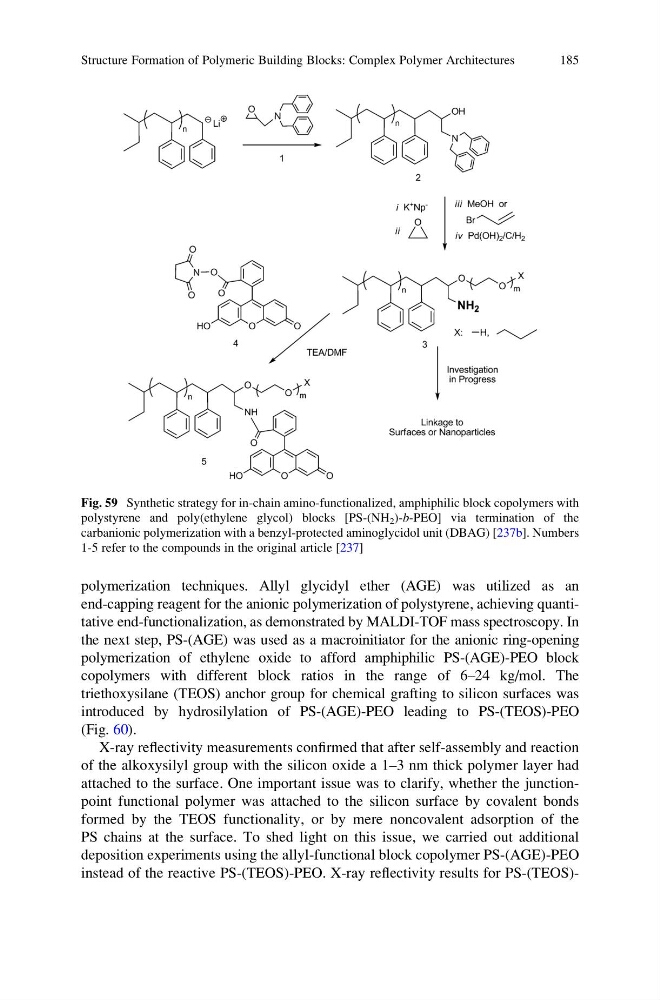
instead of the reactive PS-(TEOS)-PEO. X-ray reflectivity results for PS-(TEOS)Fig. 59 Synthetic strategy for in-chain amino-functionalized, amphiphilic block copolymers with
polystyrene and poly(ethylene glycol) blocks [PS-(NH 2 )-b-PEO] via termination of the
carbanionic polymerization with a benzyl-protected aminoglycidol unit (DBAG) [237b]. Numbers
1-5 refer to the compounds in the original article [237]
Structure Formation of Polymeric Building Blocks: Complex Polymer Architectures
185
end-capping reagent for the anionic polymerization of polystyrene, achieving quantitative end-functionalization, as demonstrated by MALDI-TOF mass spectroscopy. In
the next step, PS-(AGE) was used as a macroinitiator for the anionic ring-opening
polymerization of ethylene oxide to afford amphiphilic PS-(AGE)-PEO block
copolymers with different block ratios in the range of 6–24 kg/mol. The
triethoxysilane (TEOS) anchor group for chemical grafting to silicon surfaces was
introduced by hydrosilylation of PS-(AGE)-PEO leading to PS-(TEOS)-PEO
(Fig. 60).
X-ray reflectivity measurements confirmed that after self-assembly and reaction
of the alkoxysilyl group with the silicon oxide a 1–3 nm thick polymer layer had
attached to the surface. One important issue was to clarify, whether the junctionpoint functional polymer was attached to the silicon surface by covalent bonds
formed by the TEOS functionality, or by mere noncovalent adsorption of the
PS chains at the surface. To shed light on this issue, we carried out additional
deposition experiments using the allyl-functional block copolymer PS-(AGE)-PEO
instead of the reactive PS-(TEOS)-PEO. X-ray reflectivity results for PS-(TEOS)Fig. 59 Synthetic strategy for in-chain amino-functionalized, amphiphilic block copolymers with
polystyrene and poly(ethylene glycol) blocks [PS-(NH 2 )-b-PEO] via termination of the
carbanionic polymerization with a benzyl-protected aminoglycidol unit (DBAG) [237b]. Numbers
1-5 refer to the compounds in the original article [237]
Structure Formation of Polymeric Building Blocks: Complex Polymer Architectures
185