

Supramolecular organization is also able to create tubular molecular structures
[198, 199]. Tube stabilization utilizing strong bonds, e.g., by metal–ligand
interactions or by surfactant-templated synthetic procedures, leads to fixed
structures in the final material. To generate more flexible tubes one can take
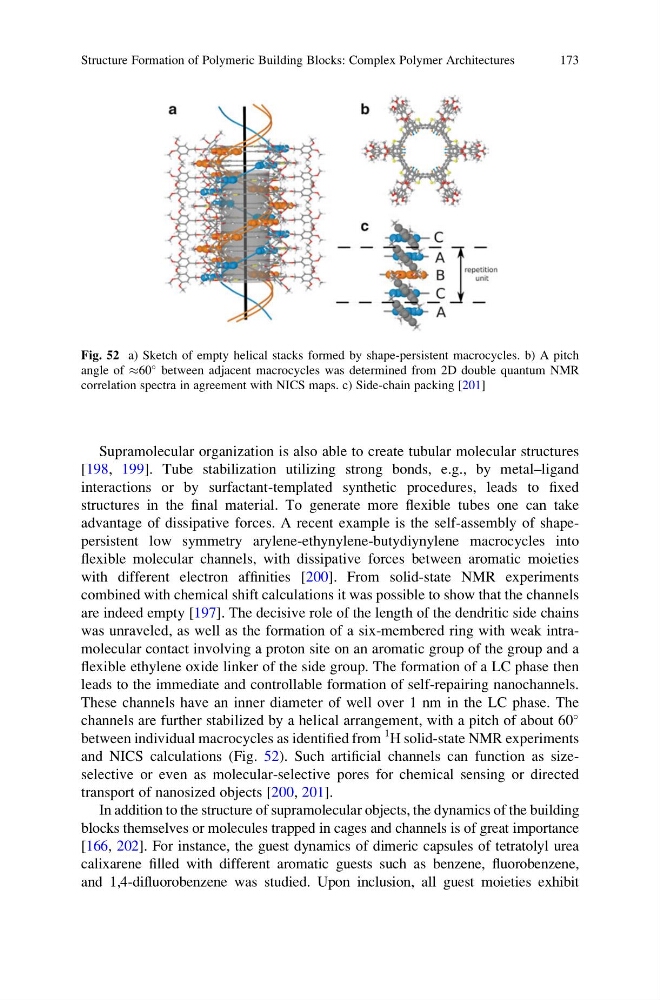
advantage of dissipative forces. A recent example is the self-assembly of shapepersistent low symmetry arylene-ethynylene-butydiynylene macrocycles into
flexible molecular channels, with dissipative forces between aromatic moieties
with different electron affinities [200]. From solid-state NMR experiments
combined with chemical shift calculations it was possible to show that the channels
are indeed empty [197]. The decisive role of the length of the dendritic side chains
was unraveled, as well as the formation of a six-membered ring with weak intramolecular contact involving a proton site on an aromatic group of the group and a
flexible ethylene oxide linker of the side group. The formation of a LC phase then
leads to the immediate and controllable formation of self-repairing nanochannels.
These channels have an inner diameter of well over 1 nm in the LC phase. The
channels are further stabilized by a helical arrangement, with a pitch of about 60
between individual macrocycles as identified from
1 H solid-state NMR experiments
and NICS calculations (Fig. 52). Such artificial channels can function as sizeselective or even as molecular-selective pores for chemical sensing or directed
transport of nanosized objects [200, 201].
In addition to the structure of supramolecular objects, the dynamics of the building
blocks themselves or molecules trapped in cages and channels is of great importance
[166, 202]. For instance, the guest dynamics of dimeric capsules of tetratolyl urea
calixarene filled with different aromatic guests such as benzene, fluorobenzene,
and 1,4-difluorobenzene was studied. Upon inclusion, all guest moieties exhibit
Fig. 52 a) Sketch of empty helical stacks formed by shape-persistent macrocycles. b) A pitch
angle of %60
between adjacent macrocycles was determined from 2D double quantum NMR
correlation spectra in agreement with NICS maps. c) Side-chain packing [201]
Structure Formation of Polymeric Building Blocks: Complex Polymer Architectures
173
[198, 199]. Tube stabilization utilizing strong bonds, e.g., by metal–ligand
interactions or by surfactant-templated synthetic procedures, leads to fixed
structures in the final material. To generate more flexible tubes one can take
advantage of dissipative forces. A recent example is the self-assembly of shapepersistent low symmetry arylene-ethynylene-butydiynylene macrocycles into
flexible molecular channels, with dissipative forces between aromatic moieties
with different electron affinities [200]. From solid-state NMR experiments
combined with chemical shift calculations it was possible to show that the channels
are indeed empty [197]. The decisive role of the length of the dendritic side chains
was unraveled, as well as the formation of a six-membered ring with weak intramolecular contact involving a proton site on an aromatic group of the group and a
flexible ethylene oxide linker of the side group. The formation of a LC phase then
leads to the immediate and controllable formation of self-repairing nanochannels.
These channels have an inner diameter of well over 1 nm in the LC phase. The
channels are further stabilized by a helical arrangement, with a pitch of about 60
between individual macrocycles as identified from
1 H solid-state NMR experiments
and NICS calculations (Fig. 52). Such artificial channels can function as sizeselective or even as molecular-selective pores for chemical sensing or directed
transport of nanosized objects [200, 201].
In addition to the structure of supramolecular objects, the dynamics of the building
blocks themselves or molecules trapped in cages and channels is of great importance
[166, 202]. For instance, the guest dynamics of dimeric capsules of tetratolyl urea
calixarene filled with different aromatic guests such as benzene, fluorobenzene,
and 1,4-difluorobenzene was studied. Upon inclusion, all guest moieties exhibit
Fig. 52 a) Sketch of empty helical stacks formed by shape-persistent macrocycles. b) A pitch
angle of %60
between adjacent macrocycles was determined from 2D double quantum NMR
correlation spectra in agreement with NICS maps. c) Side-chain packing [201]
Structure Formation of Polymeric Building Blocks: Complex Polymer Architectures
173