

copolymer. At 59
C a transition to a LC phase of the rod–coil copolymer is
observed by DSC. From solid-state NMR studies, this has been ascribed to melting
of the PEG coil, where the aggregates of the OPBA rods are preserved. Because of
the pre-organization in the LC phase, an improvement of the local order is observed
for the OPBA rods in the copolymer.
C3 symmetric benzene-1,3,5-tricarboxamides (BTAs) are known to form helical
supramolecular assemblies with columnar mesophases [195]. The driving forces for
self-organization can vary from system to system despite equivalent, hydrogenbonding central building blocks [195]. Solid-state NMR combined with X-ray
scattering, optical spectroscopy, and computer simulation provides insight in the
subtleties of the organization of the moieties [196]. When three bulky side groups,
such as 3,3
0 -diamino-2,2
0 -bipyridines, are attached to BTAs, the self-assembly of
the disk-like molecules is mainly driven by steric interactions between neighboring
molecules, where surprisingly hydrogen bonding along the columns has almost no
influence on the final supramolecular structure. This results in a complicated helical
arrangement with a pitch angle between 13
and 16
, in accord with quantum
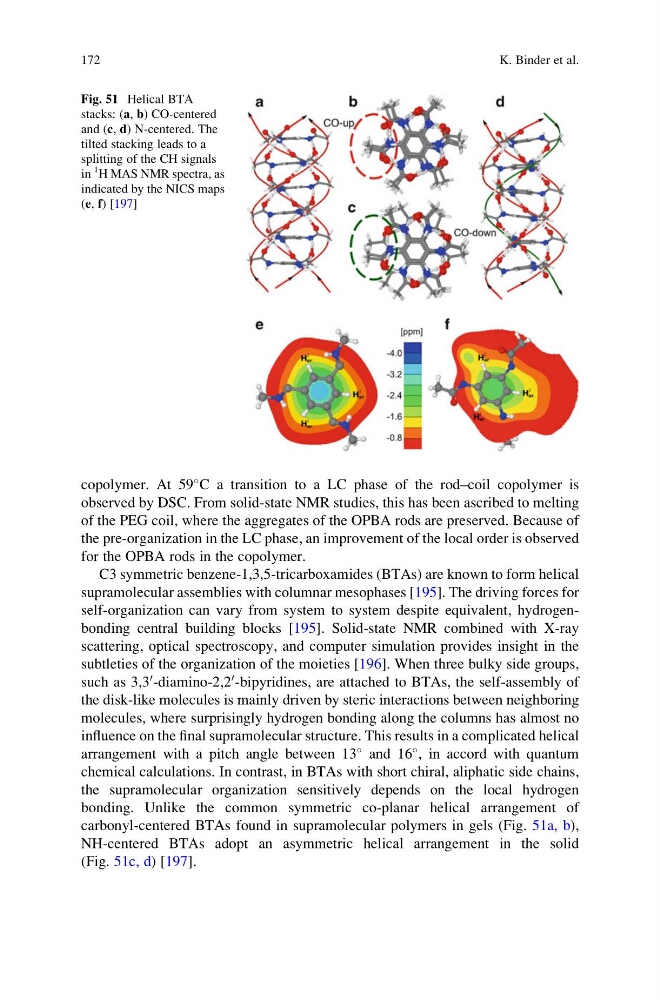
chemical calculations. In contrast, in BTAs with short chiral, aliphatic side chains,
the supramolecular organization sensitively depends on the local hydrogen
bonding. Unlike the common symmetric co-planar helical arrangement of
carbonyl-centered BTAs found in supramolecular polymers in gels (Fig. 51a, b),
NH-centered BTAs adopt an asymmetric helical arrangement in the solid
(Fig. 51c, d) [197].
Fig. 51 Helical BTA
stacks: (a, b) CO-centered
and (c, d) N-centered. The
tilted stacking leads to a
splitting of the CH signals
in
1 H MAS NMR spectra, as
indicated by the NICS maps
(e, f) [197]
172
K. Binder et al.
C a transition to a LC phase of the rod–coil copolymer is
observed by DSC. From solid-state NMR studies, this has been ascribed to melting
of the PEG coil, where the aggregates of the OPBA rods are preserved. Because of
the pre-organization in the LC phase, an improvement of the local order is observed
for the OPBA rods in the copolymer.
C3 symmetric benzene-1,3,5-tricarboxamides (BTAs) are known to form helical
supramolecular assemblies with columnar mesophases [195]. The driving forces for
self-organization can vary from system to system despite equivalent, hydrogenbonding central building blocks [195]. Solid-state NMR combined with X-ray
scattering, optical spectroscopy, and computer simulation provides insight in the
subtleties of the organization of the moieties [196]. When three bulky side groups,
such as 3,3
0 -diamino-2,2
0 -bipyridines, are attached to BTAs, the self-assembly of
the disk-like molecules is mainly driven by steric interactions between neighboring
molecules, where surprisingly hydrogen bonding along the columns has almost no
influence on the final supramolecular structure. This results in a complicated helical
arrangement with a pitch angle between 13
and 16
, in accord with quantum
chemical calculations. In contrast, in BTAs with short chiral, aliphatic side chains,
the supramolecular organization sensitively depends on the local hydrogen
bonding. Unlike the common symmetric co-planar helical arrangement of
carbonyl-centered BTAs found in supramolecular polymers in gels (Fig. 51a, b),
NH-centered BTAs adopt an asymmetric helical arrangement in the solid
(Fig. 51c, d) [197].
Fig. 51 Helical BTA
stacks: (a, b) CO-centered
and (c, d) N-centered. The
tilted stacking leads to a
splitting of the CH signals
in
1 H MAS NMR spectra, as
indicated by the NICS maps
(e, f) [197]
172
K. Binder et al.