

peptide secondary structure from coil/β-sheet conformations to α-helices that is
accompanied by an abrupt increase in the hydrodynamic radii. This change in
secondary structure and its consequences on the diffusion of the conjugates can
be crucial in the efficient design of multiple antigen peptides. Second, the bulk
studies revealed a strong effect of the polyphenylene core on the peptide secondary
motifs that could not be envisaged from their linear analogues. The time-scale and
the amplitude of polypeptide molecular motion could be measured by combining
dielectric spectroscopy with advanced NMR techniques [187].
Proline residues are of exceptional significance in protein conformation and
protein folding because proline is the only amino acid where the nitrogen bears no
amide hydrogen, preventing hydrogen bonding. Furthermore, the bulky pyrrolidine
ring restricts the available conformations. Therefore, polypeptides with proline
residues offer a unique possibility to unravel the interplay between hydrogen bonding
and geometric packing effects. A recent multi-technique study of diblock copolymers
of PBLG and poly(L-proline) (PLP) investigated their hierarchical self-assembly.
Both blocks possess helices stabilized solely either by hydrogen bonds (PBLG) or
by steric hindrance (PLP) and are further packed in two different hexagonal cells. An
intriguing trans–cis conformational change of PLP upon confinement was observed
that mimics the isomerization of isolated proline residues in proteins. These cis-PLP
conformations reside primarily at the PLP–PBLG interface, alleviate the packing
frustration, and permit PBLG and PLP helices to pack with their bulk
properties [188].
4.4 Polymers with Different Building Blocks
Precise 3D nanoscale morphological control of the solid state in the 5–10 nm range
using semiflexible chains is a demanding challenge [189]. The development of
strategies for increasing the intricacy within self-assembled nanostructures outside
of biology or analogous de novo examples is hindered by the ability to predict the
complex competition of intra- and intermolecular interactions at the molecular level.
With this in mind, fluorocarbon units were incorporated into polymers. This offers
ways of combining a low friction coefficient, high rigidity, extremely low surface
energy, hydrophobicity, chemical inertness, and thermal resistance, which make them
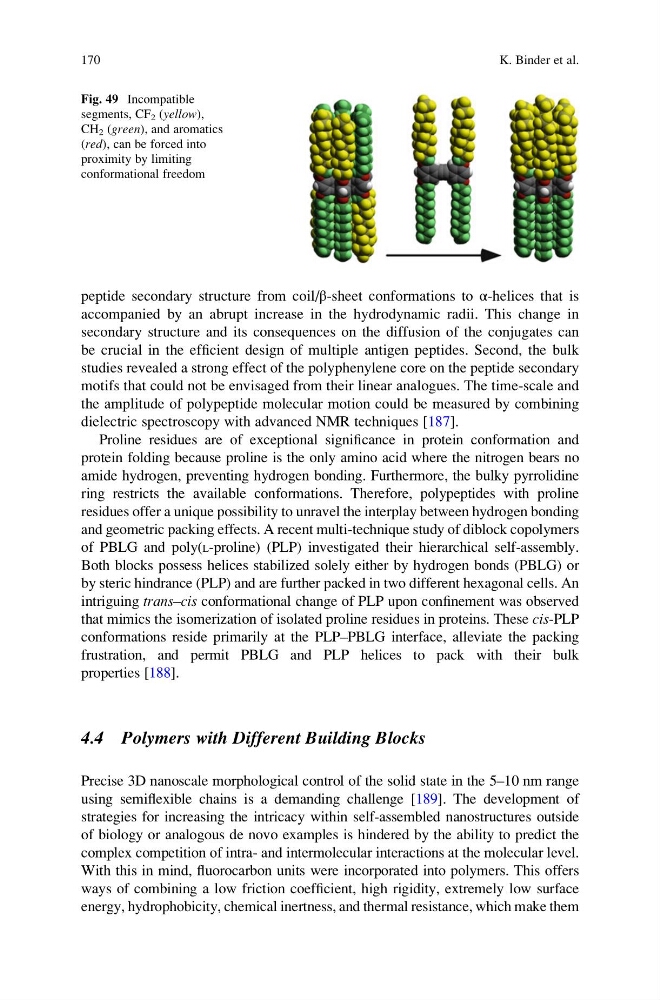
Fig. 49 Incompatible
segments, CF 2 (yellow),
CH 2 (green), and aromatics
(red), can be forced into
proximity by limiting
conformational freedom
170
K. Binder et al.
accompanied by an abrupt increase in the hydrodynamic radii. This change in
secondary structure and its consequences on the diffusion of the conjugates can
be crucial in the efficient design of multiple antigen peptides. Second, the bulk
studies revealed a strong effect of the polyphenylene core on the peptide secondary
motifs that could not be envisaged from their linear analogues. The time-scale and
the amplitude of polypeptide molecular motion could be measured by combining
dielectric spectroscopy with advanced NMR techniques [187].
Proline residues are of exceptional significance in protein conformation and
protein folding because proline is the only amino acid where the nitrogen bears no
amide hydrogen, preventing hydrogen bonding. Furthermore, the bulky pyrrolidine
ring restricts the available conformations. Therefore, polypeptides with proline
residues offer a unique possibility to unravel the interplay between hydrogen bonding
and geometric packing effects. A recent multi-technique study of diblock copolymers
of PBLG and poly(L-proline) (PLP) investigated their hierarchical self-assembly.
Both blocks possess helices stabilized solely either by hydrogen bonds (PBLG) or
by steric hindrance (PLP) and are further packed in two different hexagonal cells. An
intriguing trans–cis conformational change of PLP upon confinement was observed
that mimics the isomerization of isolated proline residues in proteins. These cis-PLP
conformations reside primarily at the PLP–PBLG interface, alleviate the packing
frustration, and permit PBLG and PLP helices to pack with their bulk
properties [188].
4.4 Polymers with Different Building Blocks
Precise 3D nanoscale morphological control of the solid state in the 5–10 nm range
using semiflexible chains is a demanding challenge [189]. The development of
strategies for increasing the intricacy within self-assembled nanostructures outside
of biology or analogous de novo examples is hindered by the ability to predict the
complex competition of intra- and intermolecular interactions at the molecular level.
With this in mind, fluorocarbon units were incorporated into polymers. This offers
ways of combining a low friction coefficient, high rigidity, extremely low surface
energy, hydrophobicity, chemical inertness, and thermal resistance, which make them
Fig. 49 Incompatible
segments, CF 2 (yellow),
CH 2 (green), and aromatics
(red), can be forced into
proximity by limiting
conformational freedom
170
K. Binder et al.