

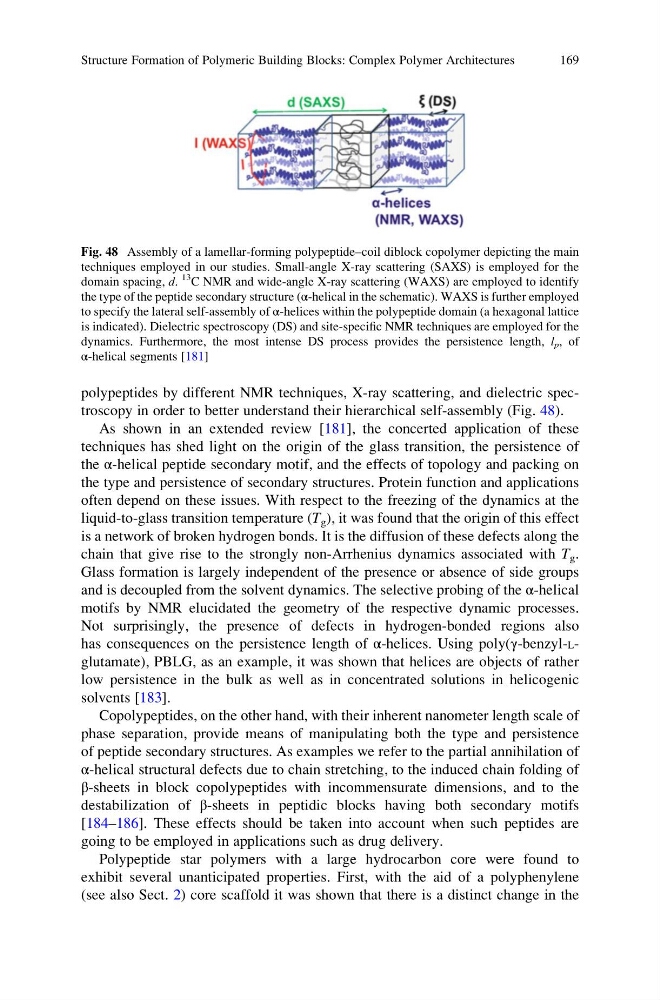
polypeptides by different NMR techniques, X-ray scattering, and dielectric spectroscopy in order to better understand their hierarchical self-assembly (Fig. 48).
As shown in an extended review [181], the concerted application of these
techniques has shed light on the origin of the glass transition, the persistence of
the α-helical peptide secondary motif, and the effects of topology and packing on
the type and persistence of secondary structures. Protein function and applications
often depend on these issues. With respect to the freezing of the dynamics at the
liquid-to-glass transition temperature (T g ), it was found that the origin of this effect
is a network of broken hydrogen bonds. It is the diffusion of these defects along the
chain that give rise to the strongly non-Arrhenius dynamics associated with T g .
Glass formation is largely independent of the presence or absence of side groups
and is decoupled from the solvent dynamics. The selective probing of the α-helical
motifs by NMR elucidated the geometry of the respective dynamic processes.
Not surprisingly, the presence of defects in hydrogen-bonded regions also
has consequences on the persistence length of α-helices. Using poly(γ-benzyl-Lglutamate), PBLG, as an example, it was shown that helices are objects of rather
low persistence in the bulk as well as in concentrated solutions in helicogenic
solvents [183].
Copolypeptides, on the other hand, with their inherent nanometer length scale of
phase separation, provide means of manipulating both the type and persistence
of peptide secondary structures. As examples we refer to the partial annihilation of
α-helical structural defects due to chain stretching, to the induced chain folding of
β-sheets in block copolypeptides with incommensurate dimensions, and to the
destabilization of β-sheets in peptidic blocks having both secondary motifs
[184–186]. These effects should be taken into account when such peptides are
going to be employed in applications such as drug delivery.
Polypeptide star polymers with a large hydrocarbon core were found to
exhibit several unanticipated properties. First, with the aid of a polyphenylene
(see also Sect. 2) core scaffold it was shown that there is a distinct change in the
Fig. 48 Assembly of a lamellar-forming polypeptide–coil diblock copolymer depicting the main
techniques employed in our studies. Small-angle X-ray scattering (SAXS) is employed for the
domain spacing, d.
13
C NMR and wide-angle X-ray scattering (WAXS) are employed to identify
the type of the peptide secondary structure (α-helical in the schematic). WAXS is further employed
to specify the lateral self-assembly of α-helices within the polypeptide domain (a hexagonal lattice
is indicated). Dielectric spectroscopy (DS) and site-specific NMR techniques are employed for the
dynamics. Furthermore, the most intense DS process provides the persistence length, l p , of
α-helical segments [181]
Structure Formation of Polymeric Building Blocks: Complex Polymer Architectures
169
As shown in an extended review [181], the concerted application of these
techniques has shed light on the origin of the glass transition, the persistence of
the α-helical peptide secondary motif, and the effects of topology and packing on
the type and persistence of secondary structures. Protein function and applications
often depend on these issues. With respect to the freezing of the dynamics at the
liquid-to-glass transition temperature (T g ), it was found that the origin of this effect
is a network of broken hydrogen bonds. It is the diffusion of these defects along the
chain that give rise to the strongly non-Arrhenius dynamics associated with T g .
Glass formation is largely independent of the presence or absence of side groups
and is decoupled from the solvent dynamics. The selective probing of the α-helical
motifs by NMR elucidated the geometry of the respective dynamic processes.
Not surprisingly, the presence of defects in hydrogen-bonded regions also
has consequences on the persistence length of α-helices. Using poly(γ-benzyl-Lglutamate), PBLG, as an example, it was shown that helices are objects of rather
low persistence in the bulk as well as in concentrated solutions in helicogenic
solvents [183].
Copolypeptides, on the other hand, with their inherent nanometer length scale of
phase separation, provide means of manipulating both the type and persistence
of peptide secondary structures. As examples we refer to the partial annihilation of
α-helical structural defects due to chain stretching, to the induced chain folding of
β-sheets in block copolypeptides with incommensurate dimensions, and to the
destabilization of β-sheets in peptidic blocks having both secondary motifs
[184–186]. These effects should be taken into account when such peptides are
going to be employed in applications such as drug delivery.
Polypeptide star polymers with a large hydrocarbon core were found to
exhibit several unanticipated properties. First, with the aid of a polyphenylene
(see also Sect. 2) core scaffold it was shown that there is a distinct change in the
Fig. 48 Assembly of a lamellar-forming polypeptide–coil diblock copolymer depicting the main
techniques employed in our studies. Small-angle X-ray scattering (SAXS) is employed for the
domain spacing, d.
13
C NMR and wide-angle X-ray scattering (WAXS) are employed to identify
the type of the peptide secondary structure (α-helical in the schematic). WAXS is further employed
to specify the lateral self-assembly of α-helices within the polypeptide domain (a hexagonal lattice
is indicated). Dielectric spectroscopy (DS) and site-specific NMR techniques are employed for the
dynamics. Furthermore, the most intense DS process provides the persistence length, l p , of
α-helical segments [181]
Structure Formation of Polymeric Building Blocks: Complex Polymer Architectures
169