

one cylinder contains the A chains and the other the B chains, both cylinders touch
along the straight backbone of the bottlebrush [105]. More complicated morphologies
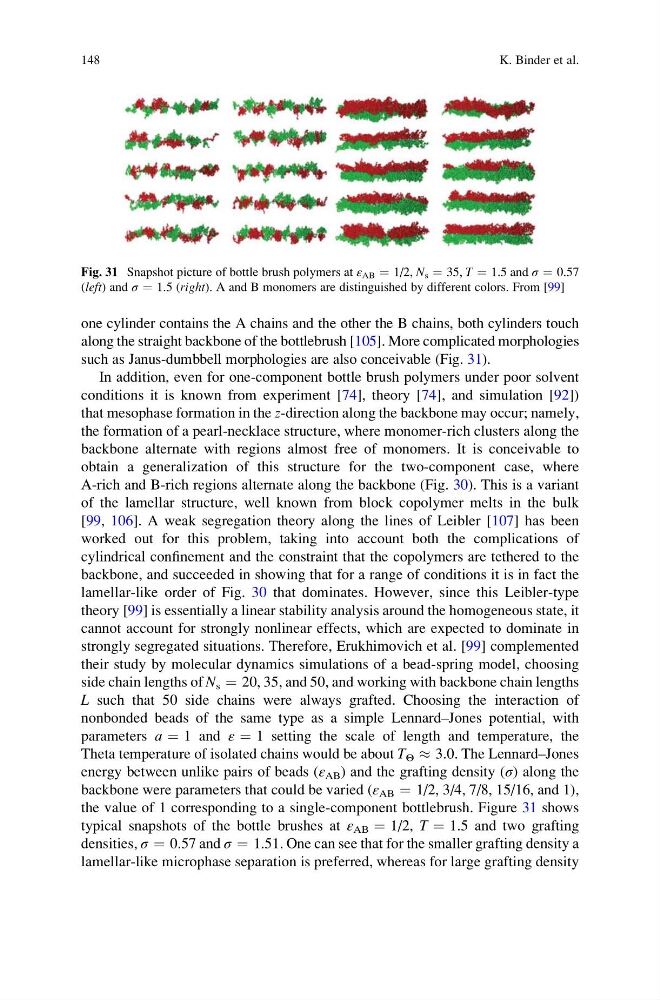
such as Janus-dumbbell morphologies are also conceivable (Fig. 31).
In addition, even for one-component bottle brush polymers under poor solvent
conditions it is known from experiment [74], theory [74], and simulation [92])
that mesophase formation in the z-direction along the backbone may occur; namely,
the formation of a pearl-necklace structure, where monomer-rich clusters along the
backbone alternate with regions almost free of monomers. It is conceivable to
obtain a generalization of this structure for the two-component case, where
A-rich and B-rich regions alternate along the backbone (Fig. 30). This is a variant
of the lamellar structure, well known from block copolymer melts in the bulk
[99, 106]. A weak segregation theory along the lines of Leibler [107] has been
worked out for this problem, taking into account both the complications of
cylindrical confinement and the constraint that the copolymers are tethered to the
backbone, and succeeded in showing that for a range of conditions it is in fact the
lamellar-like order of Fig. 30 that dominates. However, since this Leibler-type
theory [99] is essentially a linear stability analysis around the homogeneous state, it
cannot account for strongly nonlinear effects, which are expected to dominate in
strongly segregated situations. Therefore, Erukhimovich et al. [99] complemented
their study by molecular dynamics simulations of a bead-spring model, choosing
side chain lengths of N s ¼ 20, 35, and 50, and working with backbone chain lengths
L such that 50 side chains were always grafted. Choosing the interaction of
nonbonded beads of the same type as a simple Lennard–Jones potential, with
parameters a ¼ 1 and ε ¼ 1 setting the scale of length and temperature, the
Theta temperature of isolated chains would be about T Θ % 3.0. The Lennard–Jones
energy between unlike pairs of beads (ε AB ) and the grafting density (σ) along the
backbone were parameters that could be varied (ε AB ¼ 1/2, 3/4, 7/8, 15/16, and 1),
the value of 1 corresponding to a single-component bottlebrush. Figure 31 shows
typical snapshots of the bottle brushes at ε AB ¼ 1/2, T ¼ 1.5 and two grafting
densities, σ ¼ 0.57 and σ ¼ 1.51. One can see that for the smaller grafting density a
lamellar-like microphase separation is preferred, whereas for large grafting density
Fig. 31 Snapshot picture of bottle brush polymers at ε AB ¼ 1/2, N s ¼ 35, T ¼ 1.5 and σ ¼ 0.57
(left) and σ ¼ 1.5 (right). A and B monomers are distinguished by different colors. From [99]
148
K. Binder et al.
along the straight backbone of the bottlebrush [105]. More complicated morphologies
such as Janus-dumbbell morphologies are also conceivable (Fig. 31).
In addition, even for one-component bottle brush polymers under poor solvent
conditions it is known from experiment [74], theory [74], and simulation [92])
that mesophase formation in the z-direction along the backbone may occur; namely,
the formation of a pearl-necklace structure, where monomer-rich clusters along the
backbone alternate with regions almost free of monomers. It is conceivable to
obtain a generalization of this structure for the two-component case, where
A-rich and B-rich regions alternate along the backbone (Fig. 30). This is a variant
of the lamellar structure, well known from block copolymer melts in the bulk
[99, 106]. A weak segregation theory along the lines of Leibler [107] has been
worked out for this problem, taking into account both the complications of
cylindrical confinement and the constraint that the copolymers are tethered to the
backbone, and succeeded in showing that for a range of conditions it is in fact the
lamellar-like order of Fig. 30 that dominates. However, since this Leibler-type
theory [99] is essentially a linear stability analysis around the homogeneous state, it
cannot account for strongly nonlinear effects, which are expected to dominate in
strongly segregated situations. Therefore, Erukhimovich et al. [99] complemented
their study by molecular dynamics simulations of a bead-spring model, choosing
side chain lengths of N s ¼ 20, 35, and 50, and working with backbone chain lengths
L such that 50 side chains were always grafted. Choosing the interaction of
nonbonded beads of the same type as a simple Lennard–Jones potential, with
parameters a ¼ 1 and ε ¼ 1 setting the scale of length and temperature, the
Theta temperature of isolated chains would be about T Θ % 3.0. The Lennard–Jones
energy between unlike pairs of beads (ε AB ) and the grafting density (σ) along the
backbone were parameters that could be varied (ε AB ¼ 1/2, 3/4, 7/8, 15/16, and 1),
the value of 1 corresponding to a single-component bottlebrush. Figure 31 shows
typical snapshots of the bottle brushes at ε AB ¼ 1/2, T ¼ 1.5 and two grafting
densities, σ ¼ 0.57 and σ ¼ 1.51. One can see that for the smaller grafting density a
lamellar-like microphase separation is preferred, whereas for large grafting density
Fig. 31 Snapshot picture of bottle brush polymers at ε AB ¼ 1/2, N s ¼ 35, T ¼ 1.5 and σ ¼ 0.57
(left) and σ ¼ 1.5 (right). A and B monomers are distinguished by different colors. From [99]
148
K. Binder et al.