

chain, described by effective parameters such as the contour length L cc of the
backbone chain, the persistence length l p , and the cross-sectional radius R cs
(Fig. 12) [61]. But, the quantitative understanding of this picture has been rather
controversial: scaling relations for the dependence of these parameters on the
degree of polymerization N s of the side chains were proposed (e.g. [62]), which
turned out at variance with both experiments (e.g., [63]) and simulations (e.g.,
[64]); moreover, results from experiments on the persistence length of brushes
having chemically similar (or even identical) structures disagreed with each
other [63].
3.2 Simulations of Single Brushes
Getting this information experimentally is difficult [63] because one needs to do
scattering experiments over a range of several decades of scattering wave number,
and this has to be done under extremely dilute conditions (see Sect. 3.3 for
experiments). However, the simulations [61, 64–66] revealed that the problem is
more subtle, simply because the notion of persistence length is well-defined only
for semiflexible Gaussian chains [66]. For polymers under good solvent conditions,
the applicability of the Gaussian chain statistics (that is also implied by the
Kratky–Porod model of wormlike chains [67]), which rather generally is taken to
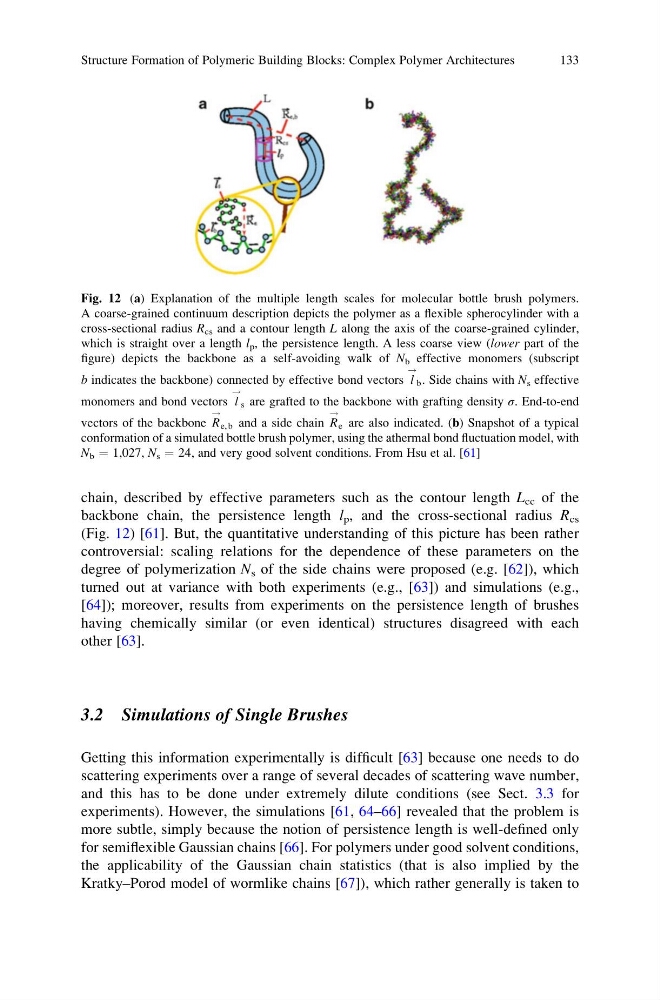
Fig. 12 (a) Explanation of the multiple length scales for molecular bottle brush polymers.
A coarse-grained continuum description depicts the polymer as a flexible spherocylinder with a
cross-sectional radius R cs and a contour length L along the axis of the coarse-grained cylinder,
which is straight over a length l p , the persistence length. A less coarse view (lower part of the
figure) depicts the backbone as a self-avoiding walk of N b effective monomers (subscript
b indicates the backbone) connected by effective bond vectors l
!
b . Side chains with N s effective
monomers and bond vectors l
!
s are grafted to the backbone with grafting density σ. End-to-end
vectors of the backbone R
!
e, b and a side chain R
!
e are also indicated. (b) Snapshot of a typical
conformation of a simulated bottle brush polymer, using the athermal bond fluctuation model, with
N b ¼ 1,027, N s ¼ 24, and very good solvent conditions. From Hsu et al. [61]
Structure Formation of Polymeric Building Blocks: Complex Polymer Architectures
133
backbone chain, the persistence length l p , and the cross-sectional radius R cs
(Fig. 12) [61]. But, the quantitative understanding of this picture has been rather
controversial: scaling relations for the dependence of these parameters on the
degree of polymerization N s of the side chains were proposed (e.g. [62]), which
turned out at variance with both experiments (e.g., [63]) and simulations (e.g.,
[64]); moreover, results from experiments on the persistence length of brushes
having chemically similar (or even identical) structures disagreed with each
other [63].
3.2 Simulations of Single Brushes
Getting this information experimentally is difficult [63] because one needs to do
scattering experiments over a range of several decades of scattering wave number,
and this has to be done under extremely dilute conditions (see Sect. 3.3 for
experiments). However, the simulations [61, 64–66] revealed that the problem is
more subtle, simply because the notion of persistence length is well-defined only
for semiflexible Gaussian chains [66]. For polymers under good solvent conditions,
the applicability of the Gaussian chain statistics (that is also implied by the
Kratky–Porod model of wormlike chains [67]), which rather generally is taken to
Fig. 12 (a) Explanation of the multiple length scales for molecular bottle brush polymers.
A coarse-grained continuum description depicts the polymer as a flexible spherocylinder with a
cross-sectional radius R cs and a contour length L along the axis of the coarse-grained cylinder,
which is straight over a length l p , the persistence length. A less coarse view (lower part of the
figure) depicts the backbone as a self-avoiding walk of N b effective monomers (subscript
b indicates the backbone) connected by effective bond vectors l
!
b . Side chains with N s effective
monomers and bond vectors l
!
s are grafted to the backbone with grafting density σ. End-to-end
vectors of the backbone R
!
e, b and a side chain R
!
e are also indicated. (b) Snapshot of a typical
conformation of a simulated bottle brush polymer, using the athermal bond fluctuation model, with
N b ¼ 1,027, N s ¼ 24, and very good solvent conditions. From Hsu et al. [61]
Structure Formation of Polymeric Building Blocks: Complex Polymer Architectures
133