

2.6 PPDs as Building Blocks for Self-Assembly
The PPDs can, indeed, serve as building blocks for assembly processes. Long fibers
are obtained when their solutions are cast on substrate surfaces [47–49]. Here again,
the shape-persistence of PPDs proves of special value because the extended arms
can interdigitate, activate π–π interactions between benzene rings, and thus lead to a
directional growth of the fibers. There are various ways to further control these
self-assembly processes: by alkyl groups or electrolyte functions on the dendrimer
surfaces [50] even including desymmetrization by forming amphiphilic Janus-type
particles, by introduction of perfluorobenzenes into the interior, or by applying
additional templating effects of the surfaces. Different, but equally powerful, cases
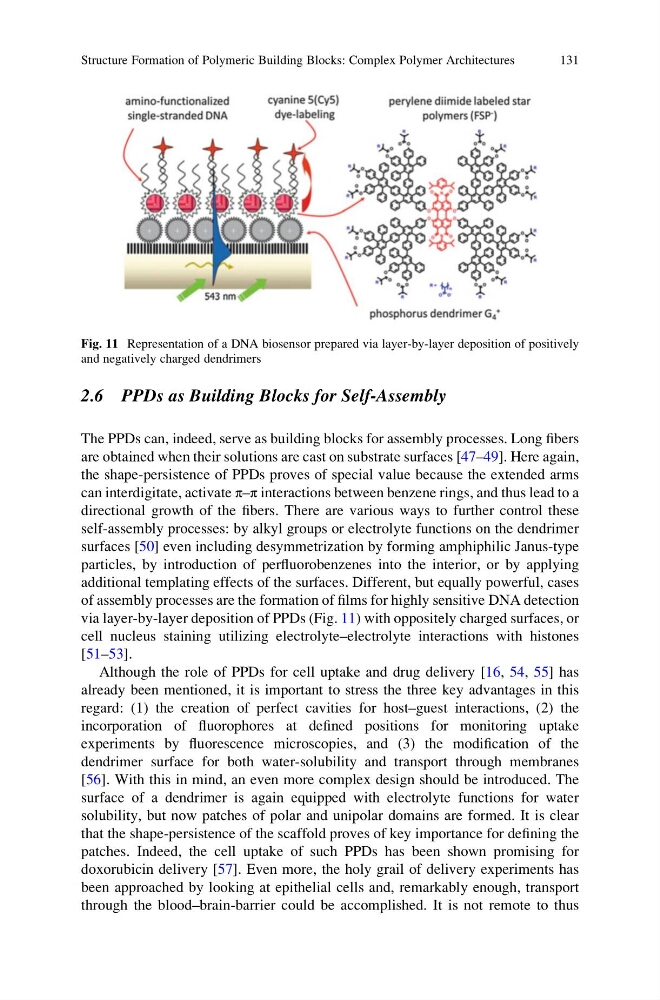
of assembly processes are the formation of films for highly sensitive DNA detection
via layer-by-layer deposition of PPDs (Fig. 11) with oppositely charged surfaces, or
cell nucleus staining utilizing electrolyte–electrolyte interactions with histones
[51–53].
Although the role of PPDs for cell uptake and drug delivery [16, 54, 55] has
already been mentioned, it is important to stress the three key advantages in this
regard: (1) the creation of perfect cavities for host–guest interactions, (2) the
incorporation of fluorophores at defined positions for monitoring uptake
experiments by fluorescence microscopies, and (3) the modification of the
dendrimer surface for both water-solubility and transport through membranes
[56]. With this in mind, an even more complex design should be introduced. The
surface of a dendrimer is again equipped with electrolyte functions for water
solubility, but now patches of polar and unipolar domains are formed. It is clear
that the shape-persistence of the scaffold proves of key importance for defining the
patches. Indeed, the cell uptake of such PPDs has been shown promising for
doxorubicin delivery [57]. Even more, the holy grail of delivery experiments has
been approached by looking at epithelial cells and, remarkably enough, transport
through the blood–brain-barrier could be accomplished. It is not remote to thus
Fig. 11 Representation of a DNA biosensor prepared via layer-by-layer deposition of positively
and negatively charged dendrimers
Structure Formation of Polymeric Building Blocks: Complex Polymer Architectures
131
The PPDs can, indeed, serve as building blocks for assembly processes. Long fibers
are obtained when their solutions are cast on substrate surfaces [47–49]. Here again,
the shape-persistence of PPDs proves of special value because the extended arms
can interdigitate, activate π–π interactions between benzene rings, and thus lead to a
directional growth of the fibers. There are various ways to further control these
self-assembly processes: by alkyl groups or electrolyte functions on the dendrimer
surfaces [50] even including desymmetrization by forming amphiphilic Janus-type
particles, by introduction of perfluorobenzenes into the interior, or by applying
additional templating effects of the surfaces. Different, but equally powerful, cases
of assembly processes are the formation of films for highly sensitive DNA detection
via layer-by-layer deposition of PPDs (Fig. 11) with oppositely charged surfaces, or
cell nucleus staining utilizing electrolyte–electrolyte interactions with histones
[51–53].
Although the role of PPDs for cell uptake and drug delivery [16, 54, 55] has
already been mentioned, it is important to stress the three key advantages in this
regard: (1) the creation of perfect cavities for host–guest interactions, (2) the
incorporation of fluorophores at defined positions for monitoring uptake
experiments by fluorescence microscopies, and (3) the modification of the
dendrimer surface for both water-solubility and transport through membranes
[56]. With this in mind, an even more complex design should be introduced. The
surface of a dendrimer is again equipped with electrolyte functions for water
solubility, but now patches of polar and unipolar domains are formed. It is clear
that the shape-persistence of the scaffold proves of key importance for defining the
patches. Indeed, the cell uptake of such PPDs has been shown promising for
doxorubicin delivery [57]. Even more, the holy grail of delivery experiments has
been approached by looking at epithelial cells and, remarkably enough, transport
through the blood–brain-barrier could be accomplished. It is not remote to thus
Fig. 11 Representation of a DNA biosensor prepared via layer-by-layer deposition of positively
and negatively charged dendrimers
Structure Formation of Polymeric Building Blocks: Complex Polymer Architectures
131