

such a constraint is formed by the adsorbing surface. As a real volumetric constraint
we include the confinement of block copolymers to small spherical drops.
We start with two examples: polyphenylene dendrimers (PPDs) and linear
brush polymers. Dendrimers (Sect. 2) are three-dimensional, mostly spherical
macromolecules that are built around a core with multiple branching points.
Among this intensively studied class of polymers, PPDs are distinguished because
they are shape-persistent due to the stiffness of the polyphenylene arms and their
steric interactions. Herein, PPDs with widely different functions, caused by different
chemical groups at their surface, in their scaffold, and in their core, are described.
Since PPDs are perfectly monodisperse and possess a defined shape, they are ideal for
addressing fundamental questions of polymer science. One example is the charging
of PPDs in organic liquids. Embedding an ionic core in a nonpolar PPD shell
immediately highlights the dissociation of ion pairs in nonpolar liquids: how does
the degree of dissociation depend on the size of the ions and the dielectric permittivity
of the solvent? As examples for functionality, two classes of PPDs are described: first,
PPDs as light harvesting, light-emitting, and photoswitchable multichromophores
and second, by designing the interior and surface solution properties, PPDs as hosts
for specific molecules and as carriers and for drug transport.
As a second example cylindrical brush polymers, often called bottle brushes, are
described (Sect. 3). Cylindrical brush polymers usually consist of a flexible main
chain, densely grafted by flexible, stiff or dendritically branched side chains. The
latter are known as dendronized polymers and have been frequently investigated by
both theory and experiment. In the present review, we focus on brush polymers with
linear side chains.
The main conformation of cylindrical brush polymers is governed by two
opposing forces: The steric repulsion of the densely grafted side chains leads to
stretching of the side chains and of the main chain, whereas the entropy elasticity
causes both main and side chains to adopt a coiled conformation. Thus, the shape of
cylindrical brush polymers emerges from a subtle balance of repulsive and entropic
forces. In more detail, the directional persistence of the main chain is primarily
governed by the grafting density, the length and the solvent quality of the side chains,
as well as by the electrostatic interaction in the case of charged side chains. Bottle
brushes have been analyzed experimentally, theoretically, and by simulations.
(A)
Comlex macromolecules
(B)
AggregaƟon
in soluƟon
(C)
AdsorpƟon
(D)
AggregaƟon
on surfaces
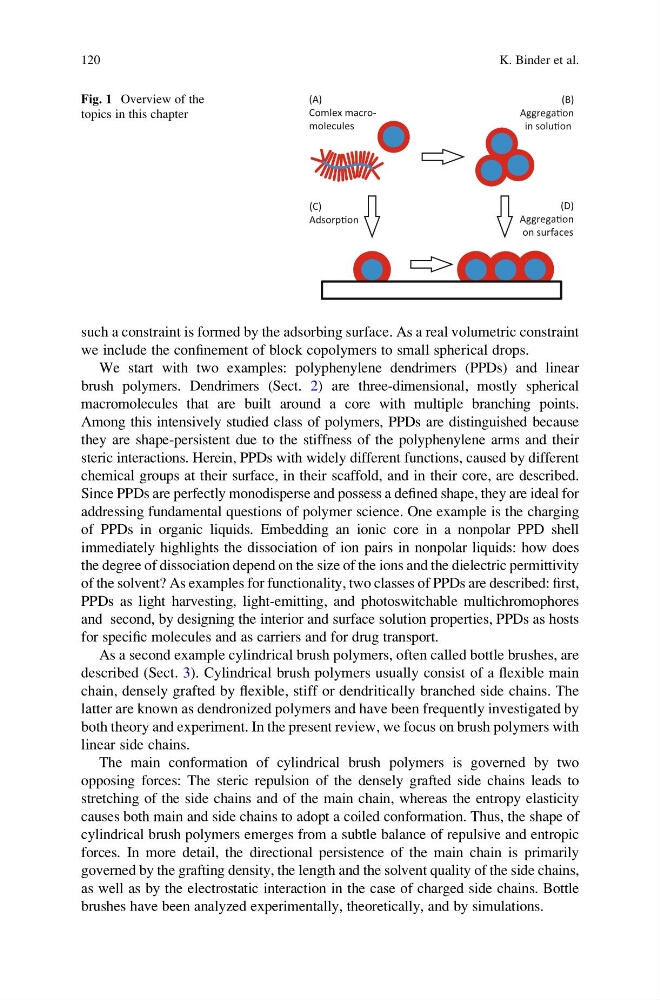
Fig. 1 Overview of the
topics in this chapter
120
K. Binder et al.
we include the confinement of block copolymers to small spherical drops.
We start with two examples: polyphenylene dendrimers (PPDs) and linear
brush polymers. Dendrimers (Sect. 2) are three-dimensional, mostly spherical
macromolecules that are built around a core with multiple branching points.
Among this intensively studied class of polymers, PPDs are distinguished because
they are shape-persistent due to the stiffness of the polyphenylene arms and their
steric interactions. Herein, PPDs with widely different functions, caused by different
chemical groups at their surface, in their scaffold, and in their core, are described.
Since PPDs are perfectly monodisperse and possess a defined shape, they are ideal for
addressing fundamental questions of polymer science. One example is the charging
of PPDs in organic liquids. Embedding an ionic core in a nonpolar PPD shell
immediately highlights the dissociation of ion pairs in nonpolar liquids: how does
the degree of dissociation depend on the size of the ions and the dielectric permittivity
of the solvent? As examples for functionality, two classes of PPDs are described: first,
PPDs as light harvesting, light-emitting, and photoswitchable multichromophores
and second, by designing the interior and surface solution properties, PPDs as hosts
for specific molecules and as carriers and for drug transport.
As a second example cylindrical brush polymers, often called bottle brushes, are
described (Sect. 3). Cylindrical brush polymers usually consist of a flexible main
chain, densely grafted by flexible, stiff or dendritically branched side chains. The
latter are known as dendronized polymers and have been frequently investigated by
both theory and experiment. In the present review, we focus on brush polymers with
linear side chains.
The main conformation of cylindrical brush polymers is governed by two
opposing forces: The steric repulsion of the densely grafted side chains leads to
stretching of the side chains and of the main chain, whereas the entropy elasticity
causes both main and side chains to adopt a coiled conformation. Thus, the shape of
cylindrical brush polymers emerges from a subtle balance of repulsive and entropic
forces. In more detail, the directional persistence of the main chain is primarily
governed by the grafting density, the length and the solvent quality of the side chains,
as well as by the electrostatic interaction in the case of charged side chains. Bottle
brushes have been analyzed experimentally, theoretically, and by simulations.
(A)
Comlex macromolecules
(B)
AggregaƟon
in soluƟon
(C)
AdsorpƟon
(D)
AggregaƟon
on surfaces
Fig. 1 Overview of the
topics in this chapter
120
K. Binder et al.