

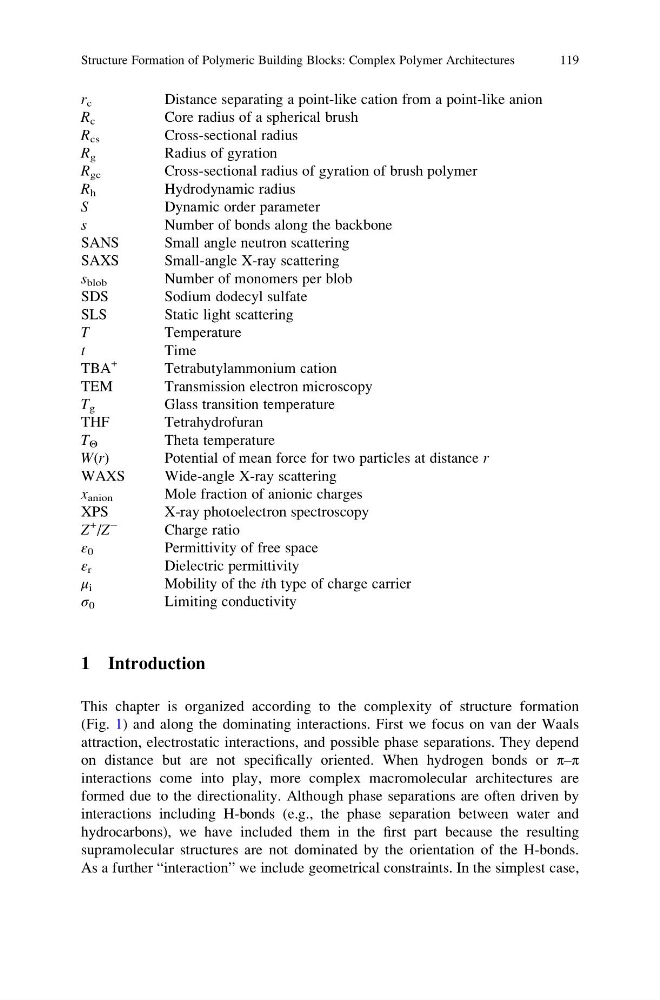
r c
Distance separating a point-like cation from a point-like anion
R c
Core radius of a spherical brush
R cs
Cross-sectional radius
R g
Radius of gyration
R gc
Cross-sectional radius of gyration of brush polymer
R h
Hydrodynamic radius
S
Dynamic order parameter
s
Number of bonds along the backbone
SANS
Small angle neutron scattering
SAXS
Small-angle X-ray scattering
s blob
Number of monomers per blob
SDS
Sodium dodecyl sulfate
SLS
Static light scattering
T
Temperature
t
Time
TBA
+
Tetrabutylammonium cation
TEM
Transmission electron microscopy
T g
Glass transition temperature
THF
Tetrahydrofuran
T Θ
Theta temperature
W(r)
Potential of mean force for two particles at distance r
WAXS
Wide-angle X-ray scattering
x anion
Mole fraction of anionic charges
XPS
X-ray photoelectron spectroscopy
Z
+ /Z
À
Charge ratio
ε 0
Permittivity of free space
ε r
Dielectric permittivity
μ i
Mobility of the ith type of charge carrier
σ 0
Limiting conductivity
1 Introduction
This chapter is organized according to the complexity of structure formation
(Fig. 1) and along the dominating interactions. First we focus on van der Waals
attraction, electrostatic interactions, and possible phase separations. They depend
on distance but are not specifically oriented. When hydrogen bonds or π–π
interactions come into play, more complex macromolecular architectures are
formed due to the directionality. Although phase separations are often driven by
interactions including H-bonds (e.g., the phase separation between water and
hydrocarbons), we have included them in the first part because the resulting
supramolecular structures are not dominated by the orientation of the H-bonds.
As a further “interaction” we include geometrical constraints. In the simplest case,
Structure Formation of Polymeric Building Blocks: Complex Polymer Architectures
119
Distance separating a point-like cation from a point-like anion
R c
Core radius of a spherical brush
R cs
Cross-sectional radius
R g
Radius of gyration
R gc
Cross-sectional radius of gyration of brush polymer
R h
Hydrodynamic radius
S
Dynamic order parameter
s
Number of bonds along the backbone
SANS
Small angle neutron scattering
SAXS
Small-angle X-ray scattering
s blob
Number of monomers per blob
SDS
Sodium dodecyl sulfate
SLS
Static light scattering
T
Temperature
t
Time
TBA
+
Tetrabutylammonium cation
TEM
Transmission electron microscopy
T g
Glass transition temperature
THF
Tetrahydrofuran
T Θ
Theta temperature
W(r)
Potential of mean force for two particles at distance r
WAXS
Wide-angle X-ray scattering
x anion
Mole fraction of anionic charges
XPS
X-ray photoelectron spectroscopy
Z
+ /Z
À
Charge ratio
ε 0
Permittivity of free space
ε r
Dielectric permittivity
μ i
Mobility of the ith type of charge carrier
σ 0
Limiting conductivity
1 Introduction
This chapter is organized according to the complexity of structure formation
(Fig. 1) and along the dominating interactions. First we focus on van der Waals
attraction, electrostatic interactions, and possible phase separations. They depend
on distance but are not specifically oriented. When hydrogen bonds or π–π
interactions come into play, more complex macromolecular architectures are
formed due to the directionality. Although phase separations are often driven by
interactions including H-bonds (e.g., the phase separation between water and
hydrocarbons), we have included them in the first part because the resulting
supramolecular structures are not dominated by the orientation of the H-bonds.
As a further “interaction” we include geometrical constraints. In the simplest case,
Structure Formation of Polymeric Building Blocks: Complex Polymer Architectures
119