

although properties such as the asymptotic exponent (v) describe how the size of
the polymer scales with its chain length (N ) and do not depend on details of the
monomer–monomer interaction, this is not true for the structure of the compact
state. Both the bond fluctuation model [4–11] and a simple off-lattice model
(tangent hard spheres with a square well attraction of range λ, in units of the sphere
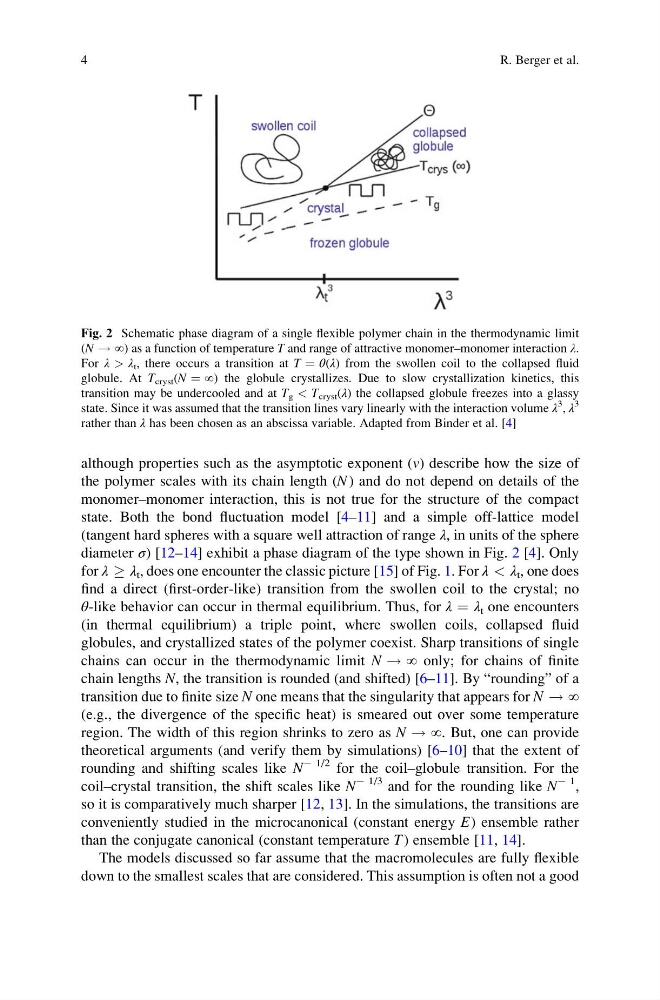
diameter σ) [12–14] exhibit a phase diagram of the type shown in Fig. 2 [4]. Only
for λ ! λ t , does one encounter the classic picture [15] of Fig. 1. For λ < λ t , one does
find a direct (first-order-like) transition from the swollen coil to the crystal; no
θ-like behavior can occur in thermal equilibrium. Thus, for λ ¼ λ t one encounters
(in thermal equilibrium) a triple point, where swollen coils, collapsed fluid
globules, and crystallized states of the polymer coexist. Sharp transitions of single
chains can occur in the thermodynamic limit N ! ∞ only; for chains of finite
chain lengths N, the transition is rounded (and shifted) [6–11]. By “rounding” of a
transition due to finite size N one means that the singularity that appears for N ! ∞
(e.g., the divergence of the specific heat) is smeared out over some temperature
region. The width of this region shrinks to zero as N ! ∞. But, one can provide
theoretical arguments (and verify them by simulations) [6–10] that the extent of
rounding and shifting scales like N
À 1/2 for the coil–globule transition. For the
coil–crystal transition, the shift scales like N
À 1/3 and for the rounding like N
À 1 ,
so it is comparatively much sharper [12, 13]. In the simulations, the transitions are
conveniently studied in the microcanonical (constant energy E) ensemble rather
than the conjugate canonical (constant temperature T ) ensemble [11, 14].
The models discussed so far assume that the macromolecules are fully flexible
down to the smallest scales that are considered. This assumption is often not a good
Fig. 2 Schematic phase diagram of a single flexible polymer chain in the thermodynamic limit
(N ! ∞) as a function of temperature T and range of attractive monomer–monomer interaction λ.
For λ > λ t , there occurs a transition at T ¼ θ(λ) from the swollen coil to the collapsed fluid
globule. At T cryst (N ¼ ∞) the globule crystallizes. Due to slow crystallization kinetics, this
transition may be undercooled and at T g < T cryst (λ) the collapsed globule freezes into a glassy
state. Since it was assumed that the transition lines vary linearly with the interaction volume λ
3
, λ
3
rather than λ has been chosen as an abscissa variable. Adapted from Binder et al. [4]
4
R. Berger et al.
the polymer scales with its chain length (N ) and do not depend on details of the
monomer–monomer interaction, this is not true for the structure of the compact
state. Both the bond fluctuation model [4–11] and a simple off-lattice model
(tangent hard spheres with a square well attraction of range λ, in units of the sphere
diameter σ) [12–14] exhibit a phase diagram of the type shown in Fig. 2 [4]. Only
for λ ! λ t , does one encounter the classic picture [15] of Fig. 1. For λ < λ t , one does
find a direct (first-order-like) transition from the swollen coil to the crystal; no
θ-like behavior can occur in thermal equilibrium. Thus, for λ ¼ λ t one encounters
(in thermal equilibrium) a triple point, where swollen coils, collapsed fluid
globules, and crystallized states of the polymer coexist. Sharp transitions of single
chains can occur in the thermodynamic limit N ! ∞ only; for chains of finite
chain lengths N, the transition is rounded (and shifted) [6–11]. By “rounding” of a
transition due to finite size N one means that the singularity that appears for N ! ∞
(e.g., the divergence of the specific heat) is smeared out over some temperature
region. The width of this region shrinks to zero as N ! ∞. But, one can provide
theoretical arguments (and verify them by simulations) [6–10] that the extent of
rounding and shifting scales like N
À 1/2 for the coil–globule transition. For the
coil–crystal transition, the shift scales like N
À 1/3 and for the rounding like N
À 1 ,
so it is comparatively much sharper [12, 13]. In the simulations, the transitions are
conveniently studied in the microcanonical (constant energy E) ensemble rather
than the conjugate canonical (constant temperature T ) ensemble [11, 14].
The models discussed so far assume that the macromolecules are fully flexible
down to the smallest scales that are considered. This assumption is often not a good
Fig. 2 Schematic phase diagram of a single flexible polymer chain in the thermodynamic limit
(N ! ∞) as a function of temperature T and range of attractive monomer–monomer interaction λ.
For λ > λ t , there occurs a transition at T ¼ θ(λ) from the swollen coil to the collapsed fluid
globule. At T cryst (N ¼ ∞) the globule crystallizes. Due to slow crystallization kinetics, this
transition may be undercooled and at T g < T cryst (λ) the collapsed globule freezes into a glassy
state. Since it was assumed that the transition lines vary linearly with the interaction volume λ
3
, λ
3
rather than λ has been chosen as an abscissa variable. Adapted from Binder et al. [4]
4
R. Berger et al.