

1 Phase Behavior, Structure, and Elastic Properties
of Single Chains
1.1 Phase Behavior of Coarse-Grained Single-Chain Models
Manipulation of single polymer chains has become a major direction of research
in polymer science because such experiments can yield valuable insight into the
relationship between the chemical structure and physical properties of macromolecules [1–3]. Such experiments do also depend on the conditions of the environment of the polymers, e.g., in an experiment where colloidal beads attached
to the chain ends of a biopolymer are moved away from each other with laser
tweezers. Then, the extension hXi versus force ( f ) relation will depend on the
quality of the solvent in which the polymer has been dissolved. Also, the structure
of a polymer adsorbed on a substrate from solution will depend on the solvent
quality [4, 5].
When one addresses such questions via computer simulation of suitable models,
knowledge of the phase behavior of the macromolecule in bulk solution (and how
this is controlled by various parameters) is a necessary ingredient of the modeling
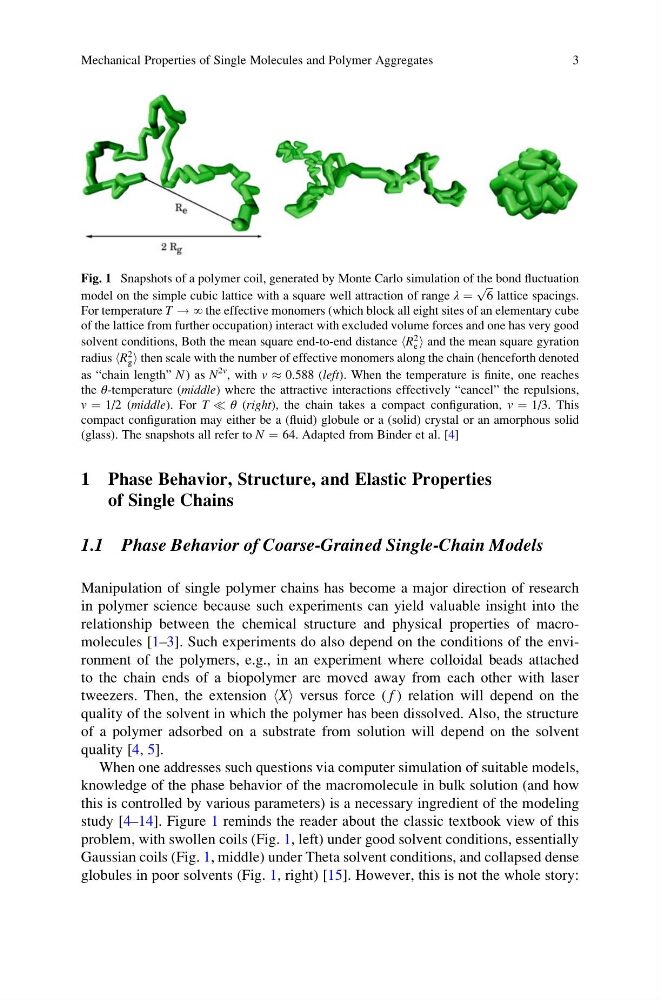
study [4–14]. Figure 1 reminds the reader about the classic textbook view of this
problem, with swollen coils (Fig. 1, left) under good solvent conditions, essentially
Gaussian coils (Fig. 1, middle) under Theta solvent conditions, and collapsed dense
globules in poor solvents (Fig. 1, right) [15]. However, this is not the whole story:
Fig. 1 Snapshots of a polymer coil, generated by Monte Carlo simulation of the bond fluctuation
model on the simple cubic lattice with a square well attraction of range λ ¼
ffiffi ffi
6
p
lattice spacings.
For temperature T ! ∞ the effective monomers (which block all eight sites of an elementary cube
of the lattice from further occupation) interact with excluded volume forces and one has very good
solvent conditions, Both the mean square end-to-end distance hR
2
e i and the mean square gyration
radius hR
2
g i then scale with the number of effective monomers along the chain (henceforth denoted
as “chain length” N ) as N
2v
, with v % 0.588 (left). When the temperature is finite, one reaches
the θ-temperature (middle) where the attractive interactions effectively “cancel” the repulsions,
v ¼ 1/2 (middle). For T ( θ (right), the chain takes a compact configuration, v ¼ 1/3. This
compact configuration may either be a (fluid) globule or a (solid) crystal or an amorphous solid
(glass). The snapshots all refer to N ¼ 64. Adapted from Binder et al. [4]
Mechanical Properties of Single Molecules and Polymer Aggregates
3
of Single Chains
1.1 Phase Behavior of Coarse-Grained Single-Chain Models
Manipulation of single polymer chains has become a major direction of research
in polymer science because such experiments can yield valuable insight into the
relationship between the chemical structure and physical properties of macromolecules [1–3]. Such experiments do also depend on the conditions of the environment of the polymers, e.g., in an experiment where colloidal beads attached
to the chain ends of a biopolymer are moved away from each other with laser
tweezers. Then, the extension hXi versus force ( f ) relation will depend on the
quality of the solvent in which the polymer has been dissolved. Also, the structure
of a polymer adsorbed on a substrate from solution will depend on the solvent
quality [4, 5].
When one addresses such questions via computer simulation of suitable models,
knowledge of the phase behavior of the macromolecule in bulk solution (and how
this is controlled by various parameters) is a necessary ingredient of the modeling
study [4–14]. Figure 1 reminds the reader about the classic textbook view of this
problem, with swollen coils (Fig. 1, left) under good solvent conditions, essentially
Gaussian coils (Fig. 1, middle) under Theta solvent conditions, and collapsed dense
globules in poor solvents (Fig. 1, right) [15]. However, this is not the whole story:
Fig. 1 Snapshots of a polymer coil, generated by Monte Carlo simulation of the bond fluctuation
model on the simple cubic lattice with a square well attraction of range λ ¼
ffiffi ffi
6
p
lattice spacings.
For temperature T ! ∞ the effective monomers (which block all eight sites of an elementary cube
of the lattice from further occupation) interact with excluded volume forces and one has very good
solvent conditions, Both the mean square end-to-end distance hR
2
e i and the mean square gyration
radius hR
2
g i then scale with the number of effective monomers along the chain (henceforth denoted
as “chain length” N ) as N
2v
, with v % 0.588 (left). When the temperature is finite, one reaches
the θ-temperature (middle) where the attractive interactions effectively “cancel” the repulsions,
v ¼ 1/2 (middle). For T ( θ (right), the chain takes a compact configuration, v ¼ 1/3. This
compact configuration may either be a (fluid) globule or a (solid) crystal or an amorphous solid
(glass). The snapshots all refer to N ¼ 64. Adapted from Binder et al. [4]
Mechanical Properties of Single Molecules and Polymer Aggregates
3