

N ¼ N
max
3
% 2a=b ¼
10
3’
r
l B
4pgr
2
k B T
(31)
that corresponds to development of dissociative instability.
In both Eqs. 30 and 31, the larger cluster corresponds to the larger ratio of r/l B
and smaller value of ’. The stable growth regime is expected for zero value of
l B (b ¼ 0), which corresponds to formation of an infinite cluster or gel-like phase.
However, the completely unstable growth regime is expected when l B exceeds some
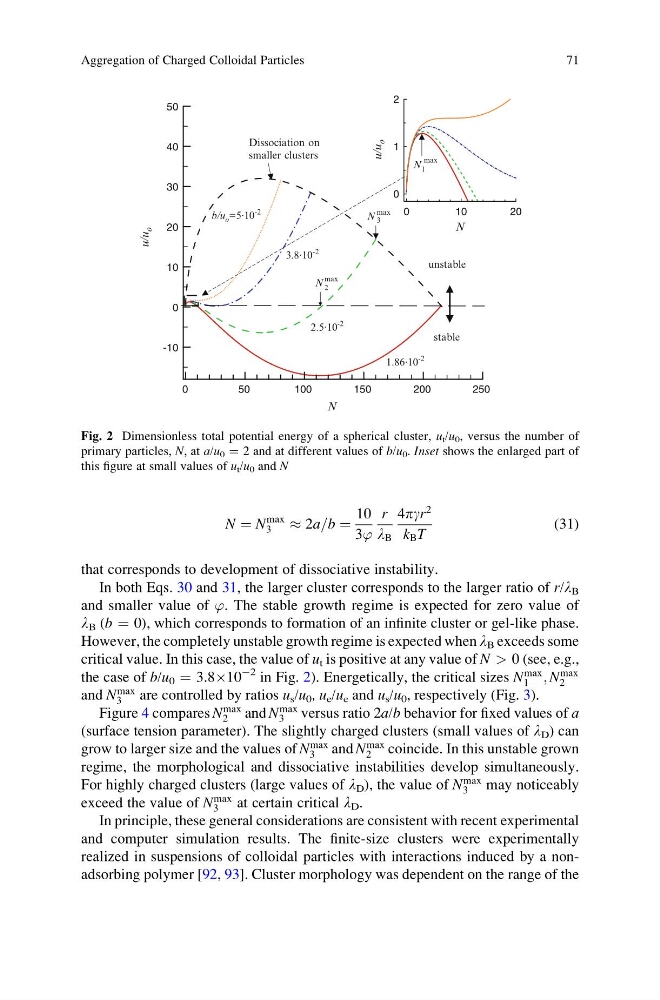
critical value. In this case, the value of u t is positive at any value of N > 0 (see, e.g.,
the case of b/u 0 ¼ 3.8Â10
À2 in Fig. 2). Energetically, the critical sizes N
max
1 ; N
max
2
and N
max
3
are controlled by ratios u s /u 0 , u e /u e and u s /u 0 , respectively (Fig. 3).
Figure 4 compares N
max
2
and N
max
3
versus ratio 2a/b behavior for fixed values of a
(surface tension parameter). The slightly charged clusters (small values of l D ) can
grow to larger size and the values of N
max
3
and N
max
2
coincide. In this unstable grown
regime, the morphological and dissociative instabilities develop simultaneously.
For highly charged clusters (large values of l D ), the value of N
max
3
may noticeably
exceed the value of N
max
3
at certain critical l D .
In principle, these general considerations are consistent with recent experimental
and computer simulation results. The finite-size clusters were experimentally
realized in suspensions of colloidal particles with interactions induced by a nonadsorbing polymer [92, 93]. Cluster morphology was dependent on the range of the
0
50
100
150
200
250
-10
0
10
20
30
40
50
N
u/u
o
u/u
o
unstable
stable
b/u o =5 . 10
-2
3.8 . 10
-2
2.5 . 10
-2
1.86 . 10
-2
max
2
N
max
3
N
0
1 0
2 0
0
1
2
N
max
1
N
Dissociation on
smaller clusters
Fig. 2 Dimensionless total potential energy of a spherical cluster, u t /u 0 , versus the number of
primary particles, N, at a/u 0 ¼ 2 and at different values of b/u 0 . Inset shows the enlarged part of
this figure at small values of u t /u 0 and N
Aggregation of Charged Colloidal Particles
71
max
3
% 2a=b ¼
10
3’
r
l B
4pgr
2
k B T
(31)
that corresponds to development of dissociative instability.
In both Eqs. 30 and 31, the larger cluster corresponds to the larger ratio of r/l B
and smaller value of ’. The stable growth regime is expected for zero value of
l B (b ¼ 0), which corresponds to formation of an infinite cluster or gel-like phase.
However, the completely unstable growth regime is expected when l B exceeds some
critical value. In this case, the value of u t is positive at any value of N > 0 (see, e.g.,
the case of b/u 0 ¼ 3.8Â10
À2 in Fig. 2). Energetically, the critical sizes N
max
1 ; N
max
2
and N
max
3
are controlled by ratios u s /u 0 , u e /u e and u s /u 0 , respectively (Fig. 3).
Figure 4 compares N
max
2
and N
max
3
versus ratio 2a/b behavior for fixed values of a
(surface tension parameter). The slightly charged clusters (small values of l D ) can
grow to larger size and the values of N
max
3
and N
max
2
coincide. In this unstable grown
regime, the morphological and dissociative instabilities develop simultaneously.
For highly charged clusters (large values of l D ), the value of N
max
3
may noticeably
exceed the value of N
max
3
at certain critical l D .
In principle, these general considerations are consistent with recent experimental
and computer simulation results. The finite-size clusters were experimentally
realized in suspensions of colloidal particles with interactions induced by a nonadsorbing polymer [92, 93]. Cluster morphology was dependent on the range of the
0
50
100
150
200
250
-10
0
10
20
30
40
50
N
u/u
o
u/u
o
unstable
stable
b/u o =5 . 10
-2
3.8 . 10
-2
2.5 . 10
-2
1.86 . 10
-2
max
2
N
max
3
N
0
1 0
2 0
0
1
2
N
max
1
N
Dissociation on
smaller clusters
Fig. 2 Dimensionless total potential energy of a spherical cluster, u t /u 0 , versus the number of
primary particles, N, at a/u 0 ¼ 2 and at different values of b/u 0 . Inset shows the enlarged part of
this figure at small values of u t /u 0 and N
Aggregation of Charged Colloidal Particles
71