

4.5 Conformational Properties of Adsorbed Polyelectrolytes
As indicated for the various geometries, the density distribution of polyelectrolytes
can be calculated within the WKB approximation. The profiles are comparable with
those presented in Sect. 3.2.2 for the adsorption of polyelectrolytes onto a sphere.
An interesting quantity is the thickness D of the polyelectrolyte layer. We define
D as the full width at half maximum of the respective radial distribution function
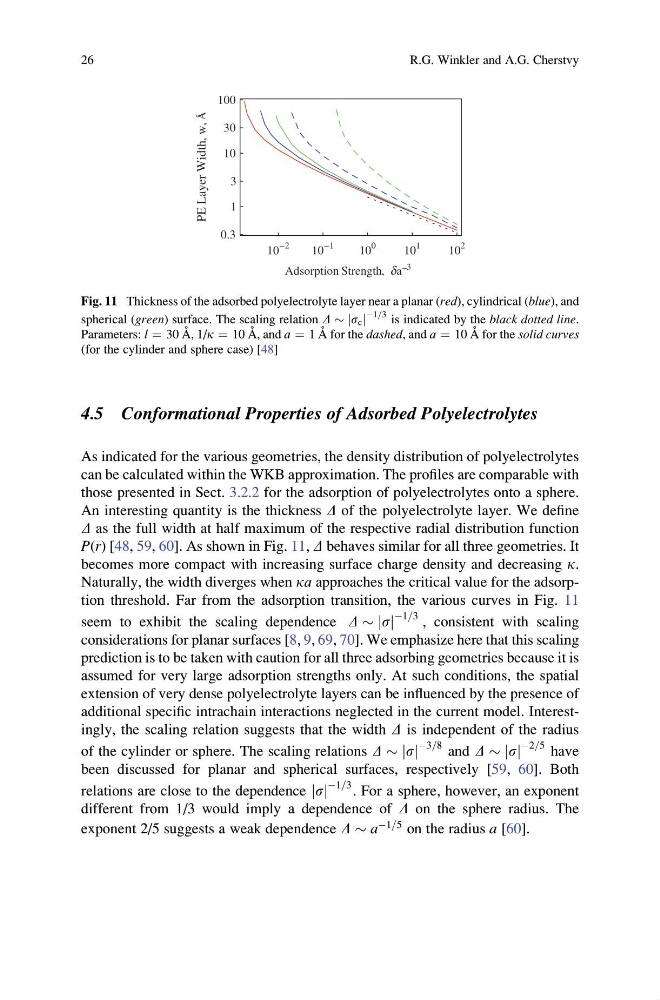
P(r) [48, 59, 60]. As shown in Fig. 11, D behaves similar for all three geometries. It
becomes more compact with increasing surface charge density and decreasing k.
Naturally, the width diverges when ka approaches the critical value for the adsorption threshold. Far from the adsorption transition, the various curves in Fig. 11
seem to exhibit the scaling dependence D $ jsj
À1=3 , consistent with scaling
considerations for planar surfaces [8, 9, 69, 70]. We emphasize here that this scaling
prediction is to be taken with caution for all three adsorbing geometries because it is
assumed for very large adsorption strengths only. At such conditions, the spatial
extension of very dense polyelectrolyte layers can be influenced by the presence of
additional specific intrachain interactions neglected in the current model. Interestingly, the scaling relation suggests that the width D is independent of the radius
of the cylinder or sphere. The scaling relations D $ jsj
À3=8 and D $ jsj
À2=5 have
been discussed for planar and spherical surfaces, respectively [59, 60]. Both
relations are close to the dependence jsj
À1=3 . For a sphere, however, an exponent
different from 1/3 would imply a dependence of D on the sphere radius. The
exponent 2/5 suggests a weak dependence D $ a
À1=5 on the radius a [60].
10
2
10
1
10
0
10
1
10
2
0.3
1
3
10
30
100
PE Layer Width, w,
Adsorption Strength, a
3
d
Fig. 11 Thickness of the adsorbed polyelectrolyte layer near a planar (red), cylindrical (blue), and
spherical (green) surface. The scaling relation D $ js c j
À1=3 is indicated by the black dotted line.
Parameters: l ¼ 30 A ˚ , 1/k ¼ 10 A ˚ , and a ¼ 1 A ˚ for the dashed, and a ¼ 10 A ˚ for the solid curves
(for the cylinder and sphere case) [48]
26
R.G. Winkler and A.G. Cherstvy
As indicated for the various geometries, the density distribution of polyelectrolytes
can be calculated within the WKB approximation. The profiles are comparable with
those presented in Sect. 3.2.2 for the adsorption of polyelectrolytes onto a sphere.
An interesting quantity is the thickness D of the polyelectrolyte layer. We define
D as the full width at half maximum of the respective radial distribution function
P(r) [48, 59, 60]. As shown in Fig. 11, D behaves similar for all three geometries. It
becomes more compact with increasing surface charge density and decreasing k.
Naturally, the width diverges when ka approaches the critical value for the adsorption threshold. Far from the adsorption transition, the various curves in Fig. 11
seem to exhibit the scaling dependence D $ jsj
À1=3 , consistent with scaling
considerations for planar surfaces [8, 9, 69, 70]. We emphasize here that this scaling
prediction is to be taken with caution for all three adsorbing geometries because it is
assumed for very large adsorption strengths only. At such conditions, the spatial
extension of very dense polyelectrolyte layers can be influenced by the presence of
additional specific intrachain interactions neglected in the current model. Interestingly, the scaling relation suggests that the width D is independent of the radius
of the cylinder or sphere. The scaling relations D $ jsj
À3=8 and D $ jsj
À2=5 have
been discussed for planar and spherical surfaces, respectively [59, 60]. Both
relations are close to the dependence jsj
À1=3 . For a sphere, however, an exponent
different from 1/3 would imply a dependence of D on the sphere radius. The
exponent 2/5 suggests a weak dependence D $ a
À1=5 on the radius a [60].
10
2
10
1
10
0
10
1
10
2
0.3
1
3
10
30
100
PE Layer Width, w,
Adsorption Strength, a
3
d
Fig. 11 Thickness of the adsorbed polyelectrolyte layer near a planar (red), cylindrical (blue), and
spherical (green) surface. The scaling relation D $ js c j
À1=3 is indicated by the black dotted line.
Parameters: l ¼ 30 A ˚ , 1/k ¼ 10 A ˚ , and a ¼ 1 A ˚ for the dashed, and a ¼ 10 A ˚ for the solid curves
(for the cylinder and sphere case) [48]
26
R.G. Winkler and A.G. Cherstvy