

4.3 Cylindrical Surface
The linearized Poisson–Boltzmann equation yields the interaction potential
between a polyelectrolyte chain and the surface of an infinitely long, uniformly
charged cylinder:
V DH ðrÞ ¼ À
4pjrsj
ek
K 0 ðkrÞ
K 1 ðkaÞ
;
(39)
where K 0 and K 1 denote modified Bessel functions of the second kind and a is the
radius of the cylinder. The equation for the radial component of the Green function
of the cylinder is [48]:
l
6
@
2 c 0 ðrÞ
@r 2 þ
1
r
@c 0 ðrÞ
@r
þ y
K 0 ðkrÞ
K 1 ðkaÞ
c 0 ðrÞ ¼ Àl 0 c 0 ðrÞ:
(40)
By the substitution kr ¼ e
u
, we obtain the equation @
2 c 0 ðuÞ=@u
2
þ Q
2 c 0 ðuÞ ¼ 0
suitable for the WKB approximation, with:
QðuÞ
2 ¼
6e
2u
lk 2 l 0 þ y
K 0 ðe
u
Þ
K 1 ðkaÞ
:
(41)
The point r 0 , where the potential is zero, follows from the equation K 0 ðkr 0 Þ ¼
jl 0 jK 1 ðkaÞ=y, because l 0 < 0 for a bound state. In the interval a < r < r 0 , (35)
becomes:
xðrÞ ¼
ð r 0
r
ffiffiffiffiffiffiffiffiffiffiffiffiffiffiffiffiffiffiffiffiffiffiffiffiffiffiffiffiffiffiffiffiffiffiffiffiffiffiffiffiffiffiffiffi ffi
6
l
y
K 0 ðkrÞ
K 1 ðkaÞ
À jl 0 j
dr
s
;
(42)
adsorption
desorption
sphere
rod
plane
10 0
10 1
10 2
10 3
10 –6
10 –4
10 –4 10 –3 10 –2 10 –1
10 –2
10 0
10 2
10 4
10 6
10 8
B
a
3
k Tb
Î
24
c r
s
p
æ
a
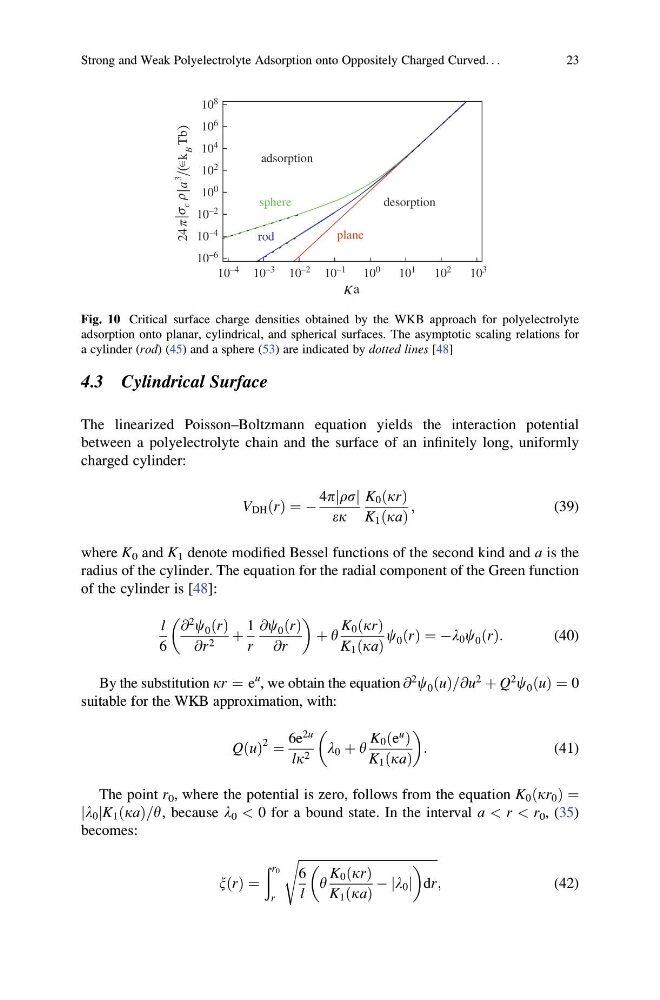
Fig. 10 Critical surface charge densities obtained by the WKB approach for polyelectrolyte
adsorption onto planar, cylindrical, and spherical surfaces. The asymptotic scaling relations for
a cylinder (rod) (45) and a sphere (53) are indicated by dotted lines [48]
Strong and Weak Polyelectrolyte Adsorption onto Oppositely Charged Curved. . .
23
The linearized Poisson–Boltzmann equation yields the interaction potential
between a polyelectrolyte chain and the surface of an infinitely long, uniformly
charged cylinder:
V DH ðrÞ ¼ À
4pjrsj
ek
K 0 ðkrÞ
K 1 ðkaÞ
;
(39)
where K 0 and K 1 denote modified Bessel functions of the second kind and a is the
radius of the cylinder. The equation for the radial component of the Green function
of the cylinder is [48]:
l
6
@
2 c 0 ðrÞ
@r 2 þ
1
r
@c 0 ðrÞ
@r
þ y
K 0 ðkrÞ
K 1 ðkaÞ
c 0 ðrÞ ¼ Àl 0 c 0 ðrÞ:
(40)
By the substitution kr ¼ e
u
, we obtain the equation @
2 c 0 ðuÞ=@u
2
þ Q
2 c 0 ðuÞ ¼ 0
suitable for the WKB approximation, with:
QðuÞ
2 ¼
6e
2u
lk 2 l 0 þ y
K 0 ðe
u
Þ
K 1 ðkaÞ
:
(41)
The point r 0 , where the potential is zero, follows from the equation K 0 ðkr 0 Þ ¼
jl 0 jK 1 ðkaÞ=y, because l 0 < 0 for a bound state. In the interval a < r < r 0 , (35)
becomes:
xðrÞ ¼
ð r 0
r
ffiffiffiffiffiffiffiffiffiffiffiffiffiffiffiffiffiffiffiffiffiffiffiffiffiffiffiffiffiffiffiffiffiffiffiffiffiffiffiffiffiffiffiffi ffi
6
l
y
K 0 ðkrÞ
K 1 ðkaÞ
À jl 0 j
dr
s
;
(42)
adsorption
desorption
sphere
rod
plane
10 0
10 1
10 2
10 3
10 –6
10 –4
10 –4 10 –3 10 –2 10 –1
10 –2
10 0
10 2
10 4
10 6
10 8
B
a
3
k Tb
Î
24
c r
s
p
æ
a
Fig. 10 Critical surface charge densities obtained by the WKB approach for polyelectrolyte
adsorption onto planar, cylindrical, and spherical surfaces. The asymptotic scaling relations for
a cylinder (rod) (45) and a sphere (53) are indicated by dotted lines [48]
Strong and Weak Polyelectrolyte Adsorption onto Oppositely Charged Curved. . .
23