

cðxÞ ¼
N c
x
1=6
ffiffiffiffiffiffiffi
QðxÞ
p
Ai À½3x=2
2=3
for x < x 0
N c
jxj
1=6
ffiffiffiffiffiffiffiffi ffi
QðxÞ
j
j
p
Ai 3jxj=2
½
2=3
for x > x 0
8
> <
> :
;
(36)
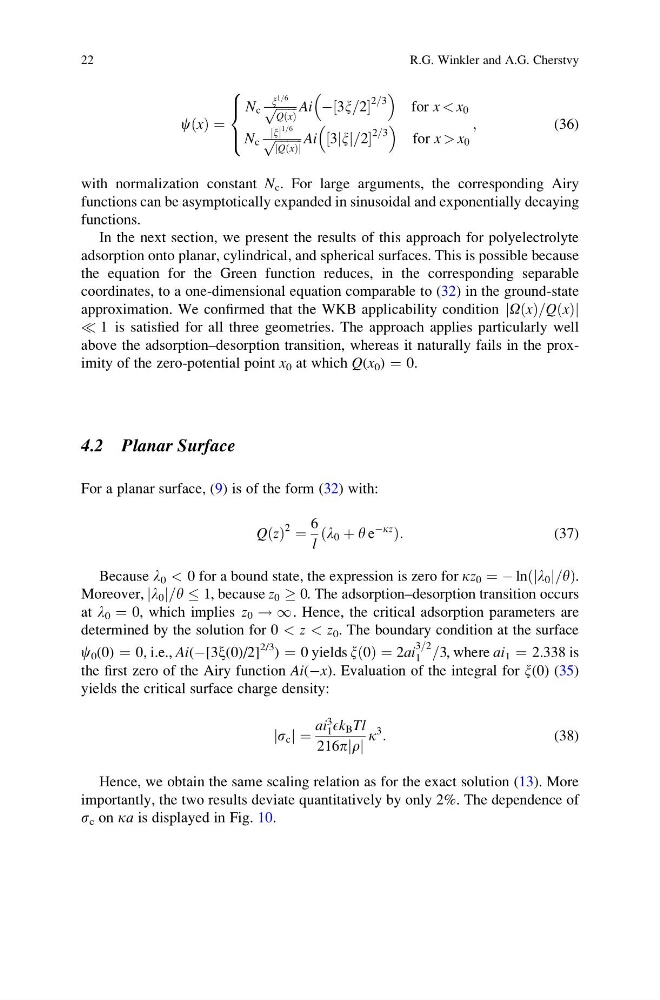
with normalization constant N c . For large arguments, the corresponding Airy
functions can be asymptotically expanded in sinusoidal and exponentially decaying
functions.
In the next section, we present the results of this approach for polyelectrolyte
adsorption onto planar, cylindrical, and spherical surfaces. This is possible because
the equation for the Green function reduces, in the corresponding separable
coordinates, to a one-dimensional equation comparable to (32) in the ground-state
approximation. We confirmed that the WKB applicability condition OðxÞ=QðxÞ
j
j
( 1 is satisfied for all three geometries. The approach applies particularly well
above the adsorption–desorption transition, whereas it naturally fails in the proximity of the zero-potential point x 0 at which Q(x 0 ) ¼ 0.
4.2 Planar Surface
For a planar surface, (9) is of the form (32) with:
QðzÞ
2 ¼
6
l
ðl 0 þ y e
Àkz
Þ:
(37)
Because l 0 < 0 for a bound state, the expression is zero for kz 0 ¼ À ln l 0
j j=y
ð
Þ.
Moreover, jl 0 j=y 1, because z 0 ! 0. The adsorption–desorption transition occurs
at l 0 ¼ 0, which implies z 0 ! 1. Hence, the critical adsorption parameters are
determined by the solution for 0 < z < z 0 . The boundary condition at the surface
c 0 (0) ¼ 0, i.e., Ai(À[3x(0)/2]
2/3 ) ¼ 0 yields xð0Þ ¼ 2ai
3=2
1 =3, where ai 1 ¼ 2.338 is
the first zero of the Airy function Ai(Àx). Evaluation of the integral for x(0) (35)
yields the critical surface charge density:
js c j ¼
ai
3
1 Ek B Tl
216pjrj
k
3
:
(38)
Hence, we obtain the same scaling relation as for the exact solution (13). More
importantly, the two results deviate quantitatively by only 2%. The dependence of
s c on ka is displayed in Fig. 10.
22
R.G. Winkler and A.G. Cherstvy
N c
x
1=6
ffiffiffiffiffiffiffi
QðxÞ
p
Ai À½3x=2
2=3
for x < x 0
N c
jxj
1=6
ffiffiffiffiffiffiffiffi ffi
QðxÞ
j
j
p
Ai 3jxj=2
½
2=3
for x > x 0
8
> <
> :
;
(36)
with normalization constant N c . For large arguments, the corresponding Airy
functions can be asymptotically expanded in sinusoidal and exponentially decaying
functions.
In the next section, we present the results of this approach for polyelectrolyte
adsorption onto planar, cylindrical, and spherical surfaces. This is possible because
the equation for the Green function reduces, in the corresponding separable
coordinates, to a one-dimensional equation comparable to (32) in the ground-state
approximation. We confirmed that the WKB applicability condition OðxÞ=QðxÞ
j
j
( 1 is satisfied for all three geometries. The approach applies particularly well
above the adsorption–desorption transition, whereas it naturally fails in the proximity of the zero-potential point x 0 at which Q(x 0 ) ¼ 0.
4.2 Planar Surface
For a planar surface, (9) is of the form (32) with:
QðzÞ
2 ¼
6
l
ðl 0 þ y e
Àkz
Þ:
(37)
Because l 0 < 0 for a bound state, the expression is zero for kz 0 ¼ À ln l 0
j j=y
ð
Þ.
Moreover, jl 0 j=y 1, because z 0 ! 0. The adsorption–desorption transition occurs
at l 0 ¼ 0, which implies z 0 ! 1. Hence, the critical adsorption parameters are
determined by the solution for 0 < z < z 0 . The boundary condition at the surface
c 0 (0) ¼ 0, i.e., Ai(À[3x(0)/2]
2/3 ) ¼ 0 yields xð0Þ ¼ 2ai
3=2
1 =3, where ai 1 ¼ 2.338 is
the first zero of the Airy function Ai(Àx). Evaluation of the integral for x(0) (35)
yields the critical surface charge density:
js c j ¼
ai
3
1 Ek B Tl
216pjrj
k
3
:
(38)
Hence, we obtain the same scaling relation as for the exact solution (13). More
importantly, the two results deviate quantitatively by only 2%. The dependence of
s c on ka is displayed in Fig. 10.
22
R.G. Winkler and A.G. Cherstvy