

prepared upon exposure of hydrophilic surfaces to a solution of micellar IPECs
containing the silver NPs.
The IPECs based on triblock terpolymers containing polybutadiene (PB),
P2VPQ, and PMAA blocks acted as scaffolds for the preparation of polymer–inorganic nanohybrids [96]. The IPEC shell on a hydrophobic PB core (Fig. 25a) was
assembled from the P2VPQ and PMAA blocks while the excess segments of the
PMAA blocks formed a hydrophilic corona. The PMAA blocks and the discontinuous (patchy) intramicellar IPEC {PMAA-P2VPQ} shell were loaded with AuCl 4
À
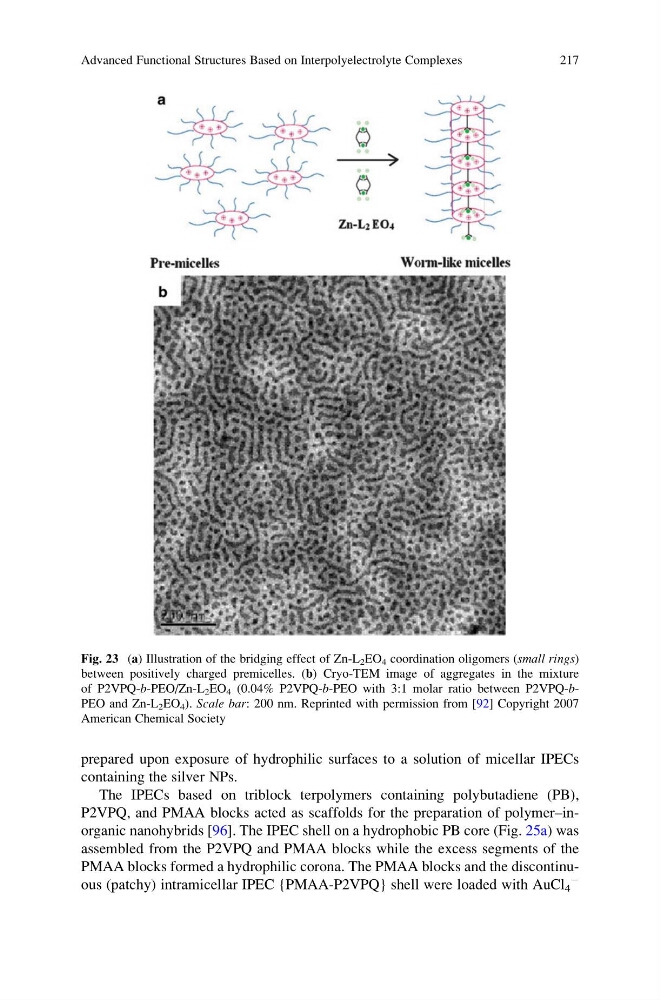
Fig. 23 (a) Illustration of the bridging effect of Zn-L 2 EO 4 coordination oligomers (small rings)
between positively charged premicelles. (b) Cryo-TEM image of aggregates in the mixture
of P2VPQ-b-PEO/Zn-L 2 EO 4 (0.04% P2VPQ-b-PEO with 3:1 molar ratio between P2VPQ-bPEO and Zn-L 2 EO 4 ). Scale bar: 200 nm. Reprinted with permission from [92] Copyright 2007
American Chemical Society
Advanced Functional Structures Based on Interpolyelectrolyte Complexes
217
containing the silver NPs.
The IPECs based on triblock terpolymers containing polybutadiene (PB),
P2VPQ, and PMAA blocks acted as scaffolds for the preparation of polymer–inorganic nanohybrids [96]. The IPEC shell on a hydrophobic PB core (Fig. 25a) was
assembled from the P2VPQ and PMAA blocks while the excess segments of the
PMAA blocks formed a hydrophilic corona. The PMAA blocks and the discontinuous (patchy) intramicellar IPEC {PMAA-P2VPQ} shell were loaded with AuCl 4
À
Fig. 23 (a) Illustration of the bridging effect of Zn-L 2 EO 4 coordination oligomers (small rings)
between positively charged premicelles. (b) Cryo-TEM image of aggregates in the mixture
of P2VPQ-b-PEO/Zn-L 2 EO 4 (0.04% P2VPQ-b-PEO with 3:1 molar ratio between P2VPQ-bPEO and Zn-L 2 EO 4 ). Scale bar: 200 nm. Reprinted with permission from [92] Copyright 2007
American Chemical Society
Advanced Functional Structures Based on Interpolyelectrolyte Complexes
217