

containing two oppositely charged protein molecules and therefore a heterogeneous
cell model has to be used. In this model, a mixture of colloidal spheres with fixed
charged and volume in an aqueous environment containing small ions is considered. For the salt ions, a fixed chemical potential is assumed [82] (as if the system is
in equilibrium with a large solution via a permeable membrane through which small
ions and solvents can diffuse).
The non-electrochemical contributions are approximated using a Carnahan–Starling
[87]–van der Waals equation of state. Figure 18 shows the phase diagram in the
ionic strength versus protein concentration plane, at 1:1 mixing ratio and for various
temperatures. To model the experimental results the only parameter that is not fixed
is w. This parameter is used to model the non-electrostatic contributions. It can be
seen in Fig. 18 that w is temperature-dependent, which is expected because the
precipitates dissolved when the temperature was increased.
By changing the pH, the number of charges on the protein molecules will be
altered and asymmetric mixtures of lysozyme and succinylated lysozyme are
obtained. These mixtures were also studied both experimentally and theoretically
[88]. The heterogeneous cell model was further extended to include the ionisation
of the protein molecules. In the model, the protein charge is not only considered a
function of the pH and ionic strength, but also of the density and composition of the
dilute and dense phases.
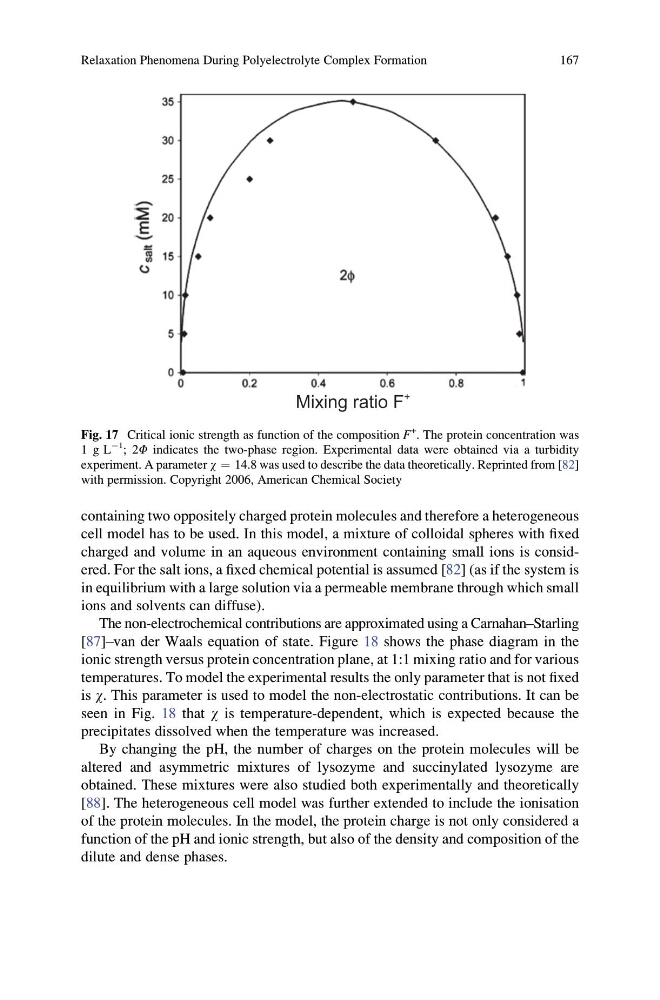
Fig. 17 Critical ionic strength as function of the composition F
+ . The protein concentration was
1 g L
À1
; 2F indicates the two-phase region. Experimental data were obtained via a turbidity
experiment. A parameter w ¼ 14.8 was used to describe the data theoretically. Reprinted from [82]
with permission. Copyright 2006, American Chemical Society
Relaxation Phenomena During Polyelectrolyte Complex Formation
167
cell model has to be used. In this model, a mixture of colloidal spheres with fixed
charged and volume in an aqueous environment containing small ions is considered. For the salt ions, a fixed chemical potential is assumed [82] (as if the system is
in equilibrium with a large solution via a permeable membrane through which small
ions and solvents can diffuse).
The non-electrochemical contributions are approximated using a Carnahan–Starling
[87]–van der Waals equation of state. Figure 18 shows the phase diagram in the
ionic strength versus protein concentration plane, at 1:1 mixing ratio and for various
temperatures. To model the experimental results the only parameter that is not fixed
is w. This parameter is used to model the non-electrostatic contributions. It can be
seen in Fig. 18 that w is temperature-dependent, which is expected because the
precipitates dissolved when the temperature was increased.
By changing the pH, the number of charges on the protein molecules will be
altered and asymmetric mixtures of lysozyme and succinylated lysozyme are
obtained. These mixtures were also studied both experimentally and theoretically
[88]. The heterogeneous cell model was further extended to include the ionisation
of the protein molecules. In the model, the protein charge is not only considered a
function of the pH and ionic strength, but also of the density and composition of the
dilute and dense phases.
Fig. 17 Critical ionic strength as function of the composition F
+ . The protein concentration was
1 g L
À1
; 2F indicates the two-phase region. Experimental data were obtained via a turbidity
experiment. A parameter w ¼ 14.8 was used to describe the data theoretically. Reprinted from [82]
with permission. Copyright 2006, American Chemical Society
Relaxation Phenomena During Polyelectrolyte Complex Formation
167