

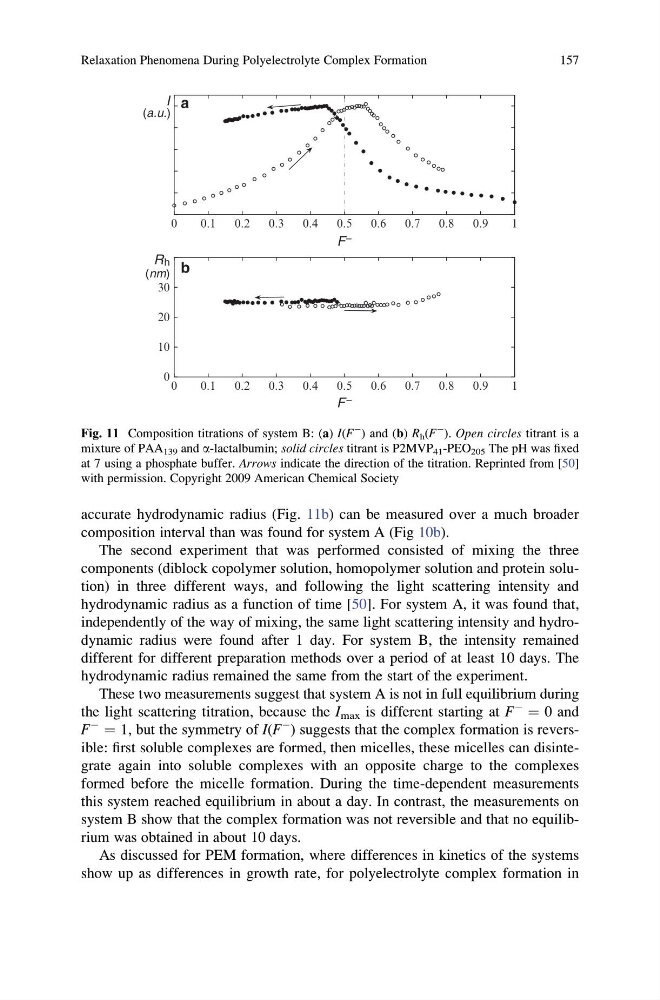
accurate hydrodynamic radius (Fig. 11b) can be measured over a much broader
composition interval than was found for system A (Fig 10b).
The second experiment that was performed consisted of mixing the three
components (diblock copolymer solution, homopolymer solution and protein solution) in three different ways, and following the light scattering intensity and
hydrodynamic radius as a function of time [50]. For system A, it was found that,
independently of the way of mixing, the same light scattering intensity and hydrodynamic radius were found after 1 day. For system B, the intensity remained
different for different preparation methods over a period of at least 10 days. The
hydrodynamic radius remained the same from the start of the experiment.
These two measurements suggest that system A is not in full equilibrium during
the light scattering titration, because the I max is different starting at F
À
¼ 0 and
F
À
¼ 1, but the symmetry of I(F
À ) suggests that the complex formation is reversible: first soluble complexes are formed, then micelles, these micelles can disintegrate again into soluble complexes with an opposite charge to the complexes
formed before the micelle formation. During the time-dependent measurements
this system reached equilibrium in about a day. In contrast, the measurements on
system B show that the complex formation was not reversible and that no equilibrium was obtained in about 10 days.
As discussed for PEM formation, where differences in kinetics of the systems
show up as differences in growth rate, for polyelectrolyte complex formation in
0
0.1
0.2
0.3
0.4
0.5
0.6
0.7
0.8
0.9
1
0
10
20
30
F −
0
0.1
0.2
0.3
0.4
0.5
0.6
0.7
0.8
0.9
1
F −
a
b
I
R h
(a.u.)
(nm)
Fig. 11 Composition titrations of system B: (a) I(F
À ) and (b) R h (F
À
). Open circles titrant is a
mixture of PAA 139 and a-lactalbumin; solid circles titrant is P2MVP 41 -PEO 205 The pH was fixed
at 7 using a phosphate buffer. Arrows indicate the direction of the titration. Reprinted from [50]
with permission. Copyright 2009 American Chemical Society
Relaxation Phenomena During Polyelectrolyte Complex Formation
157
composition interval than was found for system A (Fig 10b).
The second experiment that was performed consisted of mixing the three
components (diblock copolymer solution, homopolymer solution and protein solution) in three different ways, and following the light scattering intensity and
hydrodynamic radius as a function of time [50]. For system A, it was found that,
independently of the way of mixing, the same light scattering intensity and hydrodynamic radius were found after 1 day. For system B, the intensity remained
different for different preparation methods over a period of at least 10 days. The
hydrodynamic radius remained the same from the start of the experiment.
These two measurements suggest that system A is not in full equilibrium during
the light scattering titration, because the I max is different starting at F
À
¼ 0 and
F
À
¼ 1, but the symmetry of I(F
À ) suggests that the complex formation is reversible: first soluble complexes are formed, then micelles, these micelles can disintegrate again into soluble complexes with an opposite charge to the complexes
formed before the micelle formation. During the time-dependent measurements
this system reached equilibrium in about a day. In contrast, the measurements on
system B show that the complex formation was not reversible and that no equilibrium was obtained in about 10 days.
As discussed for PEM formation, where differences in kinetics of the systems
show up as differences in growth rate, for polyelectrolyte complex formation in
0
0.1
0.2
0.3
0.4
0.5
0.6
0.7
0.8
0.9
1
0
10
20
30
F −
0
0.1
0.2
0.3
0.4
0.5
0.6
0.7
0.8
0.9
1
F −
a
b
I
R h
(a.u.)
(nm)
Fig. 11 Composition titrations of system B: (a) I(F
À ) and (b) R h (F
À
). Open circles titrant is a
mixture of PAA 139 and a-lactalbumin; solid circles titrant is P2MVP 41 -PEO 205 The pH was fixed
at 7 using a phosphate buffer. Arrows indicate the direction of the titration. Reprinted from [50]
with permission. Copyright 2009 American Chemical Society
Relaxation Phenomena During Polyelectrolyte Complex Formation
157