

molecular weight polymers is restricted to the upper part of the film, whereas
polymers with lower molecular weights can diffuse into and through the entire
film [41].
1.3 Influence of Ionic Strength on the Kinetics
of Polyelectrolyte Complex Formation
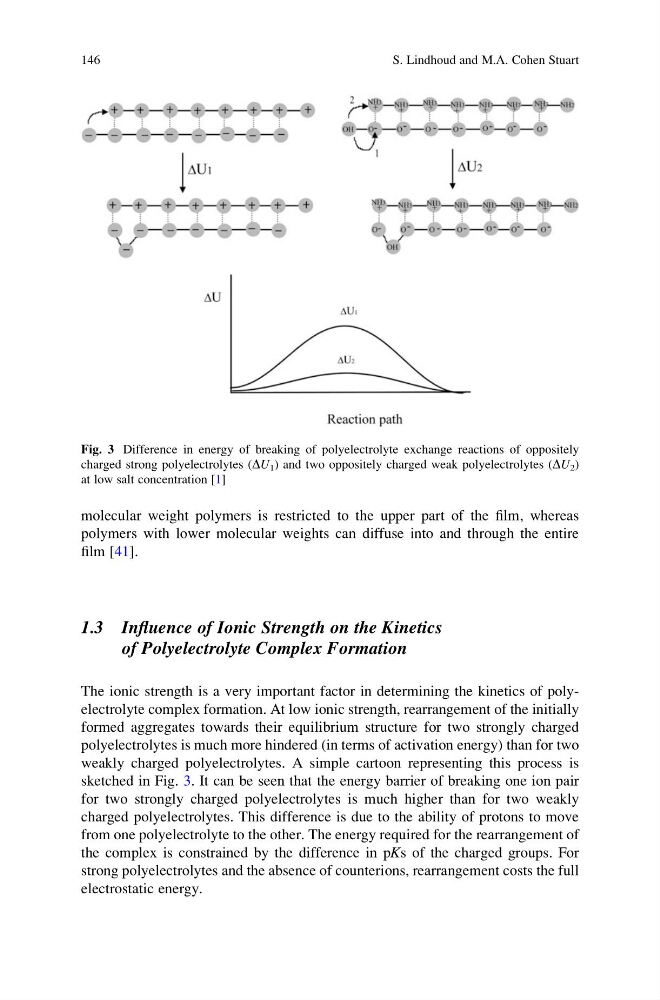
The ionic strength is a very important factor in determining the kinetics of polyelectrolyte complex formation. At low ionic strength, rearrangement of the initially
formed aggregates towards their equilibrium structure for two strongly charged
polyelectrolytes is much more hindered (in terms of activation energy) than for two
weakly charged polyelectrolytes. A simple cartoon representing this process is
sketched in Fig. 3. It can be seen that the energy barrier of breaking one ion pair
for two strongly charged polyelectrolytes is much higher than for two weakly
charged polyelectrolytes. This difference is due to the ability of protons to move
from one polyelectrolyte to the other. The energy required for the rearrangement of
the complex is constrained by the difference in pKs of the charged groups. For
strong polyelectrolytes and the absence of counterions, rearrangement costs the full
electrostatic energy.
Fig. 3 Difference in energy of breaking of polyelectrolyte exchange reactions of oppositely
charged strong polyelectrolytes (DU 1 ) and two oppositely charged weak polyelectrolytes (DU 2 )
at low salt concentration [1]
146
S. Lindhoud and M.A. Cohen Stuart
polymers with lower molecular weights can diffuse into and through the entire
film [41].
1.3 Influence of Ionic Strength on the Kinetics
of Polyelectrolyte Complex Formation
The ionic strength is a very important factor in determining the kinetics of polyelectrolyte complex formation. At low ionic strength, rearrangement of the initially
formed aggregates towards their equilibrium structure for two strongly charged
polyelectrolytes is much more hindered (in terms of activation energy) than for two
weakly charged polyelectrolytes. A simple cartoon representing this process is
sketched in Fig. 3. It can be seen that the energy barrier of breaking one ion pair
for two strongly charged polyelectrolytes is much higher than for two weakly
charged polyelectrolytes. This difference is due to the ability of protons to move
from one polyelectrolyte to the other. The energy required for the rearrangement of
the complex is constrained by the difference in pKs of the charged groups. For
strong polyelectrolytes and the absence of counterions, rearrangement costs the full
electrostatic energy.
Fig. 3 Difference in energy of breaking of polyelectrolyte exchange reactions of oppositely
charged strong polyelectrolytes (DU 1 ) and two oppositely charged weak polyelectrolytes (DU 2 )
at low salt concentration [1]
146
S. Lindhoud and M.A. Cohen Stuart