

complexes were also found by Michaels [21]. It was found that the composition of
the colloidal precipitate was independent of the relative proportions in which the
polyelectrolytes were mixed, and independent of the order of addition. The same
phenomenon is found in multilayers consisting of two strongly charged polyelectrolytes. Within the multilayers stoichiometry is obeyed; only the surface bears a
considerable excess charge and the charges on the polymers balance each other
without the requirement for additional counterions [22].
A certain minimum charge density is needed for PEM formation to occur. Four
different regimes can be identified when one fully charged polyelectrolyte is used
and the charge density of the oppositely charged polyelectrolyte is varied
[2, 23–25]. First, when the charge density is very low, no PEMs will form. The
second regime is where interactions other than electrostatic interactions (such as
hydrogen bonding, hydrophobic interactions and van der Waals interactions) cause
the formation of PEMs; typically these “PEMs” are thin. The ionic strength does not
influence the formation of these multilayers, nor its thickness or surface roughness
[25, 26]. The third regime is roughly found between a charge density of 50% and
75%. In this regime, thicker PEMs are found because the uncharged patches of the
polyelectrolytes require more space. Fourth, above a charge density of roughly
75%, thinner multilayers are formed. In this regime, the polyelectrolytes adsorb in a
flat conformation, because repulsion between the charged groups on the polymer
leads to stretching of the polymer backbone [2, 23, 24]. Also, linear growth of
PEMs is observed.
For PEM formation, two growth regimes are found: exponential [27–29] and
linear growth. Linear growth is typically observed when two strongly charged
polyelectrolytes are used and for two weakly charged polyelectrolytes at a pH in
between their pKs and at low ionic strength [30, 31]. During linear PEM growth, the
thickness increment is constant for each polyelectrolyte addition.
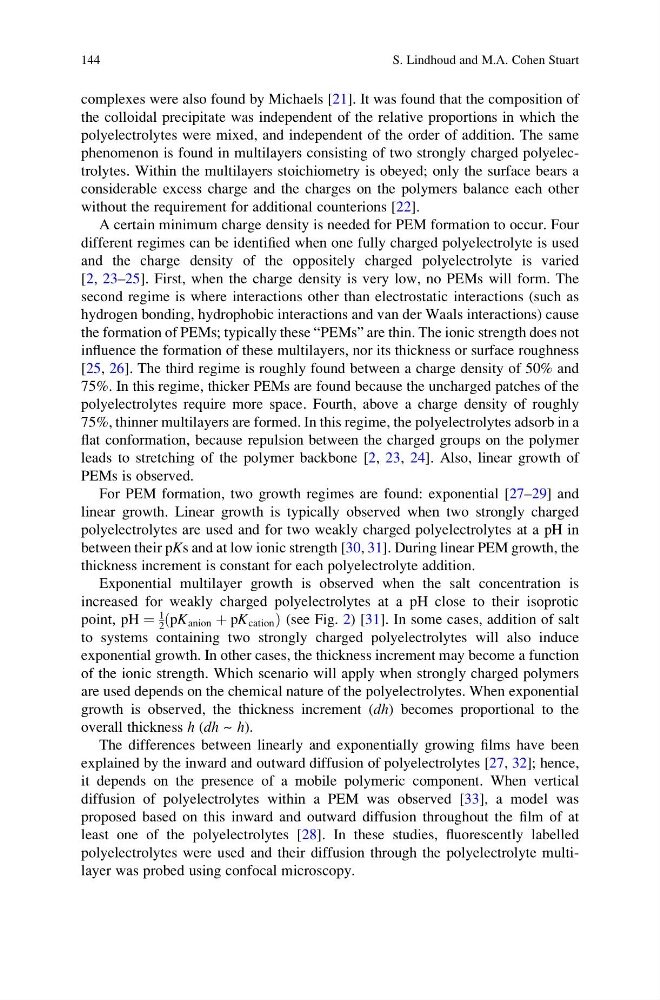
Exponential multilayer growth is observed when the salt concentration is
increased for weakly charged polyelectrolytes at a pH close to their isoprotic
point, pH ¼
1
2 ðpK anion þ pK cation Þ (see Fig. 2) [31]. In some cases, addition of salt
to systems containing two strongly charged polyelectrolytes will also induce
exponential growth. In other cases, the thickness increment may become a function
of the ionic strength. Which scenario will apply when strongly charged polymers
are used depends on the chemical nature of the polyelectrolytes. When exponential
growth is observed, the thickness increment (dh) becomes proportional to the
overall thickness h (dh ~ h).
The differences between linearly and exponentially growing films have been
explained by the inward and outward diffusion of polyelectrolytes [27, 32]; hence,
it depends on the presence of a mobile polymeric component. When vertical
diffusion of polyelectrolytes within a PEM was observed [33], a model was
proposed based on this inward and outward diffusion throughout the film of at
least one of the polyelectrolytes [28]. In these studies, fluorescently labelled
polyelectrolytes were used and their diffusion through the polyelectrolyte multilayer was probed using confocal microscopy.
144
S. Lindhoud and M.A. Cohen Stuart
the colloidal precipitate was independent of the relative proportions in which the
polyelectrolytes were mixed, and independent of the order of addition. The same
phenomenon is found in multilayers consisting of two strongly charged polyelectrolytes. Within the multilayers stoichiometry is obeyed; only the surface bears a
considerable excess charge and the charges on the polymers balance each other
without the requirement for additional counterions [22].
A certain minimum charge density is needed for PEM formation to occur. Four
different regimes can be identified when one fully charged polyelectrolyte is used
and the charge density of the oppositely charged polyelectrolyte is varied
[2, 23–25]. First, when the charge density is very low, no PEMs will form. The
second regime is where interactions other than electrostatic interactions (such as
hydrogen bonding, hydrophobic interactions and van der Waals interactions) cause
the formation of PEMs; typically these “PEMs” are thin. The ionic strength does not
influence the formation of these multilayers, nor its thickness or surface roughness
[25, 26]. The third regime is roughly found between a charge density of 50% and
75%. In this regime, thicker PEMs are found because the uncharged patches of the
polyelectrolytes require more space. Fourth, above a charge density of roughly
75%, thinner multilayers are formed. In this regime, the polyelectrolytes adsorb in a
flat conformation, because repulsion between the charged groups on the polymer
leads to stretching of the polymer backbone [2, 23, 24]. Also, linear growth of
PEMs is observed.
For PEM formation, two growth regimes are found: exponential [27–29] and
linear growth. Linear growth is typically observed when two strongly charged
polyelectrolytes are used and for two weakly charged polyelectrolytes at a pH in
between their pKs and at low ionic strength [30, 31]. During linear PEM growth, the
thickness increment is constant for each polyelectrolyte addition.
Exponential multilayer growth is observed when the salt concentration is
increased for weakly charged polyelectrolytes at a pH close to their isoprotic
point, pH ¼
1
2 ðpK anion þ pK cation Þ (see Fig. 2) [31]. In some cases, addition of salt
to systems containing two strongly charged polyelectrolytes will also induce
exponential growth. In other cases, the thickness increment may become a function
of the ionic strength. Which scenario will apply when strongly charged polymers
are used depends on the chemical nature of the polyelectrolytes. When exponential
growth is observed, the thickness increment (dh) becomes proportional to the
overall thickness h (dh ~ h).
The differences between linearly and exponentially growing films have been
explained by the inward and outward diffusion of polyelectrolytes [27, 32]; hence,
it depends on the presence of a mobile polymeric component. When vertical
diffusion of polyelectrolytes within a PEM was observed [33], a model was
proposed based on this inward and outward diffusion throughout the film of at
least one of the polyelectrolytes [28]. In these studies, fluorescently labelled
polyelectrolytes were used and their diffusion through the polyelectrolyte multilayer was probed using confocal microscopy.
144
S. Lindhoud and M.A. Cohen Stuart