

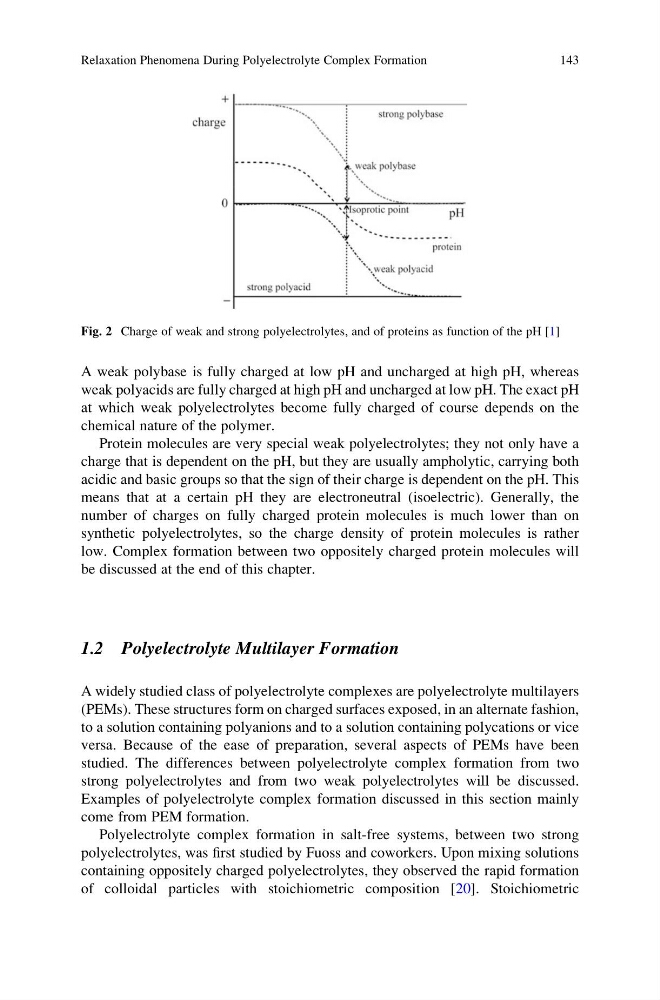
A weak polybase is fully charged at low pH and uncharged at high pH, whereas
weak polyacids are fully charged at high pH and uncharged at low pH. The exact pH
at which weak polyelectrolytes become fully charged of course depends on the
chemical nature of the polymer.
Protein molecules are very special weak polyelectrolytes; they not only have a
charge that is dependent on the pH, but they are usually ampholytic, carrying both
acidic and basic groups so that the sign of their charge is dependent on the pH. This
means that at a certain pH they are electroneutral (isoelectric). Generally, the
number of charges on fully charged protein molecules is much lower than on
synthetic polyelectrolytes, so the charge density of protein molecules is rather
low. Complex formation between two oppositely charged protein molecules will
be discussed at the end of this chapter.
1.2 Polyelectrolyte Multilayer Formation
A widely studied class of polyelectrolyte complexes are polyelectrolyte multilayers
(PEMs). These structures form on charged surfaces exposed, in an alternate fashion,
to a solution containing polyanions and to a solution containing polycations or vice
versa. Because of the ease of preparation, several aspects of PEMs have been
studied. The differences between polyelectrolyte complex formation from two
strong polyelectrolytes and from two weak polyelectrolytes will be discussed.
Examples of polyelectrolyte complex formation discussed in this section mainly
come from PEM formation.
Polyelectrolyte complex formation in salt-free systems, between two strong
polyelectrolytes, was first studied by Fuoss and coworkers. Upon mixing solutions
containing oppositely charged polyelectrolytes, they observed the rapid formation
of colloidal particles with stoichiometric composition [20]. Stoichiometric
Fig. 2 Charge of weak and strong polyelectrolytes, and of proteins as function of the pH [1]
Relaxation Phenomena During Polyelectrolyte Complex Formation
143
weak polyacids are fully charged at high pH and uncharged at low pH. The exact pH
at which weak polyelectrolytes become fully charged of course depends on the
chemical nature of the polymer.
Protein molecules are very special weak polyelectrolytes; they not only have a
charge that is dependent on the pH, but they are usually ampholytic, carrying both
acidic and basic groups so that the sign of their charge is dependent on the pH. This
means that at a certain pH they are electroneutral (isoelectric). Generally, the
number of charges on fully charged protein molecules is much lower than on
synthetic polyelectrolytes, so the charge density of protein molecules is rather
low. Complex formation between two oppositely charged protein molecules will
be discussed at the end of this chapter.
1.2 Polyelectrolyte Multilayer Formation
A widely studied class of polyelectrolyte complexes are polyelectrolyte multilayers
(PEMs). These structures form on charged surfaces exposed, in an alternate fashion,
to a solution containing polyanions and to a solution containing polycations or vice
versa. Because of the ease of preparation, several aspects of PEMs have been
studied. The differences between polyelectrolyte complex formation from two
strong polyelectrolytes and from two weak polyelectrolytes will be discussed.
Examples of polyelectrolyte complex formation discussed in this section mainly
come from PEM formation.
Polyelectrolyte complex formation in salt-free systems, between two strong
polyelectrolytes, was first studied by Fuoss and coworkers. Upon mixing solutions
containing oppositely charged polyelectrolytes, they observed the rapid formation
of colloidal particles with stoichiometric composition [20]. Stoichiometric
Fig. 2 Charge of weak and strong polyelectrolytes, and of proteins as function of the pH [1]
Relaxation Phenomena During Polyelectrolyte Complex Formation
143