

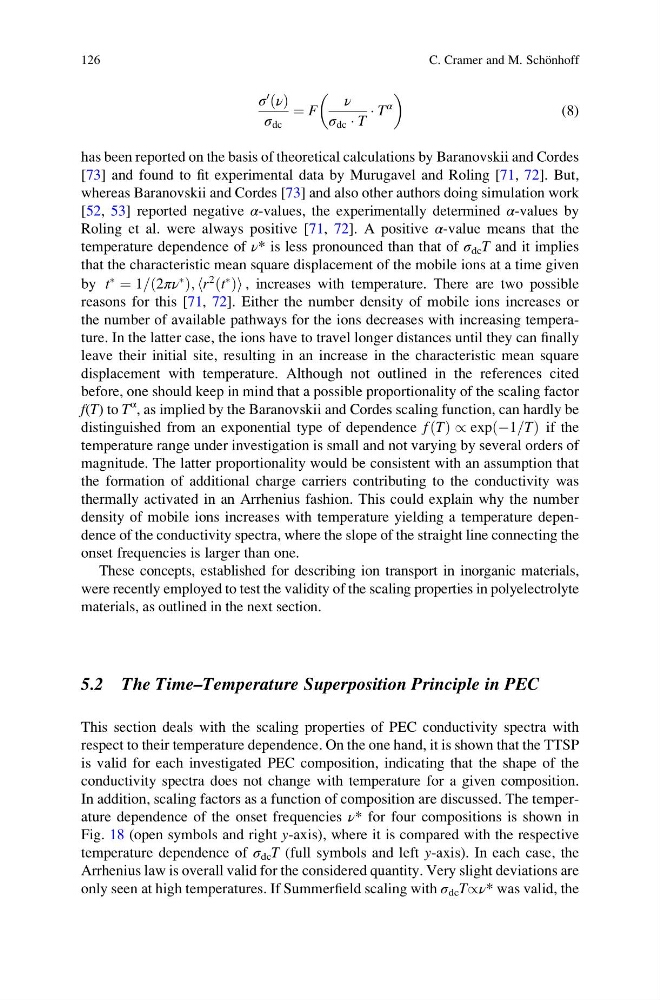
σ
0
ðνÞ
σ dc
¼ F
ν
σ dc Á T
Á T
α
(8)
has been reported on the basis of theoretical calculations by Baranovskii and Cordes
[73] and found to fit experimental data by Murugavel and Roling [71, 72]. But,
whereas Baranovskii and Cordes [73] and also other authors doing simulation work
[52, 53] reported negative α-values, the experimentally determined α-values by
Roling et al. were always positive [71, 72]. A positive α-value means that the
temperature dependence of ν* is less pronounced than that of σ dc T and it implies
that the characteristic mean square displacement of the mobile ions at a time given
by t
Ã
¼ 1=ð2πν
Ã
Þ; hr
2 t
Ã
ð Þi , increases with temperature. There are two possible
reasons for this [71, 72]. Either the number density of mobile ions increases or
the number of available pathways for the ions decreases with increasing temperature. In the latter case, the ions have to travel longer distances until they can finally
leave their initial site, resulting in an increase in the characteristic mean square
displacement with temperature. Although not outlined in the references cited
before, one should keep in mind that a possible proportionality of the scaling factor
f(T) to T
α
, as implied by the Baranovskii and Cordes scaling function, can hardly be
distinguished from an exponential type of dependence f ðTÞ / expðÀ1=TÞ if the
temperature range under investigation is small and not varying by several orders of
magnitude. The latter proportionality would be consistent with an assumption that
the formation of additional charge carriers contributing to the conductivity was
thermally activated in an Arrhenius fashion. This could explain why the number
density of mobile ions increases with temperature yielding a temperature dependence of the conductivity spectra, where the slope of the straight line connecting the
onset frequencies is larger than one.
These concepts, established for describing ion transport in inorganic materials,
were recently employed to test the validity of the scaling properties in polyelectrolyte
materials, as outlined in the next section.
5.2 The Time–Temperature Superposition Principle in PEC
This section deals with the scaling properties of PEC conductivity spectra with
respect to their temperature dependence. On the one hand, it is shown that the TTSP
is valid for each investigated PEC composition, indicating that the shape of the
conductivity spectra does not change with temperature for a given composition.
In addition, scaling factors as a function of composition are discussed. The temperature dependence of the onset frequencies ν* for four compositions is shown in
Fig. 18 (open symbols and right y-axis), where it is compared with the respective
temperature dependence of σ dc T (full symbols and left y-axis). In each case, the
Arrhenius law is overall valid for the considered quantity. Very slight deviations are
only seen at high temperatures. If Summerfield scaling with σ dc T/ν* was valid, the
126
C. Cramer and M. Scho ¨nhoff
0
ðνÞ
σ dc
¼ F
ν
σ dc Á T
Á T
α
(8)
has been reported on the basis of theoretical calculations by Baranovskii and Cordes
[73] and found to fit experimental data by Murugavel and Roling [71, 72]. But,
whereas Baranovskii and Cordes [73] and also other authors doing simulation work
[52, 53] reported negative α-values, the experimentally determined α-values by
Roling et al. were always positive [71, 72]. A positive α-value means that the
temperature dependence of ν* is less pronounced than that of σ dc T and it implies
that the characteristic mean square displacement of the mobile ions at a time given
by t
Ã
¼ 1=ð2πν
Ã
Þ; hr
2 t
Ã
ð Þi , increases with temperature. There are two possible
reasons for this [71, 72]. Either the number density of mobile ions increases or
the number of available pathways for the ions decreases with increasing temperature. In the latter case, the ions have to travel longer distances until they can finally
leave their initial site, resulting in an increase in the characteristic mean square
displacement with temperature. Although not outlined in the references cited
before, one should keep in mind that a possible proportionality of the scaling factor
f(T) to T
α
, as implied by the Baranovskii and Cordes scaling function, can hardly be
distinguished from an exponential type of dependence f ðTÞ / expðÀ1=TÞ if the
temperature range under investigation is small and not varying by several orders of
magnitude. The latter proportionality would be consistent with an assumption that
the formation of additional charge carriers contributing to the conductivity was
thermally activated in an Arrhenius fashion. This could explain why the number
density of mobile ions increases with temperature yielding a temperature dependence of the conductivity spectra, where the slope of the straight line connecting the
onset frequencies is larger than one.
These concepts, established for describing ion transport in inorganic materials,
were recently employed to test the validity of the scaling properties in polyelectrolyte
materials, as outlined in the next section.
5.2 The Time–Temperature Superposition Principle in PEC
This section deals with the scaling properties of PEC conductivity spectra with
respect to their temperature dependence. On the one hand, it is shown that the TTSP
is valid for each investigated PEC composition, indicating that the shape of the
conductivity spectra does not change with temperature for a given composition.
In addition, scaling factors as a function of composition are discussed. The temperature dependence of the onset frequencies ν* for four compositions is shown in
Fig. 18 (open symbols and right y-axis), where it is compared with the respective
temperature dependence of σ dc T (full symbols and left y-axis). In each case, the
Arrhenius law is overall valid for the considered quantity. Very slight deviations are
only seen at high temperatures. If Summerfield scaling with σ dc T/ν* was valid, the
126
C. Cramer and M. Scho ¨nhoff