

compensated and would not contain any kind of conducting species in the matrix.
Therefore, such PEC should not be ion-conducting at all. However, it is evident
from the experimental data that PEC of composition 0.5 PSS (Li, Na and Cs) · 0.5
PDADMAC are not perfectly intrinsically compensated, but still have a small
amount of mobile ions. In such PEC, which consist of strongly crosslinked polyions
and are diluted with respect to small ions, the nature of the alkali PSS (LiPSS,
NaPSS and CsPSS) does not seem to play a significant role as far as the activation
enthalpy is concerned.
Turning now to non-stoichiometric complexes with a large charge carrier
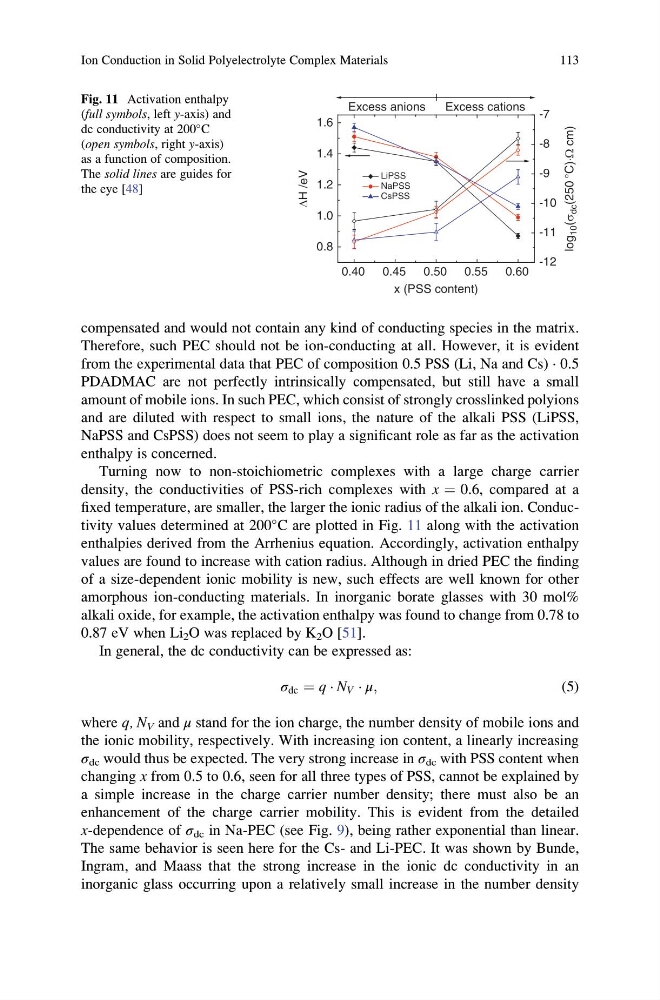
density, the conductivities of PSS-rich complexes with x ¼ 0.6, compared at a
fixed temperature, are smaller, the larger the ionic radius of the alkali ion. Conductivity values determined at 200
C are plotted in Fig. 11 along with the activation
enthalpies derived from the Arrhenius equation. Accordingly, activation enthalpy
values are found to increase with cation radius. Although in dried PEC the finding
of a size-dependent ionic mobility is new, such effects are well known for other
amorphous ion-conducting materials. In inorganic borate glasses with 30 mol%
alkali oxide, for example, the activation enthalpy was found to change from 0.78 to
0.87 eV when Li 2 O was replaced by K 2 O [51].
In general, the dc conductivity can be expressed as:
σ dc ¼ q Á N V Á μ;
(5)
where q, N V and μ stand for the ion charge, the number density of mobile ions and
the ionic mobility, respectively. With increasing ion content, a linearly increasing
σ dc would thus be expected. The very strong increase in σ dc with PSS content when
changing x from 0.5 to 0.6, seen for all three types of PSS, cannot be explained by
a simple increase in the charge carrier number density; there must also be an
enhancement of the charge carrier mobility. This is evident from the detailed
x-dependence of σ dc in Na-PEC (see Fig. 9), being rather exponential than linear.
The same behavior is seen here for the Cs- and Li-PEC. It was shown by Bunde,
Ingram, and Maass that the strong increase in the ionic dc conductivity in an
inorganic glass occurring upon a relatively small increase in the number density
0.40 0.45 0.50 0.55 0.60
0.8
1.0
1.2
1.4
1.6
-12
-11
-10
-9
-8
-7
Excess anions
log
10 (σ
dc (250 °C)⋅Ω cm)
x (PSS content)
LiPSS
NaPSS
CsPSS
Excess cations
ΔH /eV
Fig. 11 Activation enthalpy
(full symbols, left y-axis) and
dc conductivity at 200
C
(open symbols, right y-axis)
as a function of composition.
The solid lines are guides for
the eye [48]
Ion Conduction in Solid Polyelectrolyte Complex Materials
113
Therefore, such PEC should not be ion-conducting at all. However, it is evident
from the experimental data that PEC of composition 0.5 PSS (Li, Na and Cs) · 0.5
PDADMAC are not perfectly intrinsically compensated, but still have a small
amount of mobile ions. In such PEC, which consist of strongly crosslinked polyions
and are diluted with respect to small ions, the nature of the alkali PSS (LiPSS,
NaPSS and CsPSS) does not seem to play a significant role as far as the activation
enthalpy is concerned.
Turning now to non-stoichiometric complexes with a large charge carrier
density, the conductivities of PSS-rich complexes with x ¼ 0.6, compared at a
fixed temperature, are smaller, the larger the ionic radius of the alkali ion. Conductivity values determined at 200
C are plotted in Fig. 11 along with the activation
enthalpies derived from the Arrhenius equation. Accordingly, activation enthalpy
values are found to increase with cation radius. Although in dried PEC the finding
of a size-dependent ionic mobility is new, such effects are well known for other
amorphous ion-conducting materials. In inorganic borate glasses with 30 mol%
alkali oxide, for example, the activation enthalpy was found to change from 0.78 to
0.87 eV when Li 2 O was replaced by K 2 O [51].
In general, the dc conductivity can be expressed as:
σ dc ¼ q Á N V Á μ;
(5)
where q, N V and μ stand for the ion charge, the number density of mobile ions and
the ionic mobility, respectively. With increasing ion content, a linearly increasing
σ dc would thus be expected. The very strong increase in σ dc with PSS content when
changing x from 0.5 to 0.6, seen for all three types of PSS, cannot be explained by
a simple increase in the charge carrier number density; there must also be an
enhancement of the charge carrier mobility. This is evident from the detailed
x-dependence of σ dc in Na-PEC (see Fig. 9), being rather exponential than linear.
The same behavior is seen here for the Cs- and Li-PEC. It was shown by Bunde,
Ingram, and Maass that the strong increase in the ionic dc conductivity in an
inorganic glass occurring upon a relatively small increase in the number density
0.40 0.45 0.50 0.55 0.60
0.8
1.0
1.2
1.4
1.6
-12
-11
-10
-9
-8
-7
Excess anions
log
10 (σ
dc (250 °C)⋅Ω cm)
x (PSS content)
LiPSS
NaPSS
CsPSS
Excess cations
ΔH /eV
Fig. 11 Activation enthalpy
(full symbols, left y-axis) and
dc conductivity at 200
C
(open symbols, right y-axis)
as a function of composition.
The solid lines are guides for
the eye [48]
Ion Conduction in Solid Polyelectrolyte Complex Materials
113