

On the one hand, the simple dc conductivity provides information for discussion
of the relevance of the contributions of different ionic species, such as the alkali
cations, anions, or protons to the conductivity. The activation of ionic mobility by
temperature or by increasing RH shows interesting analogies, such that humidity is
considered as an activation parameter.
On the other hand, special focus is put on the shape of conductivity spectra.
Modeling of different contributions to the spectra in the framework of concepts
established in other well-characterized ion conductors sheds more light on the
transport processes in PEC, especially on shorter time scales (see Sect. 3.4).
Furthermore, in recent years general scaling concepts such as the time–temperature
superposition principle (TTSP) have been applied to polyelectrolyte complexes.
Their power in giving a generalized description of ionic transport processes is
tremendous. In particular, a novel time–humidity superposition principle (THSP)
was established (see Sect. 5.3). This review therefore also focuses on the basics and
implications of ion transport models and scaling concepts.
2 Conductivity Spectra: Concepts and Initial Findings
2.1 Basic Concepts of Conductivity Spectroscopy
Conductivity spectroscopy is a unique tool for studying the dynamics of ions in
condensed matter. In many disordered ion-conducting materials, the motion of ions
occurs via hopping processes where ions leave their sites and jump into vacant
neighboring sites. Frequency-dependent conductivities have the advantage of
providing information about ion dynamics on different time scales, the latter
being given by the inverse angular frequency, ω. Therefore, conductivity spectroscopy can be considered as a “microscope in time” [42]. Wide-range conductivity
spectra probe the transition from elementary steps of the ionic movement to
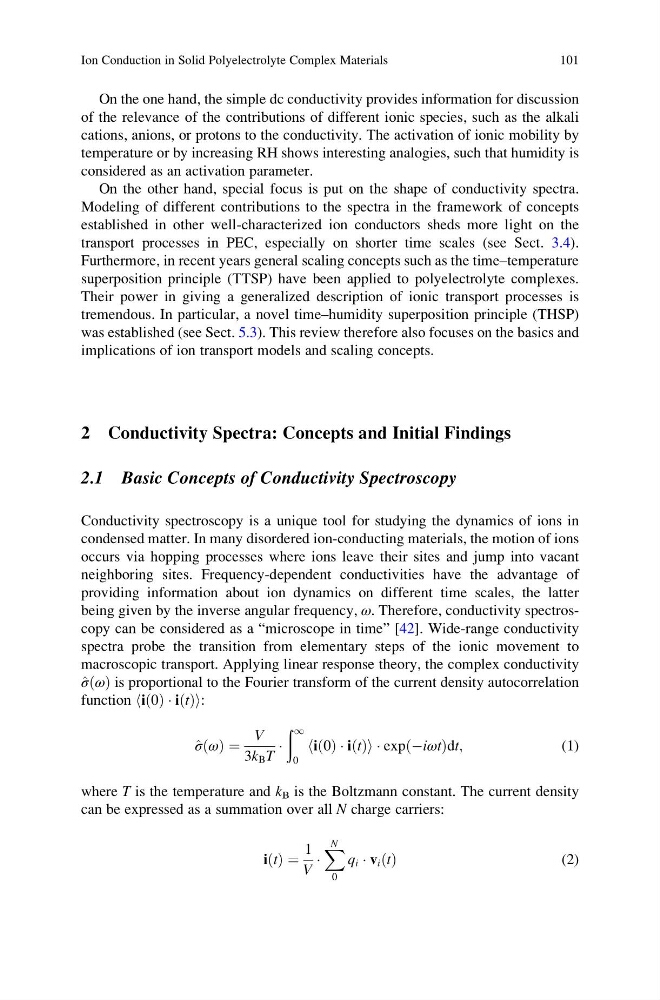
macroscopic transport. Applying linear response theory, the complex conductivity
^
σðωÞ is proportional to the Fourier transform of the current density autocorrelation
function ið0Þ Á iðtÞ
h
i :
^
σðωÞ ¼
V
3k B T
Á
ð 1
0
ið0Þ Á iðtÞ
h
iÁ expðÀiωtÞdt;
(1)
where T is the temperature and k B is the Boltzmann constant. The current density
can be expressed as a summation over all N charge carriers:
iðtÞ ¼
1
V
Á
X N
0
q i Á v i ðtÞ
(2)
Ion Conduction in Solid Polyelectrolyte Complex Materials
101
of the relevance of the contributions of different ionic species, such as the alkali
cations, anions, or protons to the conductivity. The activation of ionic mobility by
temperature or by increasing RH shows interesting analogies, such that humidity is
considered as an activation parameter.
On the other hand, special focus is put on the shape of conductivity spectra.
Modeling of different contributions to the spectra in the framework of concepts
established in other well-characterized ion conductors sheds more light on the
transport processes in PEC, especially on shorter time scales (see Sect. 3.4).
Furthermore, in recent years general scaling concepts such as the time–temperature
superposition principle (TTSP) have been applied to polyelectrolyte complexes.
Their power in giving a generalized description of ionic transport processes is
tremendous. In particular, a novel time–humidity superposition principle (THSP)
was established (see Sect. 5.3). This review therefore also focuses on the basics and
implications of ion transport models and scaling concepts.
2 Conductivity Spectra: Concepts and Initial Findings
2.1 Basic Concepts of Conductivity Spectroscopy
Conductivity spectroscopy is a unique tool for studying the dynamics of ions in
condensed matter. In many disordered ion-conducting materials, the motion of ions
occurs via hopping processes where ions leave their sites and jump into vacant
neighboring sites. Frequency-dependent conductivities have the advantage of
providing information about ion dynamics on different time scales, the latter
being given by the inverse angular frequency, ω. Therefore, conductivity spectroscopy can be considered as a “microscope in time” [42]. Wide-range conductivity
spectra probe the transition from elementary steps of the ionic movement to
macroscopic transport. Applying linear response theory, the complex conductivity
^
σðωÞ is proportional to the Fourier transform of the current density autocorrelation
function ið0Þ Á iðtÞ
h
i :
^
σðωÞ ¼
V
3k B T
Á
ð 1
0
ið0Þ Á iðtÞ
h
iÁ expðÀiωtÞdt;
(1)
where T is the temperature and k B is the Boltzmann constant. The current density
can be expressed as a summation over all N charge carriers:
iðtÞ ¼
1
V
Á
X N
0
q i Á v i ðtÞ
(2)
Ion Conduction in Solid Polyelectrolyte Complex Materials
101