

2.3 Directional Epitaxial Crystallization
One of the first examples of efficient epitaxial orientation of P3HT was obtained
by directional epitaxial crystallization (DEC) in 1,3,5-trichlorobenzene (TCB)
[43–51]. The originality of this orientation method lies in the use of a crystallizable
aromatic solvent, in the present case TCB, which can successively play the role of
solvent for the polymer and, once crystallized, the role of substrate for epitaxy.
After orientation, TCB is readily removed by evaporation in vacuum, leaving large
areas of highly oriented P3HT film. For P3HT with M w ¼ 17 kDa, the use of DEC
produces oriented films with a high in-plane orientation of the chains. The ED
pattern indicates fiber symmetry i.e. only the in-plane direction of the chains is well
defined. However, to be able to prepare large-scale oriented domains, it was
necessary to improve the original growth method [46]. Figure 5a describes and
illustrates the various steps used to prepare P3HT films by the so-called slow-DEC
method. In brief, the method achieves long range in-plane orientation of P3HT
by using an orienting substrate of PTFE to guide the crystallization of TCB.
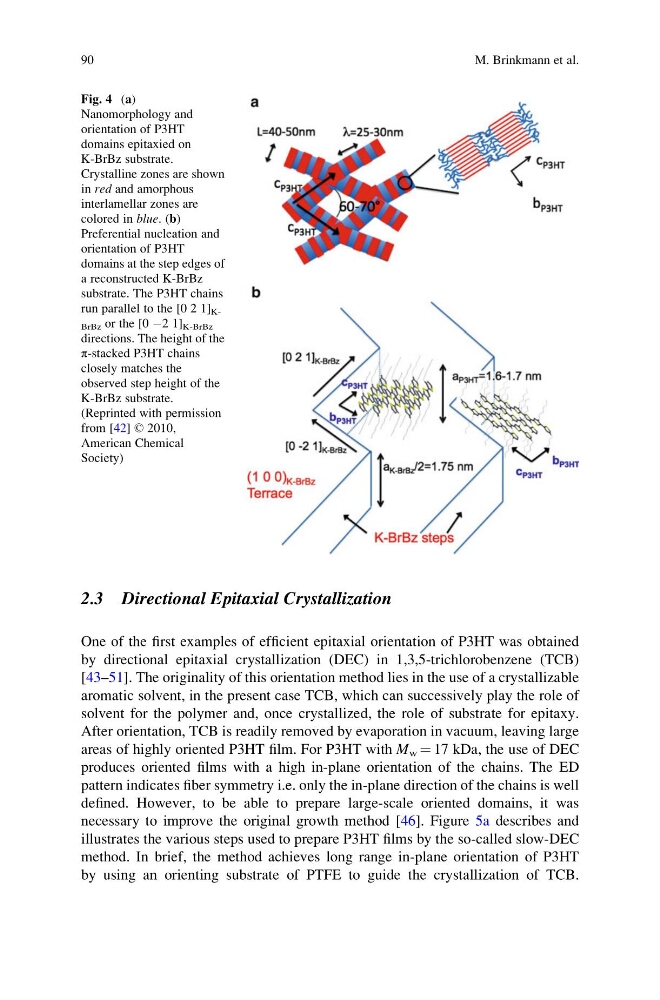
Fig. 4 (a)
Nanomorphology and
orientation of P3HT
domains epitaxied on
K-BrBz substrate.
Crystalline zones are shown
in red and amorphous
interlamellar zones are
colored in blue. (b)
Preferential nucleation and
orientation of P3HT
domains at the step edges of
a reconstructed K-BrBz
substrate. The P3HT chains
run parallel to the [0 2 1] KBrBz or the [0 À2 1] K-BrBz
directions. The height of the
π-stacked P3HT chains
closely matches the
observed step height of the
K-BrBz substrate.
(Reprinted with permission
from [42] © 2010,
American Chemical
Society)
90
M. Brinkmann et al.
One of the first examples of efficient epitaxial orientation of P3HT was obtained
by directional epitaxial crystallization (DEC) in 1,3,5-trichlorobenzene (TCB)
[43–51]. The originality of this orientation method lies in the use of a crystallizable
aromatic solvent, in the present case TCB, which can successively play the role of
solvent for the polymer and, once crystallized, the role of substrate for epitaxy.
After orientation, TCB is readily removed by evaporation in vacuum, leaving large
areas of highly oriented P3HT film. For P3HT with M w ¼ 17 kDa, the use of DEC
produces oriented films with a high in-plane orientation of the chains. The ED
pattern indicates fiber symmetry i.e. only the in-plane direction of the chains is well
defined. However, to be able to prepare large-scale oriented domains, it was
necessary to improve the original growth method [46]. Figure 5a describes and
illustrates the various steps used to prepare P3HT films by the so-called slow-DEC
method. In brief, the method achieves long range in-plane orientation of P3HT
by using an orienting substrate of PTFE to guide the crystallization of TCB.
Fig. 4 (a)
Nanomorphology and
orientation of P3HT
domains epitaxied on
K-BrBz substrate.
Crystalline zones are shown
in red and amorphous
interlamellar zones are
colored in blue. (b)
Preferential nucleation and
orientation of P3HT
domains at the step edges of
a reconstructed K-BrBz
substrate. The P3HT chains
run parallel to the [0 2 1] KBrBz or the [0 À2 1] K-BrBz
directions. The height of the
π-stacked P3HT chains
closely matches the
observed step height of the
K-BrBz substrate.
(Reprinted with permission
from [42] © 2010,
American Chemical
Society)
90
M. Brinkmann et al.