

directions, namely the [0 Æ 2 1] directions of K-BrBz. Preferred orientation of
P3HT crystalline domains occurs at step edges of the substrate (see Fig. 4b) because
of the matching between the layer period of P3HT, a P3HT , and the terrace height of
the K-BrBz substrate, a K-BrBz , at the annealing temperature of 180
C
(a P3HT ¼ 1.75 nm versus a K-BrBz /2 ¼ 1.745 nm) [42].
Accordingly, as illustrated in Fig. 4b, in the absence of a matching between
in-plane unit cell parameters of the substrate and P3HT, it is a matching of unit cell
parameters along the substrate normal that gives rise to this unique type of epitaxial
growth of P3HT on K-BrBz. In addition to K-BrBz, epitaxial orientation of P3HT
was also observed for substrates of potassium acid phthalate (KAP). This type of
substrate was originally used for the alignment of a series of diactylenes by Thierry
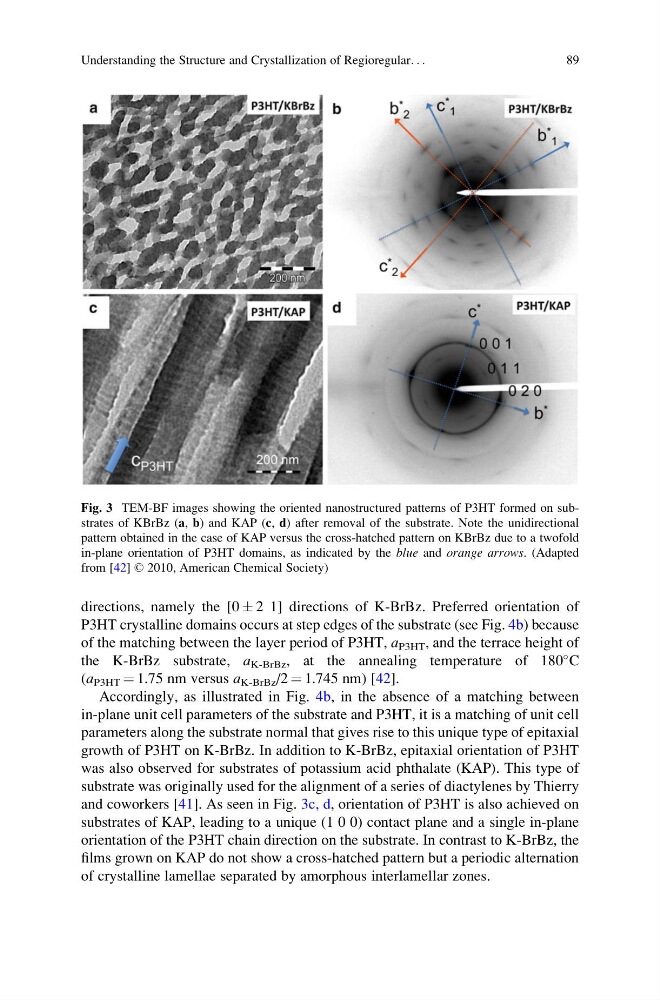
and coworkers [41]. As seen in Fig. 3c, d, orientation of P3HT is also achieved on
substrates of KAP, leading to a unique (1 0 0) contact plane and a single in-plane
orientation of the P3HT chain direction on the substrate. In contrast to K-BrBz, the
films grown on KAP do not show a cross-hatched pattern but a periodic alternation
of crystalline lamellae separated by amorphous interlamellar zones.
Fig. 3 TEM-BF images showing the oriented nanostructured patterns of P3HT formed on substrates of KBrBz (a, b) and KAP (c, d) after removal of the substrate. Note the unidirectional
pattern obtained in the case of KAP versus the cross-hatched pattern on KBrBz due to a twofold
in-plane orientation of P3HT domains, as indicated by the blue and orange arrows. (Adapted
from [42] © 2010, American Chemical Society)
Understanding the Structure and Crystallization of Regioregular. . .
89
P3HT crystalline domains occurs at step edges of the substrate (see Fig. 4b) because
of the matching between the layer period of P3HT, a P3HT , and the terrace height of
the K-BrBz substrate, a K-BrBz , at the annealing temperature of 180
C
(a P3HT ¼ 1.75 nm versus a K-BrBz /2 ¼ 1.745 nm) [42].
Accordingly, as illustrated in Fig. 4b, in the absence of a matching between
in-plane unit cell parameters of the substrate and P3HT, it is a matching of unit cell
parameters along the substrate normal that gives rise to this unique type of epitaxial
growth of P3HT on K-BrBz. In addition to K-BrBz, epitaxial orientation of P3HT
was also observed for substrates of potassium acid phthalate (KAP). This type of
substrate was originally used for the alignment of a series of diactylenes by Thierry
and coworkers [41]. As seen in Fig. 3c, d, orientation of P3HT is also achieved on
substrates of KAP, leading to a unique (1 0 0) contact plane and a single in-plane
orientation of the P3HT chain direction on the substrate. In contrast to K-BrBz, the
films grown on KAP do not show a cross-hatched pattern but a periodic alternation
of crystalline lamellae separated by amorphous interlamellar zones.
Fig. 3 TEM-BF images showing the oriented nanostructured patterns of P3HT formed on substrates of KBrBz (a, b) and KAP (c, d) after removal of the substrate. Note the unidirectional
pattern obtained in the case of KAP versus the cross-hatched pattern on KBrBz due to a twofold
in-plane orientation of P3HT domains, as indicated by the blue and orange arrows. (Adapted
from [42] © 2010, American Chemical Society)
Understanding the Structure and Crystallization of Regioregular. . .
89