

during the imprinting process. On the basis of these results, Hu and coworkers
proposed a more vertical orientation of chains in the case of high nanostructures
with high aspect ratio, whereas the tendency of lying chains (face-on or edge-on) is
stronger in flat nanostructures with a relatively thick residual layer [121]. This
explanation is in agreement with results by McGehee and coworkers, who observed
a clear correlation of structure size and molecular orientation in P3HT pillars of
different diameter that were produced by filling anodic alumina films of different
pore size with P3HT [122].
A development in NIL is the use of solvent vapor instead of temperature to assist
lithography [123–125]. In solvent vapor, the viscosity of the polymer layer is
significantly decreased, allowing the patterning of thermosensitive polymers at
reduced pressures and temperatures. Line patterns of P3HT achieved by solvent
vapor-assisted imprint lithography showed strong birefringence when crystallized
under low nucleation density conditions in a well-defined solvent vapor atmosphere, as can be seen in Fig. 26a, b. The AFM image of a single P3HT line of
around 500 nm in width (Fig. 26c) reveals a lamellar morphology that is indicative
of a predominant edge-on texture, while the lamellae preferentially align parallel to
the channel axis.
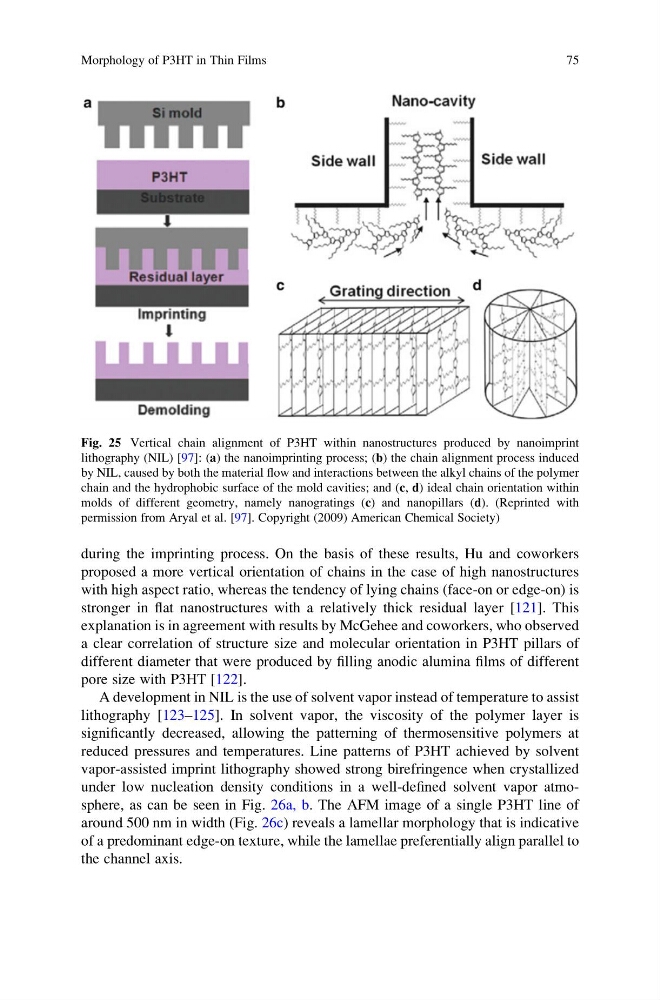
Fig. 25 Vertical chain alignment of P3HT within nanostructures produced by nanoimprint
lithography (NIL) [97]: (a) the nanoimprinting process; (b) the chain alignment process induced
by NIL, caused by both the material flow and interactions between the alkyl chains of the polymer
chain and the hydrophobic surface of the mold cavities; and (c, d) ideal chain orientation within
molds of different geometry, namely nanogratings (c) and nanopillars (d). (Reprinted with
permission from Aryal et al. [97]. Copyright (2009) American Chemical Society)
Morphology of P3HT in Thin Films
75
proposed a more vertical orientation of chains in the case of high nanostructures
with high aspect ratio, whereas the tendency of lying chains (face-on or edge-on) is
stronger in flat nanostructures with a relatively thick residual layer [121]. This
explanation is in agreement with results by McGehee and coworkers, who observed
a clear correlation of structure size and molecular orientation in P3HT pillars of
different diameter that were produced by filling anodic alumina films of different
pore size with P3HT [122].
A development in NIL is the use of solvent vapor instead of temperature to assist
lithography [123–125]. In solvent vapor, the viscosity of the polymer layer is
significantly decreased, allowing the patterning of thermosensitive polymers at
reduced pressures and temperatures. Line patterns of P3HT achieved by solvent
vapor-assisted imprint lithography showed strong birefringence when crystallized
under low nucleation density conditions in a well-defined solvent vapor atmosphere, as can be seen in Fig. 26a, b. The AFM image of a single P3HT line of
around 500 nm in width (Fig. 26c) reveals a lamellar morphology that is indicative
of a predominant edge-on texture, while the lamellae preferentially align parallel to
the channel axis.
Fig. 25 Vertical chain alignment of P3HT within nanostructures produced by nanoimprint
lithography (NIL) [97]: (a) the nanoimprinting process; (b) the chain alignment process induced
by NIL, caused by both the material flow and interactions between the alkyl chains of the polymer
chain and the hydrophobic surface of the mold cavities; and (c, d) ideal chain orientation within
molds of different geometry, namely nanogratings (c) and nanopillars (d). (Reprinted with
permission from Aryal et al. [97]. Copyright (2009) American Chemical Society)
Morphology of P3HT in Thin Films
75