

of polyimide films applied as alignment layers in liquid crystal displays. Brinkmann
and coworkers performed a detailed study on the orientation mechanism of P3HT
by mechanical rubbing using a combination of TEM and polarized absorption
spectroscopy [100]. In rubbed P3HT layers, the polymer backbone orients along
the rubbing direction and the chains undergo a transition from edge-on to face-on,
which was evidenced by electron diffraction (see Fig. 24a). After solution-casting,
the ED pattern consists of a broad ring, which is assigned to the (020) reflection of
the π-stacking (0.38 nm), indicating a preferential edge-on texture within
isotropically oriented, crystalline domains. Rubbing (one or two cycles) of P3HT
results in the appearance of arced (h00) reflections on the equator caused by the
preferred in-plane orientation of the polymer backbone parallel to the rubbing
direction. After four rubbing cycles, the (020) reflection is almost completely
absent, while strongly arced (h00) reflections with h ¼ 1, 2, 3 define the ED pattern.
This observation demonstrates two points: (1) the degree of in-plane alignment of
the polymer backbone parallel to the rubbing increases with increasing number of
rubbing cycles and (2) rubbing causes the chains to undergo a transition from edgeon to face-on. Polarized absorption further confirms the optical anisotropy of
rubbed layers of P3HT, estimated by the dichroic ratio at 550 nm (Fig. 24b). The
degree of in-plane alignment is highly dependent on the molecular weight of the
used sample, with the maximum alignment achieved for low molecular weights
(Fig. 24c). This result is attributed to the presence of entanglements and chain folds
for high molecular weight P3HT that impede chain reorientation and alignment of
the pre-aggregated π-stacks. The effect of high temperature rubbing is currently
being explored by Brinkmann and coworkers. The evolution of structural anisotropy as a function of molecular weight is reflected in a significant charge transport
anisotropy in the a-c-plane, which is greatly increased for short chains of
M w < 10 kg/mol. Thereby, charge transport along the polymer chains is more
than one order of magnitude higher than along the insulating side chains. This
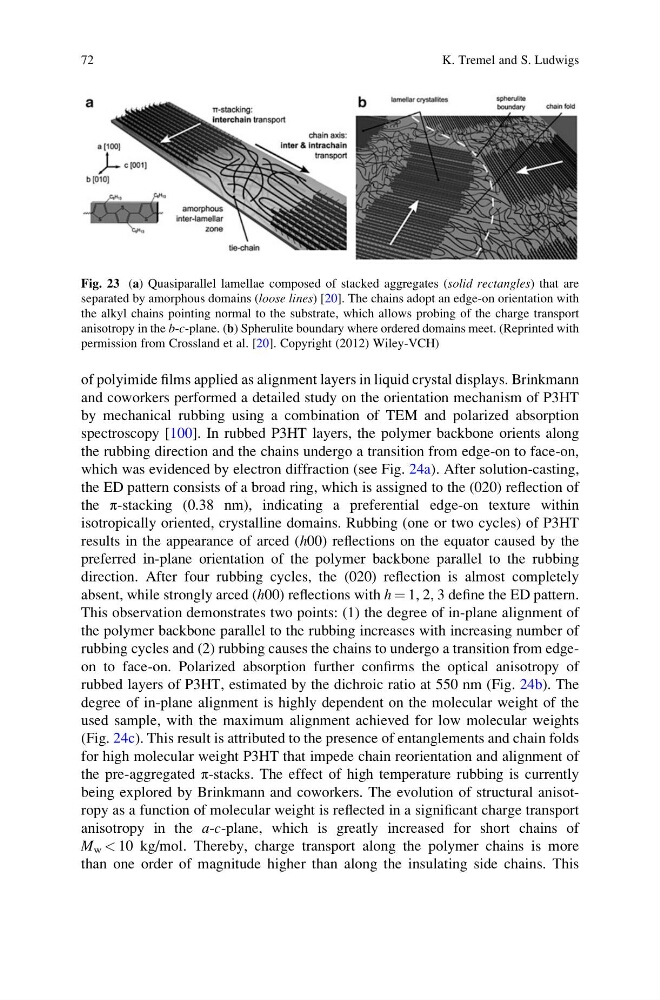
Fig. 23 (a) Quasiparallel lamellae composed of stacked aggregates (solid rectangles) that are
separated by amorphous domains (loose lines) [20]. The chains adopt an edge-on orientation with
the alkyl chains pointing normal to the substrate, which allows probing of the charge transport
anisotropy in the b-c-plane. (b) Spherulite boundary where ordered domains meet. (Reprinted with
permission from Crossland et al. [20]. Copyright (2012) Wiley-VCH)
72
K. Tremel and S. Ludwigs
and coworkers performed a detailed study on the orientation mechanism of P3HT
by mechanical rubbing using a combination of TEM and polarized absorption
spectroscopy [100]. In rubbed P3HT layers, the polymer backbone orients along
the rubbing direction and the chains undergo a transition from edge-on to face-on,
which was evidenced by electron diffraction (see Fig. 24a). After solution-casting,
the ED pattern consists of a broad ring, which is assigned to the (020) reflection of
the π-stacking (0.38 nm), indicating a preferential edge-on texture within
isotropically oriented, crystalline domains. Rubbing (one or two cycles) of P3HT
results in the appearance of arced (h00) reflections on the equator caused by the
preferred in-plane orientation of the polymer backbone parallel to the rubbing
direction. After four rubbing cycles, the (020) reflection is almost completely
absent, while strongly arced (h00) reflections with h ¼ 1, 2, 3 define the ED pattern.
This observation demonstrates two points: (1) the degree of in-plane alignment of
the polymer backbone parallel to the rubbing increases with increasing number of
rubbing cycles and (2) rubbing causes the chains to undergo a transition from edgeon to face-on. Polarized absorption further confirms the optical anisotropy of
rubbed layers of P3HT, estimated by the dichroic ratio at 550 nm (Fig. 24b). The
degree of in-plane alignment is highly dependent on the molecular weight of the
used sample, with the maximum alignment achieved for low molecular weights
(Fig. 24c). This result is attributed to the presence of entanglements and chain folds
for high molecular weight P3HT that impede chain reorientation and alignment of
the pre-aggregated π-stacks. The effect of high temperature rubbing is currently
being explored by Brinkmann and coworkers. The evolution of structural anisotropy as a function of molecular weight is reflected in a significant charge transport
anisotropy in the a-c-plane, which is greatly increased for short chains of
M w < 10 kg/mol. Thereby, charge transport along the polymer chains is more
than one order of magnitude higher than along the insulating side chains. This
Fig. 23 (a) Quasiparallel lamellae composed of stacked aggregates (solid rectangles) that are
separated by amorphous domains (loose lines) [20]. The chains adopt an edge-on orientation with
the alkyl chains pointing normal to the substrate, which allows probing of the charge transport
anisotropy in the b-c-plane. (b) Spherulite boundary where ordered domains meet. (Reprinted with
permission from Crossland et al. [20]. Copyright (2012) Wiley-VCH)
72
K. Tremel and S. Ludwigs