

single crystals in form II were recently grown by a self-seeding approach from
solution [44]. For a more in-depth discussion of the crystal structures we refer
to [93] and Ref. [45] in this book.
Values of the degree of crystallinity are not usually discussed in the literature.
This is because it is very difficult to determine the reference melting enthalpy ΔH m
of an ideal crystal of P3HT. A first value of 99 J/g was given by Malik and Nandi
[94]. Only recently have optimized values of around 37 J/g been determined by
DSC measurements and
13 C solid-state NMR measurements by Saalwa ¨chter and
Thurn-Albrecht [16, 81], and values of around 50 J/g were found by Snyder and
coworkers [95, 96]. Density measurements and correlations of the obtained densities to these melting enthalpies strongly suggest that values between 37 and 50 J/g
seem to be correct [96].
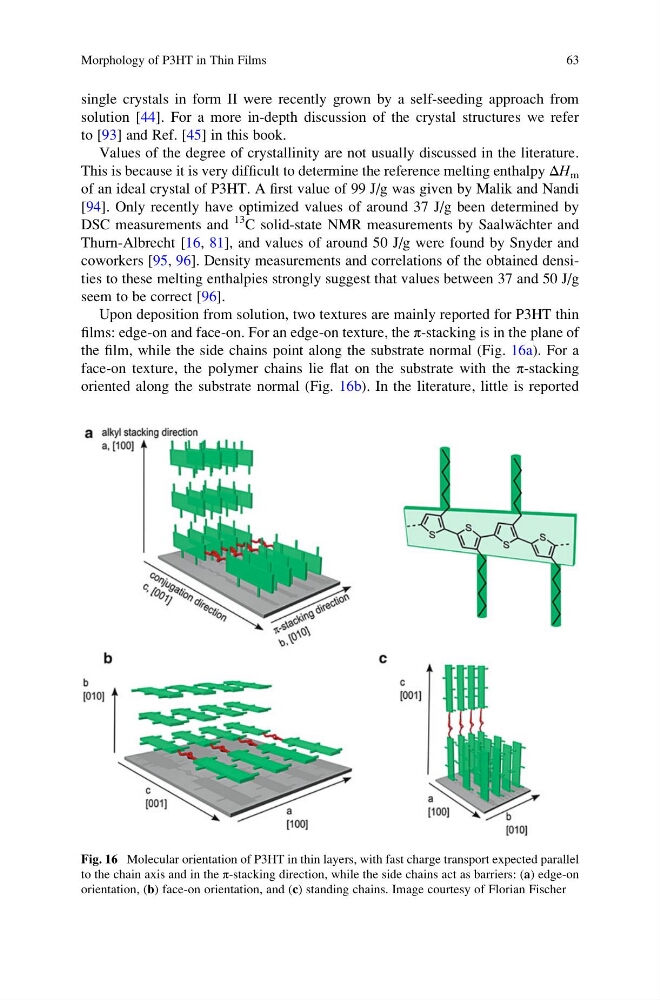
Upon deposition from solution, two textures are mainly reported for P3HT thin
films: edge-on and face-on. For an edge-on texture, the π-stacking is in the plane of
the film, while the side chains point along the substrate normal (Fig. 16a). For a
face-on texture, the polymer chains lie flat on the substrate with the π-stacking
oriented along the substrate normal (Fig. 16b). In the literature, little is reported
Fig. 16 Molecular orientation of P3HT in thin layers, with fast charge transport expected parallel
to the chain axis and in the π-stacking direction, while the side chains act as barriers: (a) edge-on
orientation, (b) face-on orientation, and (c) standing chains. Image courtesy of Florian Fischer
Morphology of P3HT in Thin Films
63
solution [44]. For a more in-depth discussion of the crystal structures we refer
to [93] and Ref. [45] in this book.
Values of the degree of crystallinity are not usually discussed in the literature.
This is because it is very difficult to determine the reference melting enthalpy ΔH m
of an ideal crystal of P3HT. A first value of 99 J/g was given by Malik and Nandi
[94]. Only recently have optimized values of around 37 J/g been determined by
DSC measurements and
13 C solid-state NMR measurements by Saalwa ¨chter and
Thurn-Albrecht [16, 81], and values of around 50 J/g were found by Snyder and
coworkers [95, 96]. Density measurements and correlations of the obtained densities to these melting enthalpies strongly suggest that values between 37 and 50 J/g
seem to be correct [96].
Upon deposition from solution, two textures are mainly reported for P3HT thin
films: edge-on and face-on. For an edge-on texture, the π-stacking is in the plane of
the film, while the side chains point along the substrate normal (Fig. 16a). For a
face-on texture, the polymer chains lie flat on the substrate with the π-stacking
oriented along the substrate normal (Fig. 16b). In the literature, little is reported
Fig. 16 Molecular orientation of P3HT in thin layers, with fast charge transport expected parallel
to the chain axis and in the π-stacking direction, while the side chains act as barriers: (a) edge-on
orientation, (b) face-on orientation, and (c) standing chains. Image courtesy of Florian Fischer
Morphology of P3HT in Thin Films
63