

from different solvents was accomplished in later years by Bao and coworkers
[67, 68]. The fact that no clear correlation between the drying time and the field
effect mobility could be found for drop-cast layers was attributed to the precise
mesoscale morphology induced by different solvents, i.e., crystallinity, grain
boundaries, branching of fibrils, and the degree of in-plane stacking. For further
correlations between the charge carrier mobility and the processing conditions we
refer to a recent review by Wuest and coworkers [86] and the article by Zaumseil in
this book [87].
To summarize, the crucial parameters that affect hole mobility include: (1) the
mesoscale morphology comprising the interconnectivity of crystalline domains and
the presence of grain boundaries and (2) the <100> orientation distribution with
respect to the substrate and, hence, the degree of in-plane π-stacking [67]. In the
following section, studies on the orientation of the polymer chains with respect to
the substrate are reviewed.
Texture and Orientation of Polymer Chains on Substrates
Before focusing on the texture of P3HT on substrates, research on structural models
and the polymorphism into form I and form II is briefly mentioned.
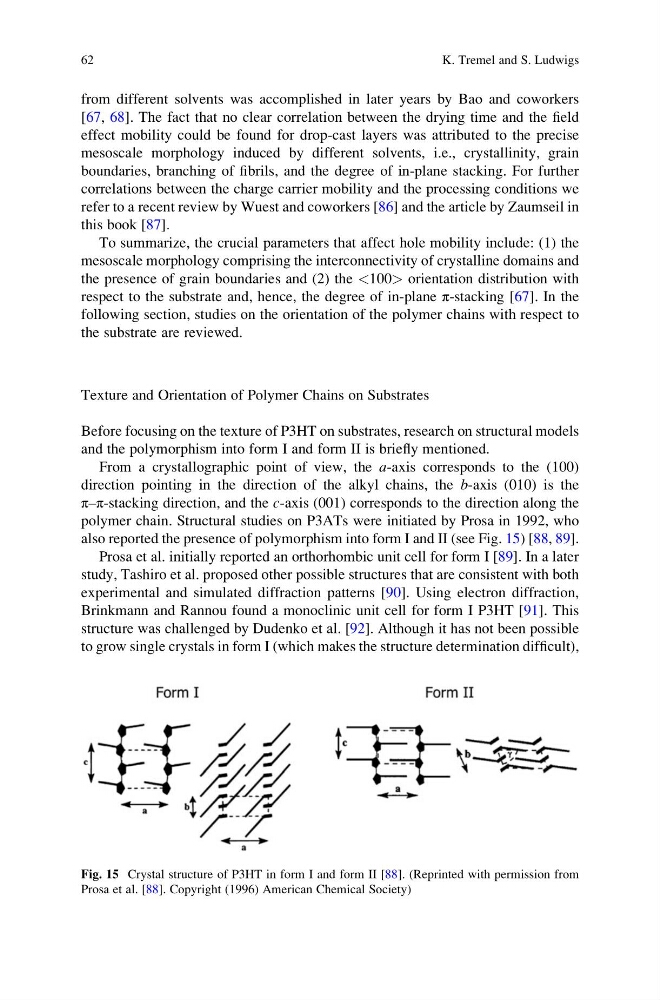
From a crystallographic point of view, the a-axis corresponds to the (100)
direction pointing in the direction of the alkyl chains, the b-axis (010) is the
π–π-stacking direction, and the c-axis (001) corresponds to the direction along the
polymer chain. Structural studies on P3ATs were initiated by Prosa in 1992, who
also reported the presence of polymorphism into form I and II (see Fig. 15) [88, 89].
Prosa et al. initially reported an orthorhombic unit cell for form I [89]. In a later
study, Tashiro et al. proposed other possible structures that are consistent with both
experimental and simulated diffraction patterns [90]. Using electron diffraction,
Brinkmann and Rannou found a monoclinic unit cell for form I P3HT [91]. This
structure was challenged by Dudenko et al. [92]. Although it has not been possible
to grow single crystals in form I (which makes the structure determination difficult),
Fig. 15 Crystal structure of P3HT in form I and form II [88]. (Reprinted with permission from
Prosa et al. [88]. Copyright (1996) American Chemical Society)
62
K. Tremel and S. Ludwigs
[67, 68]. The fact that no clear correlation between the drying time and the field
effect mobility could be found for drop-cast layers was attributed to the precise
mesoscale morphology induced by different solvents, i.e., crystallinity, grain
boundaries, branching of fibrils, and the degree of in-plane stacking. For further
correlations between the charge carrier mobility and the processing conditions we
refer to a recent review by Wuest and coworkers [86] and the article by Zaumseil in
this book [87].
To summarize, the crucial parameters that affect hole mobility include: (1) the
mesoscale morphology comprising the interconnectivity of crystalline domains and
the presence of grain boundaries and (2) the <100> orientation distribution with
respect to the substrate and, hence, the degree of in-plane π-stacking [67]. In the
following section, studies on the orientation of the polymer chains with respect to
the substrate are reviewed.
Texture and Orientation of Polymer Chains on Substrates
Before focusing on the texture of P3HT on substrates, research on structural models
and the polymorphism into form I and form II is briefly mentioned.
From a crystallographic point of view, the a-axis corresponds to the (100)
direction pointing in the direction of the alkyl chains, the b-axis (010) is the
π–π-stacking direction, and the c-axis (001) corresponds to the direction along the
polymer chain. Structural studies on P3ATs were initiated by Prosa in 1992, who
also reported the presence of polymorphism into form I and II (see Fig. 15) [88, 89].
Prosa et al. initially reported an orthorhombic unit cell for form I [89]. In a later
study, Tashiro et al. proposed other possible structures that are consistent with both
experimental and simulated diffraction patterns [90]. Using electron diffraction,
Brinkmann and Rannou found a monoclinic unit cell for form I P3HT [91]. This
structure was challenged by Dudenko et al. [92]. Although it has not been possible
to grow single crystals in form I (which makes the structure determination difficult),
Fig. 15 Crystal structure of P3HT in form I and form II [88]. (Reprinted with permission from
Prosa et al. [88]. Copyright (1996) American Chemical Society)
62
K. Tremel and S. Ludwigs