

The literature we review in this chapter deals mainly with polymers that are
made by the standard polymerization routes and that are commercially available.
To obtain P3HT with different molecular weights, the method of Soxhlet extraction
is quite common, first demonstrated for regioregular P3HT by Trznadel
et al. [30]. Soxhlet extraction makes use of the different quality of solvents to
separate P3HT into fractions of better defined molecular weight with narrow
molecular weight distribution. Throughout this review we have tried to specify
the molecular weight and polydispersity index of the samples studied in the cited
publications to make the studies as comparable as possible.
2.2 Energy Levels from Electrochemical Measurements
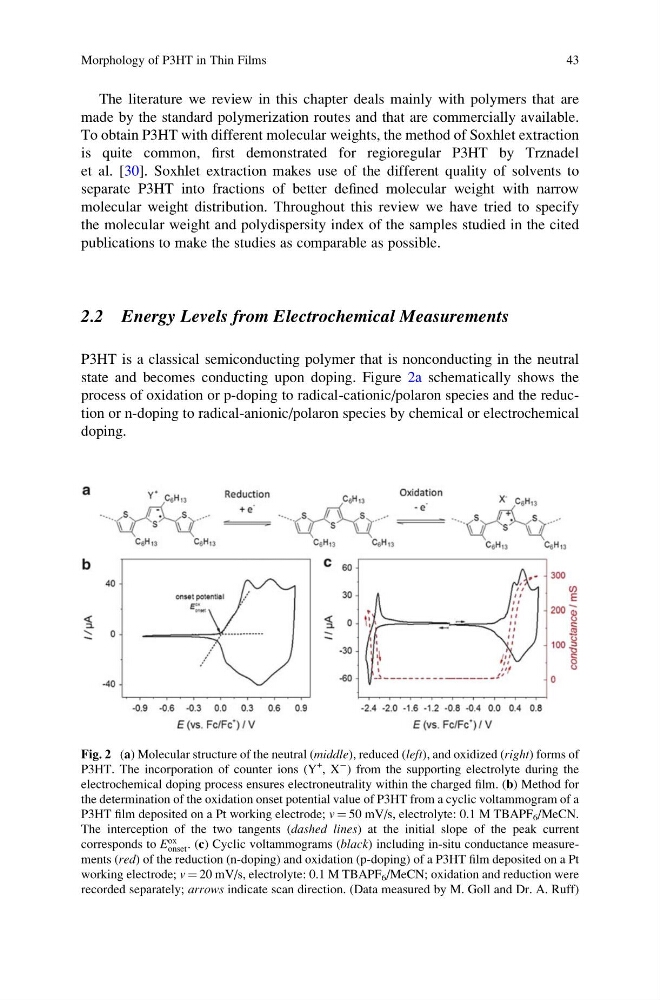
P3HT is a classical semiconducting polymer that is nonconducting in the neutral
state and becomes conducting upon doping. Figure 2a schematically shows the
process of oxidation or p-doping to radical-cationic/polaron species and the reduction or n-doping to radical-anionic/polaron species by chemical or electrochemical
doping.
Fig. 2 (a) Molecular structure of the neutral (middle), reduced (left), and oxidized (right) forms of
P3HT. The incorporation of counter ions (Y
+ , X
À ) from the supporting electrolyte during the
electrochemical doping process ensures electroneutrality within the charged film. (b) Method for
the determination of the oxidation onset potential value of P3HT from a cyclic voltammogram of a
P3HT film deposited on a Pt working electrode; v ¼ 50 mV/s, electrolyte: 0.1 M TBAPF 6 /MeCN.
The interception of the two tangents (dashed lines) at the initial slope of the peak current
corresponds to E
ox
onset . (c) Cyclic voltammograms (black) including in-situ conductance measurements (red) of the reduction (n-doping) and oxidation (p-doping) of a P3HT film deposited on a Pt
working electrode; v ¼ 20 mV/s, electrolyte: 0.1 M TBAPF 6 /MeCN; oxidation and reduction were
recorded separately; arrows indicate scan direction. (Data measured by M. Goll and Dr. A. Ruff)
Morphology of P3HT in Thin Films
43
made by the standard polymerization routes and that are commercially available.
To obtain P3HT with different molecular weights, the method of Soxhlet extraction
is quite common, first demonstrated for regioregular P3HT by Trznadel
et al. [30]. Soxhlet extraction makes use of the different quality of solvents to
separate P3HT into fractions of better defined molecular weight with narrow
molecular weight distribution. Throughout this review we have tried to specify
the molecular weight and polydispersity index of the samples studied in the cited
publications to make the studies as comparable as possible.
2.2 Energy Levels from Electrochemical Measurements
P3HT is a classical semiconducting polymer that is nonconducting in the neutral
state and becomes conducting upon doping. Figure 2a schematically shows the
process of oxidation or p-doping to radical-cationic/polaron species and the reduction or n-doping to radical-anionic/polaron species by chemical or electrochemical
doping.
Fig. 2 (a) Molecular structure of the neutral (middle), reduced (left), and oxidized (right) forms of
P3HT. The incorporation of counter ions (Y
+ , X
À ) from the supporting electrolyte during the
electrochemical doping process ensures electroneutrality within the charged film. (b) Method for
the determination of the oxidation onset potential value of P3HT from a cyclic voltammogram of a
P3HT film deposited on a Pt working electrode; v ¼ 50 mV/s, electrolyte: 0.1 M TBAPF 6 /MeCN.
The interception of the two tangents (dashed lines) at the initial slope of the peak current
corresponds to E
ox
onset . (c) Cyclic voltammograms (black) including in-situ conductance measurements (red) of the reduction (n-doping) and oxidation (p-doping) of a P3HT film deposited on a Pt
working electrode; v ¼ 20 mV/s, electrolyte: 0.1 M TBAPF 6 /MeCN; oxidation and reduction were
recorded separately; arrows indicate scan direction. (Data measured by M. Goll and Dr. A. Ruff)
Morphology of P3HT in Thin Films
43