

planar conformation of low energy with extended π-conjugation. This leads to
highly desirable properties for device applications, such as effective charge transport and high absorption in the low energy part of the visible spectrum. In 1992,
McCullough and Lowe described the first synthesis of regioregular P3HT via
Ni-catalyzed Kumada cross-coupling [23, 24]. Using 3-alkylthiophene as the
starting material, selective bromination to 2-bromo-3-alkylthiophene was followed
by lithiation, transmetallation, and polymerization in the presence of nickel. In the
same year, Chen and Rieke presented a second approach for the synthesis of
regioregular P3HT via polycondensation of 2,5-dibromo-3-alkylthiophene using
active zinc (“Rieke Zn”) and nickel catalysis [25]. Both methods presented a
breakthrough for polymer electronics, giving regioregular poly(3-alkylthiophene)s
(P3ATs) with high conductivity. However, synthesis at a large scale was problematic because of the low temperatures necessary during reaction. This problem was
overcome in 1999 by McCullough, who reported the synthesis of highly
regioregular P3ATs by the Grignard metathesis reaction (GRIM), which allows
synthesis at room temperature and at a large scale [26]. Recent progress on defectfree polythiophenes with controlled terminal groups has been accomplished by
external initiation, developed and extended by Kiriy and Luscombe, respectively
[27, 28]. A detailed review of synthetic routes for regioregular P3HT, including
mechanistic details, can be found in the chapter by Sista and Luscombe in this
book [29].
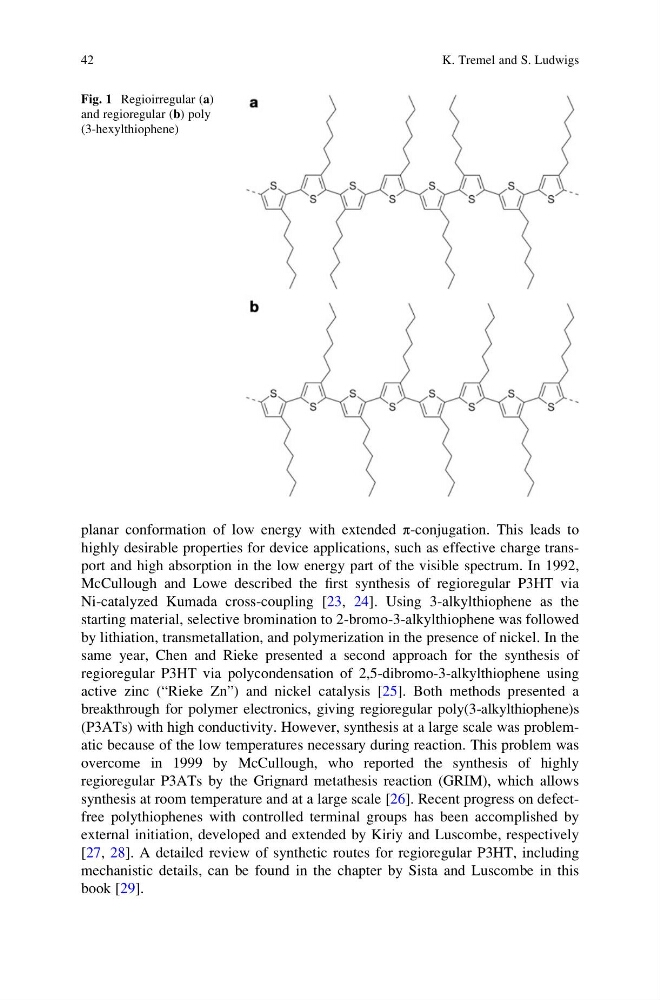
Fig. 1 Regioirregular (a)
and regioregular (b) poly
(3-hexylthiophene)
42
K. Tremel and S. Ludwigs
highly desirable properties for device applications, such as effective charge transport and high absorption in the low energy part of the visible spectrum. In 1992,
McCullough and Lowe described the first synthesis of regioregular P3HT via
Ni-catalyzed Kumada cross-coupling [23, 24]. Using 3-alkylthiophene as the
starting material, selective bromination to 2-bromo-3-alkylthiophene was followed
by lithiation, transmetallation, and polymerization in the presence of nickel. In the
same year, Chen and Rieke presented a second approach for the synthesis of
regioregular P3HT via polycondensation of 2,5-dibromo-3-alkylthiophene using
active zinc (“Rieke Zn”) and nickel catalysis [25]. Both methods presented a
breakthrough for polymer electronics, giving regioregular poly(3-alkylthiophene)s
(P3ATs) with high conductivity. However, synthesis at a large scale was problematic because of the low temperatures necessary during reaction. This problem was
overcome in 1999 by McCullough, who reported the synthesis of highly
regioregular P3ATs by the Grignard metathesis reaction (GRIM), which allows
synthesis at room temperature and at a large scale [26]. Recent progress on defectfree polythiophenes with controlled terminal groups has been accomplished by
external initiation, developed and extended by Kiriy and Luscombe, respectively
[27, 28]. A detailed review of synthetic routes for regioregular P3HT, including
mechanistic details, can be found in the chapter by Sista and Luscombe in this
book [29].
Fig. 1 Regioirregular (a)
and regioregular (b) poly
(3-hexylthiophene)
42
K. Tremel and S. Ludwigs